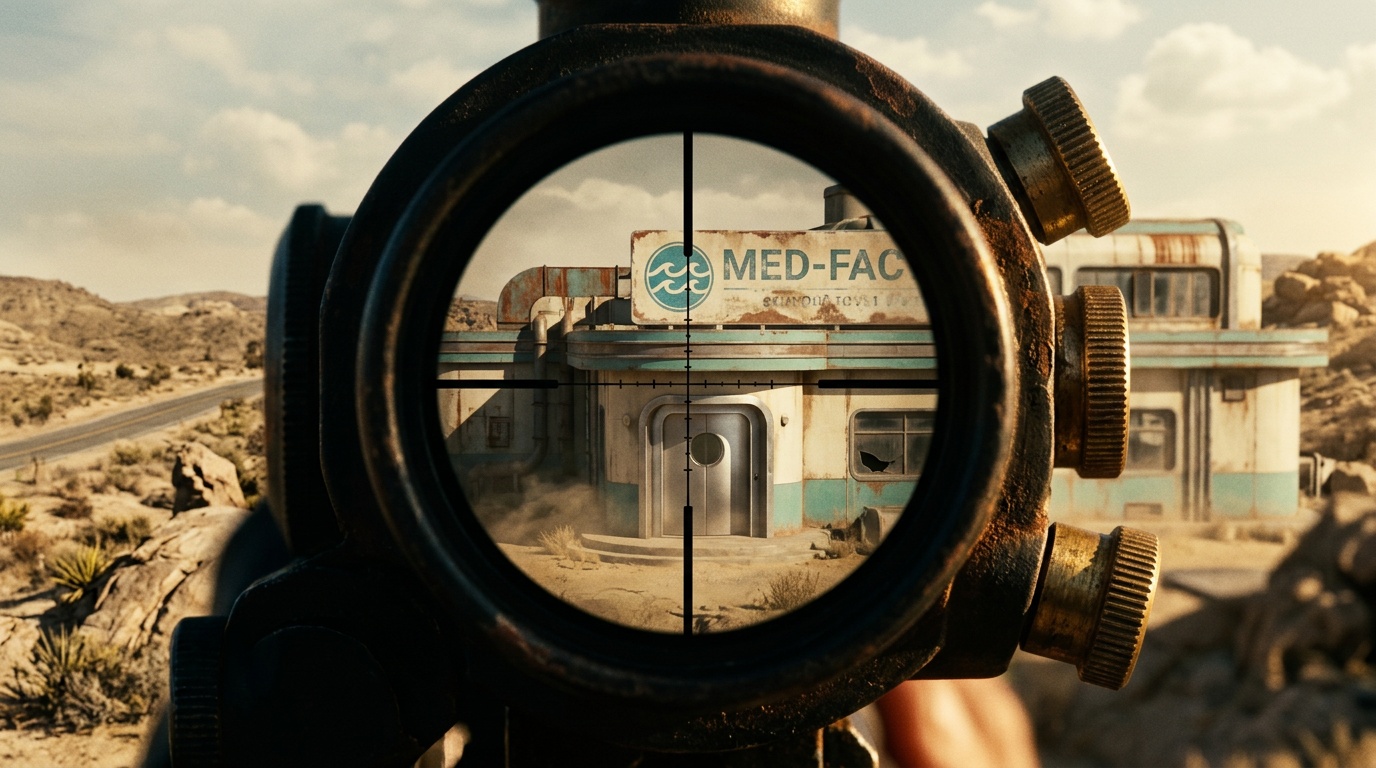
Vault-Tec Built Traps to Hunt Surface Dwellers
THE ARGUMENT
Vault-Tec's population management program did not end when the bombs fell. Hawthorne Medical Laboratories is a purpose-built capture installation, still operational, still branded, and positioned as a direct intake point for Vault 4. The corporation engineered the surface itself as a hunting ground, targeting survivors whose desperation would lead them toward anything that looked like care.
How This Theory Works
The building was never a hospital. The door labeled 'Medical Supplies' opens onto a painted wall. A pulsating ceiling light herds visitors down a single corridor toward that door. Once someone steps through, the entrance locks behind them, gas drops from the ceiling, and a trapdoor delivers the body somewhere below. Every interior element is intake infrastructure. None of it is medical. The design is not decay. It is architecture with intent.
The corporate fingerprints are not hidden. The exterior sign identifies the facility as 'a division of Vault-Tec.' A Vault-Tec logo is pressed into the asphalt of a parking lot too small to serve a real hospital. Lucy and Maximus walk past both without registering them. The show frames that blindness deliberately. The branding is visible only to the audience. Vault-Tec built an installation legible to itself and invisible to its targets, which is the operational definition of a trap.
The facility's condition closes the argument. In a world defined by collapse, the terminals inside Hawthorne are pristine. The systems function. Someone is maintaining this. These are not pre-war mechanisms coasting on inertia. They are active infrastructure, which means Vault-Tec's surface operation is not a legacy artifact. It is ongoing.
Lucy and Maximus wake up inside Vault 4. That detail is the sharpest point in the evidence. It means Hawthorne is not just a trap. It is an intake point for a specific, active vault. Vault-Tec did not build shelters for people who needed them. It built a predator-prey system in which the surface was seeded with bait designed to attract exactly the most vulnerable survivors, the injured, the sick, the desperate, and funnel them into vaults as subjects rather than residents. The corporation is not hiding underground waiting for the world to recover. It is still collecting.
Is this theory convincing?
Key Evidence
Vault-Tec Sign on Medical Building
The exterior sign for Hawthorne Medical Laboratories identifies the facility as 'a division of Vault-Tec,' directly linking a trap building to Vault-Tec's corporate infrastructure.
Logo Embedded in Parking Lot Asphalt
A Vault-Tec logo is printed into the asphalt of the facility's parking lot, which is too small to serve a genuine hospital, suggesting the building was never intended for civilian medical use.
Pulsating Light Guiding Visitors
A pulsating ceiling light actively guides Maximus down the hall toward the fake Medical Supplies door, demonstrating that the trap's interior is engineered to direct movement rather than illuminate space.
Painted Wall Behind Supply Door
The door labeled 'Medical Supplies' opens onto a painted wall rather than a room, confirming the building's interior is constructed entirely for deception with no functional medical purpose.
Gas and Trapdoor Capture Sequence
Once Maximus enters the false supply room, the entrance door locks behind him, gas from the ceiling incapacitates him, and he is dropped through a trapdoor, demonstrating a fully operational and deliberately engineered capture system.
Pristine Terminals in Ruined World
The facility's interior contains pristine-looking desks and still-functioning terminals in a world otherwise defined by decay, indicating active maintenance rather than pre-war preservation by chance.
Victims Wake Inside Vault 4
Lucy and Maximus regain consciousness inside Vault 4 after the capture, placing the trap facility in direct operational proximity to an active vault and suggesting the facility serves as an intake point for vault population management.
This theory was evaluated using Theory Atlas editorial standards, including evidence review, narrative fit, and competing interpretation analysis. Learn how Theory Atlas evaluates theories →
Other Theories for S1E05
Vault 31 Runs Two Systems Against Vault 33: A Doctrine That Lies and a Pipeline That Enforces It
Vault 31 has maintained control over Vault 33 through two interlocking mechanisms operating in parallel: an overseer pipeline that installs Vault 31 agents as every successive administrator in Vault 33's history, and a Reclamation Day doctrine kept in active circulation despite Vault 31 administrators knowing that the civilization it promised to restore had already risen and been destroyed.
Lucy Already Knows Maximus Is Lying
Lucy's immediate, casual identification of Maximus's false name is not a minor beat before trust is established, it is evidence that their entire alliance is built on her deliberate choice to proceed with a liar she has already clocked.
The Vault 32 Massacre Was a Containment Operation, and Betty Knows How It Was Done
The residents of Vault 32 died at the inter-vault threshold because they identified that Vault 31 controls surrounding vaults through embedded overseer placements and tried to breach the source directly.

Betty Lied About the Buried Pip-Boy
Betty's claim that Lucy's mother was buried with her Pip-Boy is a lie, because a raider used that registered device to open Vault 32 from the outside.
Maximus Witnessed the NCR's Deliberate Destruction
Maximus survived the deliberate post-war nuclear destruction of Shady Sands as a child and was subsequently recruited into the Brotherhood of Steel, the organization most structurally positioned to benefit from his grief and his silence.