
Khatri's Faith Buys Sara Her Life
THE ARGUMENT
Boyd keeps Sara alive solely because Father Khatri believed she could help the town find a way home. The moment she fails to deliver on that belief, Boyd has made clear he will kill her himself. This conditional arrangement reframes Sara not as a prisoner seeking redemption but as a resource with an expiration date.
How This Theory Works
Boyd's threat is not a burst of rage. It is a structured transaction. Father Khatri died in the Colony House attack, and Boyd frames his own restraint toward Sara as an inherited obligation. He is not choosing to spare her out of mercy or curiosity. He is honoring what Khatri believed, for exactly as long as that belief remains credible. The moment it stops being credible, the debt is paid and Sara is dead.
This framing strips Sara of any moral credit for remorse. She cries over Khatri's death and asks Boyd whether he thinks she is a monster. His answer is precise: he does not care. Her emotional state is irrelevant to his calculus. What matters is utility. Boyd is operating in a mode the town has forced on him, where survival decisions cannot afford sentiment. Sara is alive because she might be useful. That is the whole of it.
Boyd also takes Sara into the woods and hides her in a shack rather than bringing her back to Town. This is a deliberate separation. He is not integrating her into the community or giving her a chance to demonstrate trustworthiness in a social setting. He is isolating her under his personal supervision, which means the threat carries institutional weight. There is no appeals process. Boyd is the judge, and the standard he is judging against belongs to a dead man.
The dead man's standard is also an impossible one. Khatri assessed Sara before Boyd knew she had a direct hand in the Colony House attack that killed him. Boyd is now holding Sara to a dead man's judgment while possessing information that would almost certainly have changed that judgment. Khatri's belief in Sara's usefulness was formed in a context that no longer exists, which means Boyd is not really honoring Khatri at all. He is using Khatri's name to defer a decision he has already made structurally, if not yet consciously. The shack in the woods is not a waiting room for redemption. It is a holding pattern for an execution Boyd has not yet given himself permission to carry out.
Is this theory convincing?
Key Evidence
Boyd's explicit conditional death threat
Boyd tells Sara directly: 'The only reason you're alive is because Father Khatri thought you could help us all get home. The second you prove him wrong, I'm gonna put a bullet in you myself.'
Khatri's belief as sole protection
Boyd frames Sara's survival not as his own choice but as a proxy for Father Khatri's judgment, making her continued existence contingent on validating a dead man's assessment of her usefulness.
Boyd dismisses Sara's remorse entirely
When Sara asks if Boyd thinks she is a monster, he replies that he does not care, explicitly refusing to engage with her guilt or emotional state as factors in her fate.
Sara isolated in woodland shack
Boyd leads Sara through the woods and installs her in an old wooden shack, keeping her separate from Town and under his exclusive authority rather than any communal oversight.
Boyd invokes Sara's help with escape
Boyd takes Sara with him into the woods specifically because he believes she might be helpful in finding a way home, framing the journey as purpose-driven rather than punitive.
Sara asks about Khatri's location
Sara's first questions during the woods walk concern Father Khatri's whereabouts, and Boyd's revelation that Khatri is dead lands as the moment that fully clarifies the precariousness of her position.
This theory was evaluated using Theory Atlas editorial standards, including evidence review, narrative fit, and competing interpretation analysis. Learn how Theory Atlas evaluates theories →
Other Theories for S1E08

The Town Runs on a Designed System -- and Someone Is Still Operating It
The town's supernatural architecture is not a natural phenomenon that residents are learning to survive.
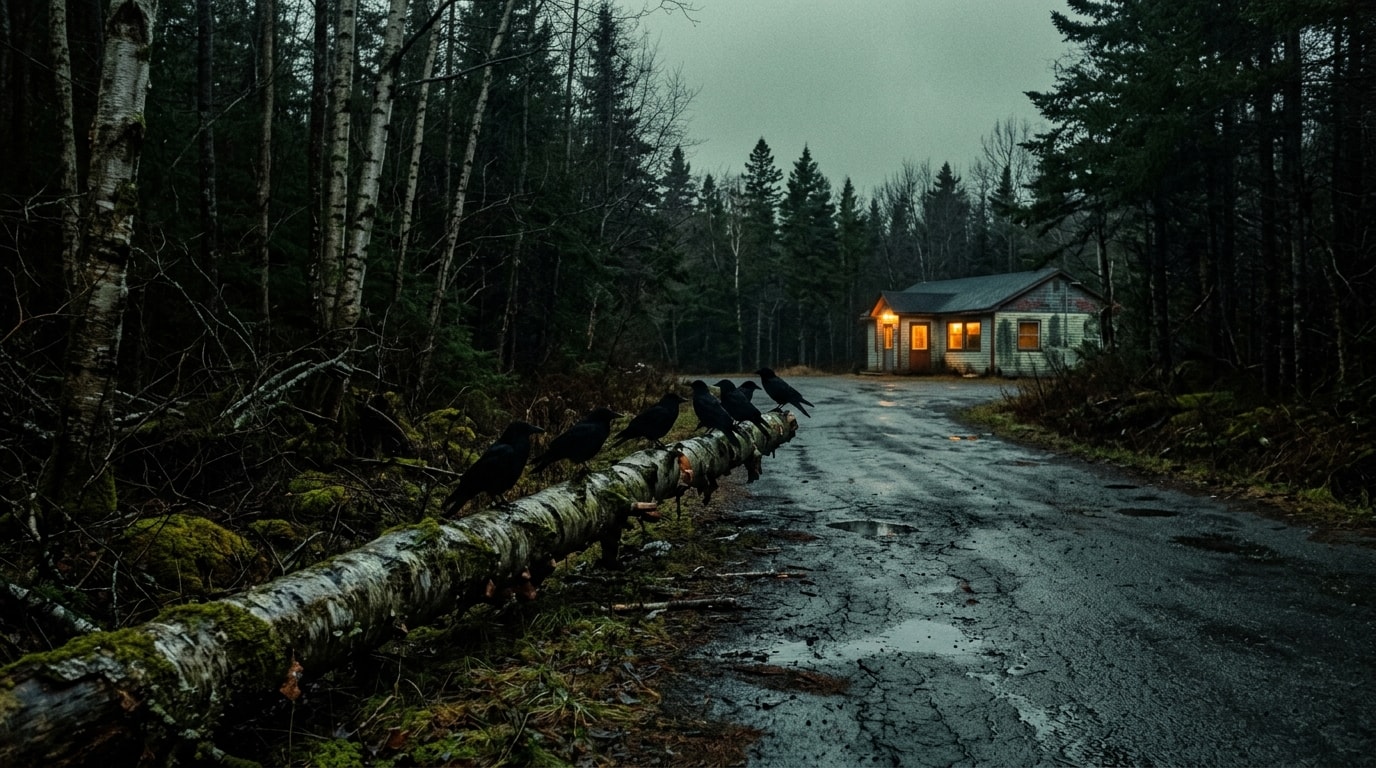
Crows and Fallen Trees Mark Entry Points
The fallen tree blocking the road functions as a consistent trigger for transport into the town, with Boyd's arrival flashback confirming the same mechanism that brought the Matthews family.