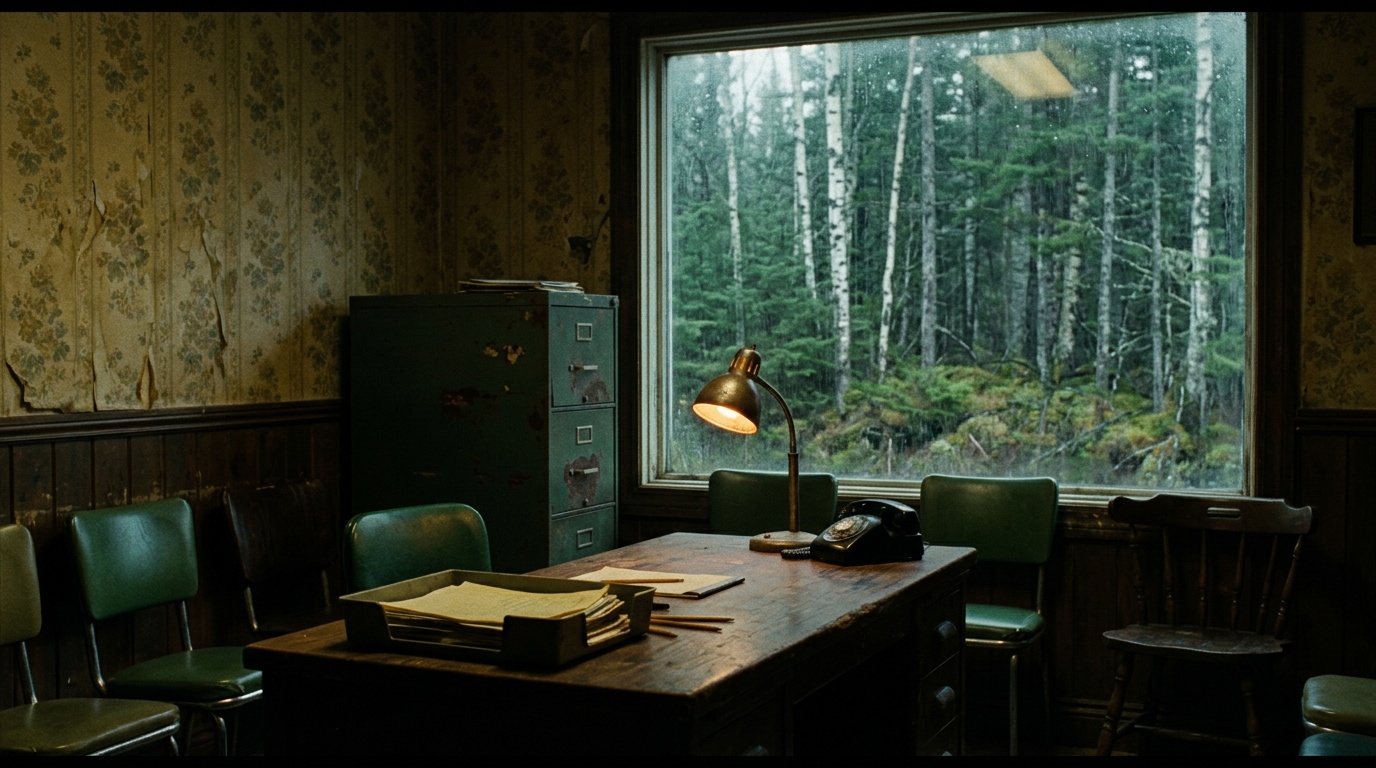
The Town Is a Pipeline: Creatures Are What the Processing System Produces
THE ARGUMENT
FROM operates a closed transformation system with two observable populations: current human subjects being processed toward psychological fracture, and creatures who are earlier outputs of that same process. The town's infrastructure, including looping roads, preserved domestic spaces, and timed creature behavior, serves the pipeline rather than incidentally trapping people. The system's terminal output is not death but a specific degraded state, and the creatures are its evidence.
How This Theory Works
The system running the town is not hunting people. It is processing them, and the creatures are what the processing eventually produces. This distinction collapses what might otherwise seem like two separate mysteries: why the town breaks minds so methodically, and why the creatures retain such precise human residue. The result is a single closed system. The creatures caress steering wheels and play with bus lights not because they evolved to mimic humans but because they were human, and the transformation is incomplete rather than total. Tactile curiosity and predatory movement appear in the Smiley Creature as separate behavioral modes operating in sequence, not as a unified hunting ritual. Something in it still reaches toward the human environment without violence as the motive. That separation is the system's fingerprint: whatever these creatures carry includes functional emotional memory, not just the vocabulary of grief and comfort but the architecture underneath it. You cannot tell someone they will feel better if you do not know what it means to feel bad.
The creature's invitation to Fatima is where both populations of the system become visible simultaneously. It does not threaten her. It offers comfort, saying "You'll feel better if you come outside," using a register that is not predator language but the language of internalized emotional knowledge applied with surgical precision to the exact load-bearing point most likely to fail. That precision is not learned through observation of the living. It is retained from having once been the kind of person who knew what that phrase does to someone at the edge of collapse. The creature is applying psychological pressure using memory it could only possess if it was once human. And that Fatima, the most composed resident established in the narrative, is the one targeted is not incidental. Composed subjects are not ignored by this system. They are prioritized, because their fracture produces the greatest downstream damage to collective cohesion: exactly the output a processing pipeline would optimize for.
Randall's near-catastrophic break at the Diner runs the same mechanism at accelerated speed. The town places a new arrival at the intersection of a weapon, the sound of people dying, and the belief that action is possible, then waits. The mechanism is not violence. It is the engineering of an impossible moral debt the mind cannot carry without fracturing. The system is patient because it has been running long enough to have a dungeon full of skeletons, long enough to have chained Martin in a space that vanishes entirely at his death. That dungeon existed not to punish but to exhaust, structured as disposable infrastructure rather than permanent architecture. The music box that counts down Boyd's window to the second is the same logic made visible: this is not a hostile environment producing incidental cruelty. These are designed ordeals, intake mechanisms, the operational layer of something built to produce a specific condition in people rather than simply kill them.
Martin's correction is the theory's structural keystone. He does not say the creatures are dangerous. He says they are the tip of the spear, which means there is a spear, which means there is a hand holding it. What that hand requires is not corpses but subjects in a particular state: psychologically fractured, isolated, morally exhausted, judgment depleted to the point of manageability. The dungeon, the music box, the creatures' verbal scripts, and the town's preserved domestic spaces all serve that requirement. The looping roads and intact houses are not incidental set dressing and not merely a prison for the living. They are the mechanism that sustains the stimuli, familiar objects, emotional triggers, the texture of a former life, that keep the transformation process cycling in both directions at once: grinding the living toward fracture while whatever remains of prior subjects continues metabolizing what it once was.
The hardest version of this argument is about continuity. If the creatures are not a separate population but an earlier output of the same system currently operating on the living, then every creature in FROM was once someone who arrived the way the current residents arrived: confused, resistant, trying to hold together under compounding psychological pressure. The town did not fail to kill them. It succeeded at something else. Whatever the system produces at the end of the pipeline, the creatures are it, still reaching toward steering wheels and banisters, still carrying the precise emotional vocabulary of people who once knew what it meant to grieve, to beg, to offer comfort. The system's output is not death. It is a specific degraded state that retains just enough of the original to be weaponized against whoever comes next.
Is this theory convincing?
Key Evidence
Creature's Invitation to Fatima
After Fatima witnesses passengers being killed, a creature outside the Sheriff's Office tells her 'You'll feel better if you come outside,' using a comforting register rather than a threatening one to target her emotional breaking point.
Fatima's Emotional Collapse
Fatima, established as one of the town's most composed residents, breaks down completely after the creature's taunt, crying and saying 'I can't do this anymore' before collapsing into Ellis's arms.
Randall's Irrational Standoff
Randall, a new arrival, seizes Kenny's gun and nearly forces open the Diner door within hours of arriving, driven to abandon all caution by the impossible moral weight of hearing people die outside while armed.
Martin's Tip of the Spear
When Boyd suggests the creatures imprisoned him, Martin corrects him directly, saying the creatures are 'just the tip of the spear,' implying a hierarchy of control that extends beyond the creatures themselves.
Dungeon's Architectural Cruelty
Martin has been shackled long enough to lose count of the days, surrounded by the skeletons of others who died in the same chains, in a space that vanishes entirely once he dies, suggesting the dungeon existed only to contain and exhaust him.
Music Box as Countdown Mechanism
The music box does not signal a random creature patrol but counts down a precise window of time, giving Boyd just enough opportunity to almost save Martin before the window closes, structuring the encounter as a designed ordeal rather than a chance attack.
This theory was evaluated using Theory Atlas editorial standards, including evidence review, narrative fit, and competing interpretation analysis. Learn how Theory Atlas evaluates theories →
Other Theories for S2E02
Martin's Warning: A Hierarchy of Threat
The creatures are not the controlling power in the world of FROM.

The Music Box Counts Down to Danger
The music box in Martin's dungeon was not discovered by accident and was not placed there by the creatures.
Martin's Infection of Boyd Was a Two-Act Operation, and the Abby Revelation Was Never the Point
The blood transfer between Martin and Boyd was not a consequence of Boyd's loyalty but its exploitation: Martin spent their entire encounter mapping Boyd's refusal threshold, then used the shock of naming Boyd's dead wife to freeze him long enough for the transfer to complete.

Farway Trees Trap and Transport the Unwary
The Farway Trees function as a deliberate sorting mechanism for a hierarchy that routes some captives to new locations and leaves others stranded to be claimed, and the system's own logic produced the one outcome it cannot accommodate: a long-term prisoner who survived long enough to alter the next person processed through his holding space.
Donna Shoots First, Explains Later
Donna's coercive methods are not a temperament problem or a power instinct.
Victor Senses Something Wrong With Elgin
Victor's immediate distrust of Elgin functions as threat detection, not social judgment, and points toward a specific unresolved problem in the show's own logic: the Creatures did not kill Elgin when they should have, which means either Elgin is protected by the Town or he is in some way part of its order.
The Dog That Leads Boyd Home
FROM's environment exploits human directionlessness, and the dog that leads Boyd home is evidence of that mechanism in operation.