Victor Is a Double-Locked Witness: The Lullaby Opens the Door, but a Compromised Man Stands Behind It
THE ARGUMENT
The knowledge Victor holds about the symbol is sealed behind a specific cognitive lock: the lullaby his mother played while people died outside. This is because that knowledge has never existed in an unprotected form, fused to its worst night at the moment of formation. But unlocking it only delivers information filtered through a former carrier of the same process: a man the symbol has already finished with, who survived Christopher's endpoint and has been doing penance inside the town's mechanism ever since, making Victor simultaneously the deepest record the show possesses and the least neutral possible source of it.
How This Theory Works
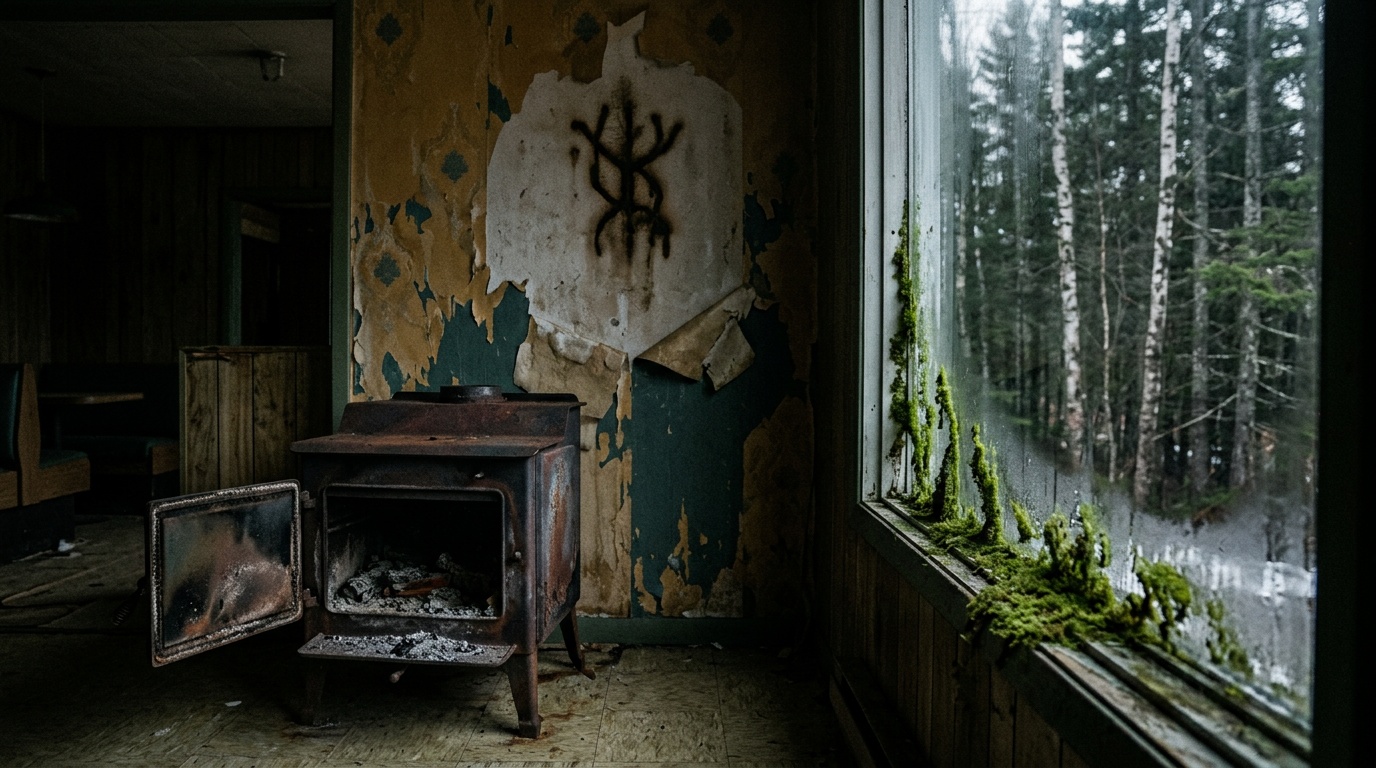
The symbol does not haunt people. It converts them along a documented sequence with a known endpoint, and the evidence for that sequence is precise enough to be mapped. Christopher encountered the symbol, became unable to stop drawing it, changed completely, and concluded as something his own community needed to hide from. Not from an abstraction, but from the man Christopher had become. Victor's mother did not order him to hide from a force or a place. She ordered him to hide from a person, and the next day everyone was dead. The threat at the end of the sequence is the carrier the symbol has finished with. Jade, arranging glass bottles on a bar floor to reconstruct the symbol while visibly deteriorating (deteriorating badly enough that Victor clocks it the moment he walks in), is not solving a mystery. He is a man in the middle of a documented conversion process, and Christopher's ghost appearing in his vision to present the bleeding journal is not a haunting. It is the mechanism announcing a handoff. The shared journal, present in both men's obsessions, appearing in Jade's vision held open by the previous link in the chain, is the clearest physical evidence that this is transmission rather than resemblance.
Victor is the only living person who has watched this sequence run, which makes him invaluable. It also makes him structurally impossible to treat as a neutral source, for a reason that operates at two separate levels. The first is cognitive. Victor does not ask for music generally, or reassurance, or even kindness. He asks for the specific lullaby his mother played while they sat on the station wagon roof and waited. That specificity is not eccentricity and it is not a trust ritual. It is a man identifying the only mechanism that ever made the knowledge survivable in the first place. The song and the survival fused into a single memory during the worst night of Victor's life, and asking him to produce the knowledge without the song is asking him to access something that has never existed in an unprotected form. His apology for his guardedness confirms this: he does not describe his behavior as deliberate withholding or strategic caution. He describes it as a residue of loss that he cannot fully account for, the language of conditioned response, not chosen secrecy. The barrier between what Victor knows and what he can say is, at minimum, functionally neurological. Every survivor who has tried to earn his confidence without the lullaby has been solving the wrong problem.
But unlocking the door only delivers the second problem, which is deeper. Victor's apology, "There are bad things here. They make people do bad things. I'm sorry," is the theory's most structurally significant line. An apology is not issued for what you witnessed. It is issued for what you did. Victor has survived in the town longer than anyone, has watched residents arrive and break and die across what appears to be generations, maintains a graveyard ritual for their dead cars (a deliberate act of grief management sustained over an extraordinary period), and keeps his distance from the community with the practiced deliberateness of someone managing rather than mourning his history. These behaviors are only legible as self-imposed penance if there are specific acts to do penance for. The town's longest survivor is not a passive archivist of cycles of violence. He is a former participant in one, now deploying his accumulated knowledge as a form of ongoing atonement, and that performance is itself shaped by what he needs to believe about himself.
This is the second lock, and it cannot be picked with a song. Victor was not merely present for Christopher's conversion. He was the child hidden from Christopher's endpoint, hidden precisely because Christopher had become the danger, which means he was present for the aftermath, survived it, and has been living inside the town's mechanism ever since. If the compulsion operating on Jade is the same force that took Christopher, then Victor's warnings are being issued by someone who has already been inside that force and emerged on the other side carrying guilt he has never directly named. Every piece of guidance he offers Jade is filtered through a specific pressure: the pressure to be useful rather than complicit, to warn rather than confess, to position himself as the person who understands the town's damage rather than one of its products. His knowledge of the conversion sequence is genuine. His warning to Jade is sincere. But sincerity and neutrality are not the same thing, and whatever Victor did during or after Christopher's endpoint has been shaping the architecture of his testimony for longer than anyone currently in the town has been alive.
The scene of Victor watching Jade reconstruct the symbol on the bar floor is therefore not a rescuer-and-victim scene. It is the system running its next cycle with a compromised operator at the controls, an operator whose own access to the relevant knowledge requires a ritual performance of his worst memory before it becomes reachable at all. What Jade faces is a double bind with no clean exit. The lullaby is the only key to the deepest record the show has access to: the cars in the graveyard predate even Victor, and whatever is stored in him represents institutional knowledge no one else can provide. But performing the lullaby to unlock that knowledge delivers testimony pre-distorted by a man the symbol has already finished with, whose account of what the conversion does to people is inseparable from what the conversion, or its aftermath, did to him. The town does not produce innocent witnesses. It produces damaged people who know things, and the knowledge is structurally indistinct from the damage that sealed it.
Is this theory convincing?
Key Evidence
Jade's Vision of Bleeding Symbol
Jade has a vision of the man from the old photograph standing before him, holding a journal open to a drawing of the symbol that begins oozing blood, terrifying him into screaming when it disappears.
Victor's Account of Christopher's Change
Victor tells Jade that Christopher was a man who used to make people laugh and was well-liked, but after he saw the symbol he obsessed over it, drew it repeatedly, changed completely, and the event that followed left everyone dead.
Jade Reconstructs Symbol on Bar Floor
Jade arranges glass bottles on the floor of the bar to recreate the symbol, a physical act of obsessive reconstruction that directly mirrors the compulsive drawing Victor attributes to Christopher.
Victor Observes Jade's Deterioration
Victor walks into the bar and immediately remarks that Jade does not look good, an external confirmation that Jade's condition is visibly worsening in a way that mirrors the early signs of Christopher's transformation.
Symbol Exposure as Corrupting Pattern
Victor states that Christopher saw the symbol and everything changed after that, establishing within the episode that the symbol functions as a trigger for psychological and behavioral transformation rather than simply being a passive mystery.
Jade and Christopher Share the Journal
Both Jade and Christopher are linked to the same journal filled with drawings of the symbol, and Jade's vision places Christopher holding that journal directly in front of him, suggesting a line of transmission rather than coincidence.
Victor's Mother Orders Hiding from Christopher
Victor reveals that his mother told him to hide somewhere Christopher did not know, and the next day everyone was dead, establishing that Christopher's transformation had a violent endpoint and raising the question of whether Jade is approaching the same one.
This theory was evaluated using Theory Atlas editorial standards, including evidence review, narrative fit, and competing interpretation analysis. Learn how Theory Atlas evaluates theories →
Other Theories for S2E05

Fear Is the Creatures' Real Weapon
The creatures' power depends on fear as an operational mechanism, and declared fearlessness demonstrably disrupts their behavior.
Sara's True Nature Is Epistemically Unreachable by Design of the Show's Own Machinery
Sara has been expelled from every social structure that would ordinarily allow a person to be seen clearly: her home, her community, even a child's goodwill.

Tilly's Morphine and the Town's Price
Tilly functions as a potential instrument of the town's control, having arrived with a terminal illness evidenced by her palliative morphine supply and a calm inconsistent with the terror of the newly trapped.