
Donna Is the System's Active Instrument, and Randall Has Moved to Extract Her
THE ARGUMENT
The town's orientation apparatus (Boyd, Donna, Father Khatri briefing newcomers in consistent sequence) is too structured to be improvised survivor wisdom, and Donna's three episodically precise appearances at sensitive interrogation moments confirm she functions as an active information suppressor rather than a fellow victim. Randall has arrived at this conclusion through the same unfalsifiable logic the show keeps failing to refute, and his decision to tie Donna to a tree at the crashed RV is the violent terminus of that reasoning: coerced intelligence extraction, involuntary creature bait, or both simultaneously.
How This Theory Works
The town's orientation process has a structural consistency that separates it from improvised survivor knowledge. When newcomers arrive, the same specific individuals step forward to explain the rules: Boyd, Donna, Father Khatri. Randall's argument, that this coordination reflects a prepared script rather than accumulated wisdom, gains force from the roster itself. These are not random community members who happened to be nearby. They are the settlement's three authority figures, appearing in sequence at the point of maximum newcomer vulnerability. Someone designed that briefing. The consistency of who delivers it, and when, is not the behavior of fellow victims. It is the behavior of staff.
Donna's episode-specific behavior provides the behavioral profile that the institutional argument requires. She is not merely an authority figure who happens to be present at difficult moments. She appears at Colony House discussing Sara with Boyd, surfaces at the Church at the precise instant Randall's questioning of Sara approaches an answer neither Sara nor Donna can afford to let reach the surface, and reappears shortly after to intercept Jim's questions about the radio voice. Three sensitive nodes, three timely presences. Randall reads the Church interruption in real time and names it: he calls her a tollbooth operator, meaning she collects passage rather than granting it. Her response is instructive. She does not engage the accusation. She pivots to Sara's emotional state and redirects the room, not because she is rattled, but because engaging the substance of the charge would be more damaging than absorbing it. That deflection is not defensiveness. It is the assigned method. What a tollbooth operator manages in this town is not transit but information, identifying which revelations are approaching the surface and absorbing them before they reach people who would act on them. Sara's exposure, Nathan's possible survival, the radio voice: these are not separate concerns Donna happens to be present for. They are the same concern, and Donna's emotional caretaking pivot is the org chart.
Randall's extension of this framework to apparent deaths is where his argument becomes both its most powerful and its most unfalsifiable. He challenges Jim to name a single casualty either of them personally witnessed. His position is that deaths attributed to the creatures serve a deterrent function: visible casualties keep the population frightened and compliant, and if the creatures are part of the apparatus, the deaths they cause can be managed too. Jim cites Father Khatri as a counterpoint. Randall absorbs it as confirmation, exactly the kind of staged event the framework predicts. He treats Nathan's death the same way, allowing that it was either arranged from inside or that Sara was deliberately pushed past her breaking point. Every counterexample is metabolized. The theory has no exterior. That unfalsifiability is its most uncomfortable structural feature: a trap sophisticated enough to stage deaths and plant rule-explainers would also be sophisticated enough to anticipate resistance and route it somewhere harmless. Randall's permanent conspiratorial clarity keeps him perpetually busy and perpetually non-threatening, the experiment's most stable data point rather than its most dangerous disruptor. The show, however, keeps declining to provide the refutation that would close that loop.
What the closing image at the RV makes concrete is that Randall's framework has now produced action the show cannot contain within theorizing. Jim arrives to find Donna bound to a tree, Randall nearby with a blade jabbed into the wood, and an announcement that the plan has changed. The original plan, passive overnight observation of creature behavior from the RV, has been superseded by a plan in which Donna serves as an involuntary variable: a source of coerced information, an unwilling lure, or both at once. Randall's Church accusation was a probe. This is the extraction. His belief that deaths are staged removes the moral brake that would otherwise constrain the escalation. If Donna is staff, her suffering is not the suffering of a victim but the exposure of an instrument, and instruments can be operated.
The sharpest pressure the scene applies is not on Donna but on Jim. He agreed to the overnight observation, which means he arrived at that RV as Randall's partner. The blade in the wood is not only a threat directed at Donna; it is a trap for Jim, forcing a choice the show has been quietly constructing. If Jim intervenes to free Donna, Randall's framework absorbs that too, another resident protecting the system, which means Jim was always part of it. If Jim stays, he crosses a line that his prior complicity in Randall's theorizing has been inching him toward across the entire episode. Randall has engineered a situation in which every available response by Jim either confirms the conspiracy or makes Jim its accessory. The system, if it exists, could not have designed a more efficient mechanism for neutralizing potential resistance. Randall, convinced he is running his own experiment on the town's terms, may have built the most elegant cage in it.
Is this theory convincing?
Key Evidence
Randall Names Rule-Explainers as Suspects
Randall explicitly asks Jim who laid out all the rules when they arrived, naming Boyd, Donna, and Father Khatri as the coordinated voices newcomers encounter, framing their role as evidence of insider status.
Staged Deaths as Fear Management
Randall argues that neither he nor Jim has directly witnessed a death, theorizing that apparent casualties are staged events designed to frighten the remaining townspeople into accepting the town's rules.
Father Khatri Death Dismissed as Performance
When Jim cites Father Khatri's creature-caused death as a counterpoint, Randall refuses to accept it as genuine, treating it as precisely the kind of staged deterrent his conspiracy framework predicts.
Randall Targets Donna as Insider
Randall's confrontational behavior toward Donna at the Church, calling her a bigshot and a powder keg, reflects his suspicion that she is a leadership-level participant in the conspiracy rather than an ordinary survivor.
Nathan's Death as Inside Job
Randall theorizes that Nathan's death was either arranged from within the conspiracy or that Sara was deliberately pushed to her breaking point, preserving the conspiracy framework regardless of which reading is correct.
Experiment Framing and Human Breaking Points
Jim acknowledges there may be value in observing how far people can be pushed before breaking, a framing Randall uses to argue the entire town is a managed experiment with inside collaborators maintaining pressure on the population.
This theory was evaluated using Theory Atlas editorial standards, including evidence review, narrative fit, and competing interpretation analysis. Learn how Theory Atlas evaluates theories →
Other Theories for S2E08
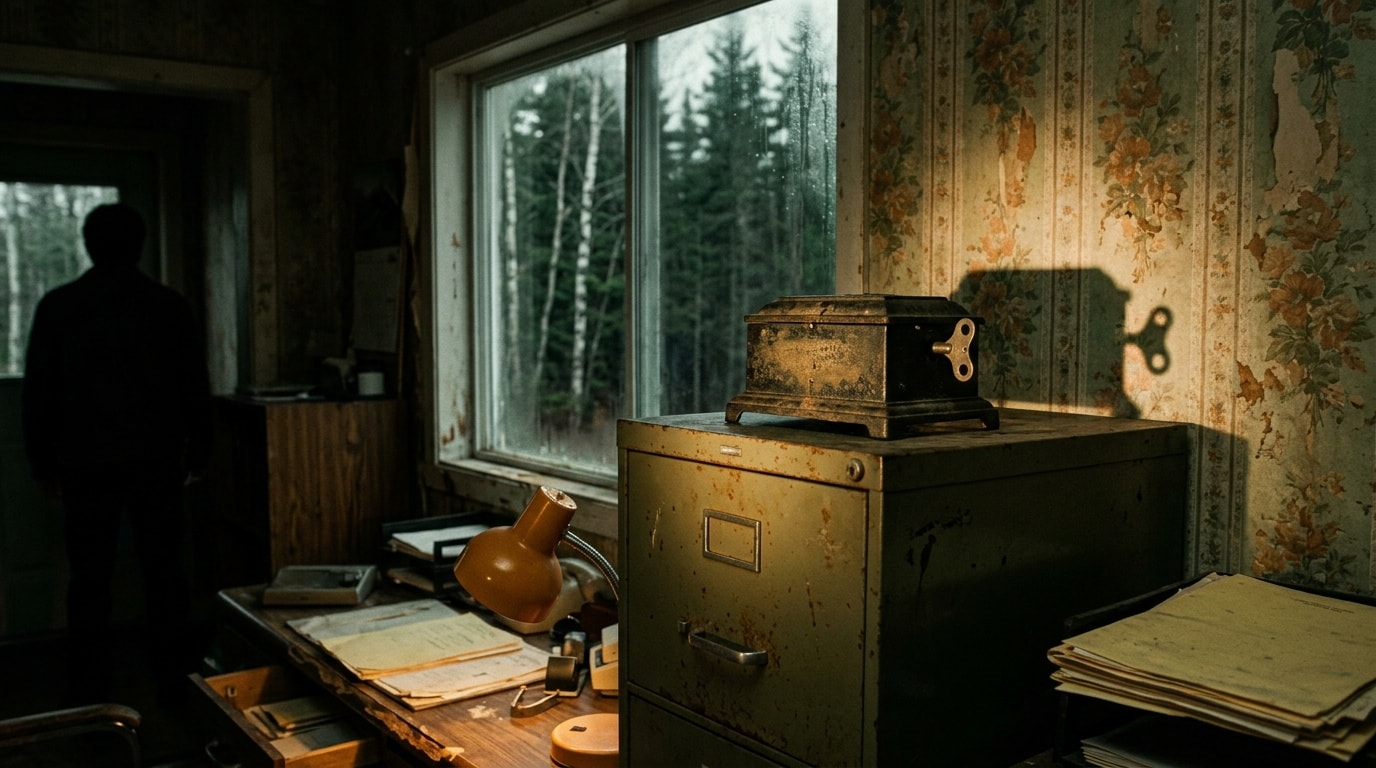
The Melody as Warning, Weapon, and Key
The music box is an active targeting mechanism that marks its recipients through dream contact, and the burn on Kenny's arm is evidence that being reached by the melody is indistinguishable from being selected by it.

The Night Miranda Walked to the Lighthouse Rewired Victor's Every Silence Since
On the night the town was destroyed, Victor's mother Miranda left him hidden in a cellar and walked to the lighthouse to free imprisoned children; his sister Eloise followed her and never returned.
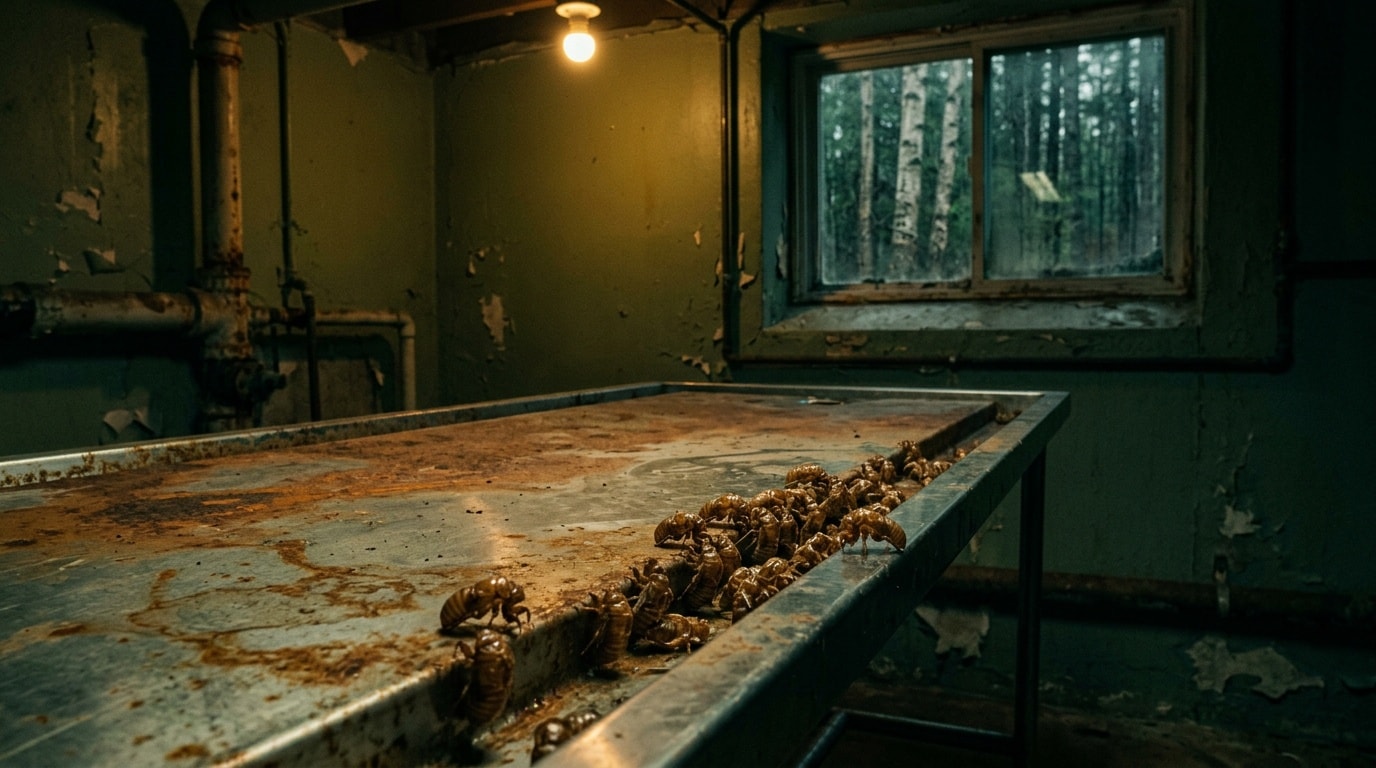
Cicadas as Transformed Parasitic Worms
The town's infection operates through a biological life cycle, and the cicadas appearing in Kenny's nightmare and across the creature's corpse mark the moment the parasitic worms previously extracted from inside the creature completed a transformation into a form that cannot be contained.

Stopping the Melody Could End the Curse
The voice in Kenny's dream positions stopping the music box's melody as the single conditional that changes the town's outcome, and the rhyme's framing, 'no one here is free' followed immediately by that condition, implies the melody sustains captivity rather than preventing harm.