
The Dead's Fears Become the Forest's Monsters
THE ARGUMENT
The theory holds that when people die in the Township, their deepest fears are absorbed into the Forest itself and then manifested as the supernatural threats the living experience. Sara articulates this directly: Nathan's childhood terror of cicadas, which he believed were monsters, may explain the cicada swarm now blanketing the town. If true, the horrors of this place are not arbitrary but biographical, built from the accumulated traumas of everyone who has died there.
How This Theory Works
Sara lays out the mechanism plainly in her conversation with Kenny. Boyd told her the Forest feeds on the pain of the people trapped within it. Sara takes that observation one step further. She proposes that the feeding does not stop at pain experienced by the living. When someone dies in the Township, whatever they feared most may be deposited into the Forest and then re-expressed as a real, physical phenomenon. The cicada swarm is her test case. Nathan was terrified of cicadas as a child because he thought they were monsters. Now cicadas are everywhere, and no one has a satisfying explanation for why.
This framing recasts every supernatural element of the Township as potentially historical. The creatures, the phenomena, the environmental disturbances may not be original properties of the place. They may be an accumulation of the dead, each person leaving behind their worst fear as a kind of residue. The Forest does not invent threats. It inherits them and makes them real.
Sara's shift in the town's atmosphere reinforces the theory's stakes. She tells Kenny that the town now feels wrong in a way that matches how the Forest felt when she and Boyd traveled deep into it. Something that was previously holding a darker power at bay may no longer be doing so. If that barrier has weakened, the town itself may be absorbing or expressing more of the Forest's accumulated fear-memory. The cicada swarm arriving at scale on this particular night, while everyone is ordered to stay awake, is the episode's most direct piece of evidence that this process is active and escalating.
The implication that cuts deepest here is one the theory has not yet pressed: if the Forest's monsters are the fears of specific dead people, then every creature the survivors have encountered may be traceable to a specific person who died there before them. The cicada swarm points to Nathan, a name Sara knows. But Nathan is recent. The Township has been consuming people for what appears to be a very long time, and the creatures that have terrorized the group from the beginning, the ones with rules, with routines, with almost ritualistic behavior, may represent fears deposited by people who died decades or centuries ago. That would mean the monsters are not the Forest's native language. They are a graveyard of other people's nightmares, and the survivors have been living inside a psychological archive of every person the place has ever killed, with no way to know whose terror they are currently running from.
Is this theory convincing?
Key Evidence
Sara Names Nathan's Cicada Fear
Sara tells Kenny that Nathan was terrified of cicadas as a child because he thought they were monsters, then directly asks whether the fears of people who die in the Township become part of the Forest itself.
Cicada Swarm Blankets Town and Colony House
The episode shows cicadas swarming across the town and Colony House grounds on the same night Sara proposes the dead-fears theory, visually linking her hypothesis to an active, ongoing phenomenon.
Boyd's Forest-Feeds-on-Pain Testimony
Sara relays that Boyd told her the Forest feeds on the pain of the people trapped there, which she uses as the foundation for her extension: that the fears of the dead may also be absorbed and re-manifested.
Town Now Feels Like the Deep Forest
Sara tells Kenny that something now feels different and wrong in the town, matching the specific quality of wrongness she experienced with Boyd in the deep Forest, implying the barrier between the two environments is dissolving.
Sara's Question Framed as Explicit Theory
Sara's words to Kenny are structured as a direct theoretical proposition: 'What if the people who died here, what if their fears become part of the Forest? What if that really is Nathan's nightmare out there?'
Fear Absorption as Collective Unconscious
The episode frames the Forest's behavior as something that may function like a collective unconscious, drawing in not just the pain of the living but the deep, irrational fears of those who have already died there.
This theory was evaluated using Theory Atlas editorial standards, including evidence review, narrative fit, and competing interpretation analysis. Learn how Theory Atlas evaluates theories →
Other Theories for S2E09

The Township Runs Three Control Protocols Simultaneously
The Township does not merely trap its residents; it administers them through at least three simultaneous control channels: a verbal/cognitive protocol delivered through the dream state that encodes the rules of captivity and may constitute the kill mechanism itself, a behavioral protocol in which the music box melody functions as a command signal that pauses and resumes creature activity rather than deterring it, and a census protocol in which the number 47 monitors population count and appears to trigger creature mobilization when thresholds become relevant.

Tabitha Is Walking Victor's Mother's Path
Tabitha is not completing Victor's mother's unfinished mission but repeating her fatal mistake, guided by the same inherited belief system that moved the mother toward the lighthouse forty years ago.
Randall's Paranoia Makes Him Dangerous
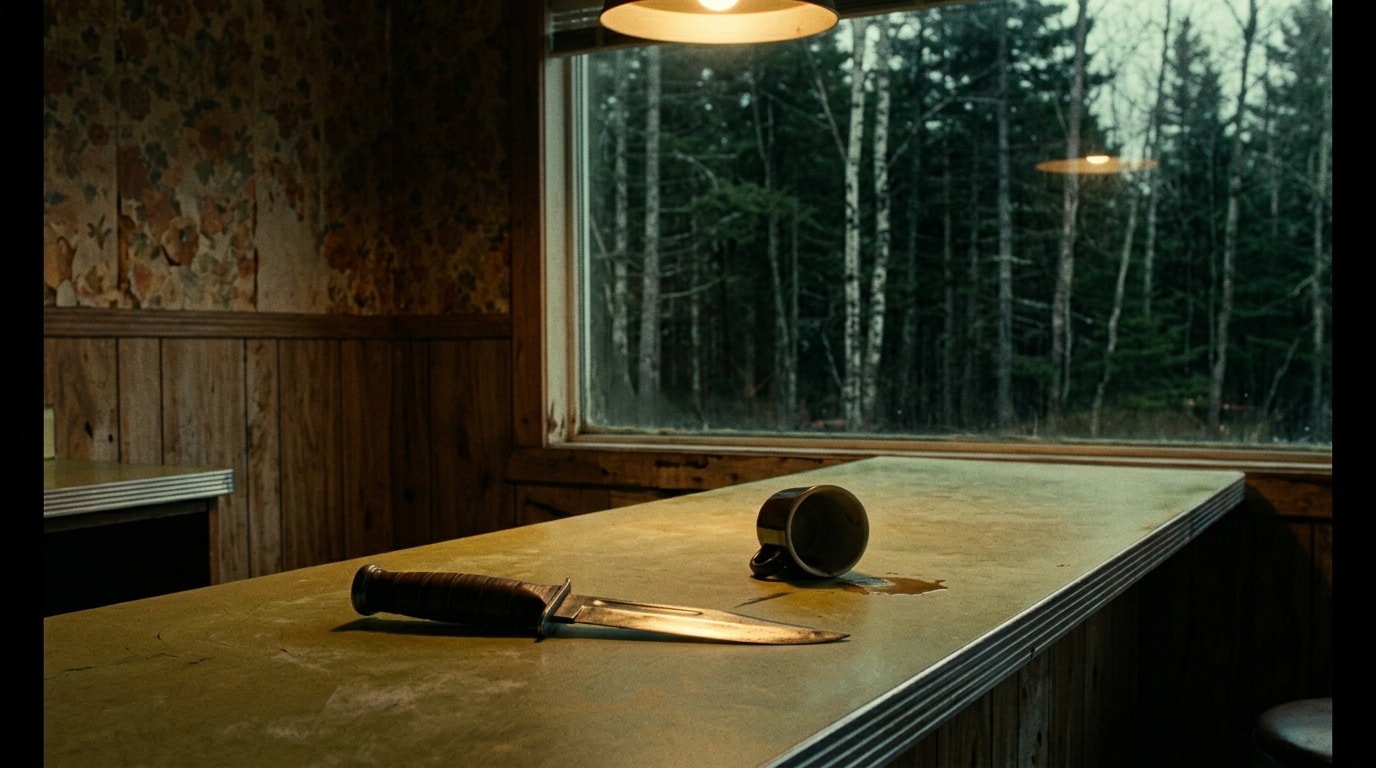
Randall's conspiracy thinking has crossed from eccentricity into active danger, culminating in him threatening Jim with a knife and sabotaging the group's escape.

Abby's Ghost Is the Town Speaking
The town is using Boyd's grief as a precision instrument, deploying Abby's image not as haunting but as a calculated psychological intervention against a resident it has identified as a structural threat.

Victor Knows How This Story Ends
Victor is withholding a functional understanding of how the township's cycles operate, derived from his mother's documented knowledge of the township's structure, and his reassurances to Ethan represent controlled disclosures from that understanding rather than comfort or faith.