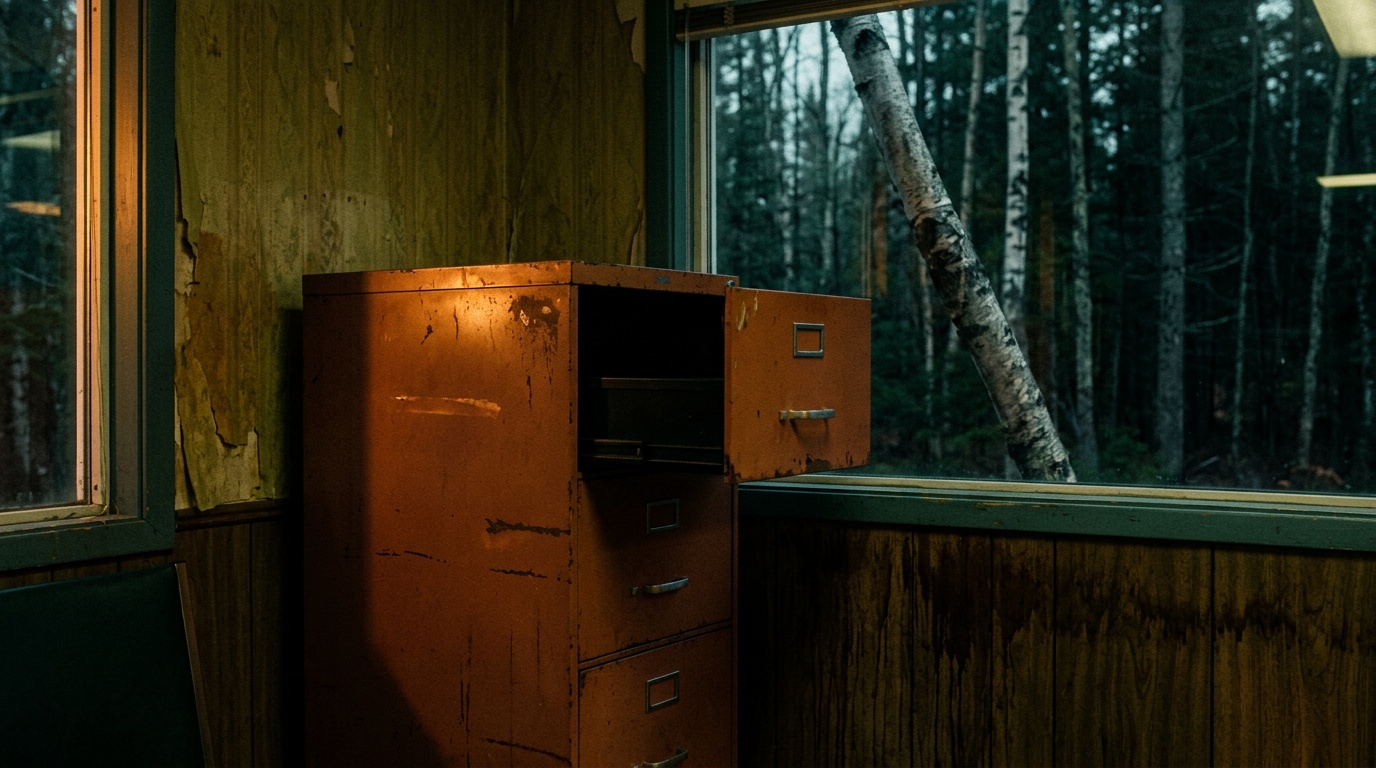
Victor's Erasure of Henry Is Load-Bearing Architecture, and the Reunion Would Collapse the Witness
THE ARGUMENT
Victor did not passively lose his father to grief. He made a deliberate architectural choice to reclassify Henry as part of a life he convinced himself was a dream, and that choice is what kept him functional across potentially five decades of captivity. The terror of reunion is not that Victor will hurt Henry, but that Victor will look at his father and feel nothing recognizable, confirming that the erasure is complete. If that confirmation arrives, it does not only threaten Victor's psychological survival; it retroactively destabilizes his credibility as the town's most important witness.
How This Theory Works
Victor says it directly: he never drew his father. He drew everything that happened in the town, its creatures, its patterns, its cycles of violence and survival, but Henry's face never appeared on the page. This is not a gap in output. Victor is not someone who forgets to document. His journals are exhaustive, maintained across decades that would have destroyed most people's capacity for record-keeping entirely. The total absence of Henry is a maintained boundary, held with the same discipline he applied to cataloguing the town itself. The omission is not incidental. It is load-bearing. Victor's long-term psychological architecture required his father not to exist on the page, and that requirement held. The unconfirmed claim is not that the erasure happened. Victor confirms it openly. What remains unconfirmed is that it holds, and that it was chosen.
When Victor retreats to the Car Graveyard while Henry attends the town meeting, his stated reason, that Henry is expecting a little boy and what will Henry think of him, functions as protective framing rather than honest accounting. Sara reads it correctly as projection, but the projection runs deeper than the show names directly. Victor has not merely anticipated his father's disappointment. He has already unmade Henry from his interior life. Convincing yourself that everything before the town was a dream is not grief. It is preemptive severance. Victor cut the cord before any reunion could force him to feel whether anything remained, and he cut it early enough, and held it long enough, that the severance may now be permanent in ways even he cannot assess.
Henry's parallel admission, that after years of hoping it became easier to convince himself that Victor, Miranda, and Eloise were simply gone, creates a surface symmetry the show is content to let stand. Both men protected themselves through self-protective forgetting. But the symmetry flattens a crucial distinction in weight and direction. Henry lost hope from the outside, across years of not knowing. Victor lost his father from the inside, as an act of deliberate psychological survival. One is the wound of absence. The other is the wound of self-surgery. Sara's framing, that perhaps both are afraid of meeting each other and not being what the other remembers, is accurate as far as it goes, but it locates the fear in mutual disappointment rather than in the specific catastrophe Victor is actually facing: not that he will disappoint Henry, but that he will look at Henry and recognize nothing, and that this failure will confirm what the town has completed in him.
That recognition failure is the specific terror the source material approaches but declines to press into fully. Victor does not fear his father's judgment. He fears his own. The possibility that he will meet the man who was once the most important person in his life and feel only the blankness of someone encountering a stranger, that is what the avoidance is protecting him from discovering. And it is a discovery with a particular structural consequence: if Victor cannot trust his own recognition of Henry, then the perceptual system he has used to witness and document the town for decades is a system he has already demonstrated the willingness to override when survival demanded it. A man who survived by classifying his entire past as a dream is not a neutral archivist. He is someone who has proven that his mind will edit reality under sufficient pressure.
This is where the reunion stops being purely about father and son and becomes a problem of epistemology. Everything Victor has recorded, every pattern identified, every survivor catalogued, every warning issued, is filtered through a consciousness that performed a radical act of self-revision and held that revision for what may be fifty years. The journals are extraordinary. They are also the product of a mind that has already shown it will reclassify the real as unreal when the alternative is collapse. The reunion does not only threaten Victor's survival architecture. It threatens the only thing that has given that survival meaning: the reliability of his testimony about the town itself. If he cannot recognize his father, he cannot fully trust what he has seen. And if he cannot trust what he has seen, the archive that defines his existence inside the town loses the one quality that made it worth keeping.
Is this theory convincing?
Key Evidence
Victor's Admission About Drawings
Victor explicitly states he never drew pictures of his father, explaining that he only drew what happened in the town and had convinced himself that everything before the town was a dream.
Pre-Town Life Classified as Dream
Victor's framing of his pre-town existence as something he actively told himself was a dream suggests a deliberate psychological reclassification rather than passive forgetting.
Henry's Mirror Coping Mechanism
Henry confesses that after years of hoping to see Victor, Miranda, and Eloise alive, it eventually became easier to convince himself they were gone, a parallel act of self-protective forgetting that mirrors Victor's own suppression.
Victor's Fear of Henry's Expectations
Victor tells Sara that Henry is expecting a little boy and asks what Henry will think of him, revealing that Victor understands the asymmetry between who Henry lost and who has actually survived.
Journals Document Town, Not Past
Victor's established habit of obsessively documenting town events across decades makes the total absence of his father from those records a meaningful structural omission rather than an incidental one.
Sara's Assessment of Victor
Sara tells Victor she does not know him well but believes he is a good person, and suggests that perhaps both he and Henry are afraid of meeting each other and not being what the other remembers.
This theory was evaluated using Theory Atlas editorial standards, including evidence review, narrative fit, and competing interpretation analysis. Learn how Theory Atlas evaluates theories →
Other Theories for S3E05
The Bottle Tree Has a List: Tabitha's Release Was the Trap
The controlling force behind the town did not fail to contain Tabitha: it selected her, moved her, and returned her on purpose.

Julie's Screams Are Supernatural, Not Psychological
Julie is not processing trauma but suppressing an active supernatural transmission, and her only coping mechanism is also the thing preventing her from understanding what is being sent through her.

The Bottle Tree Does Not Grant Escape Freely
The Bottle Tree is not a reliable exit but a mechanism operating on rules the townspeople cannot observe, and their collective rush toward it is itself the trap the system produces.

A Third Threat Patrols the Log Cabins
A distinct entity, categorically different from the known Creatures, has been observed circling the Log Cabins on both of Kenny's visits, suggesting it holds a fixed position rather than hunting the town at large.