Viserys Converts Prophecy Into Permission: The Structural Habit That Kills His Heir Before She Can Be Named
THE ARGUMENT
Viserys's prophetic certainty about a male child is not vision but motivated reasoning, and it is not an isolated error but the sharpest expression of a catastrophe-generating institutional habit. His interpretive method is structurally identical to Rhaegar Targaryen's: fixing symbolic imagery to a specific womb and a specific unborn boy. This means the error is load-bearing, not accidental. The deepest irony is that his actual heir, Rhaenyra, already dragon-bonded and legally named, satisfies the prophecy's most obvious reading, which his need for male legitimation forecloses before the question can form.
How This Theory Works
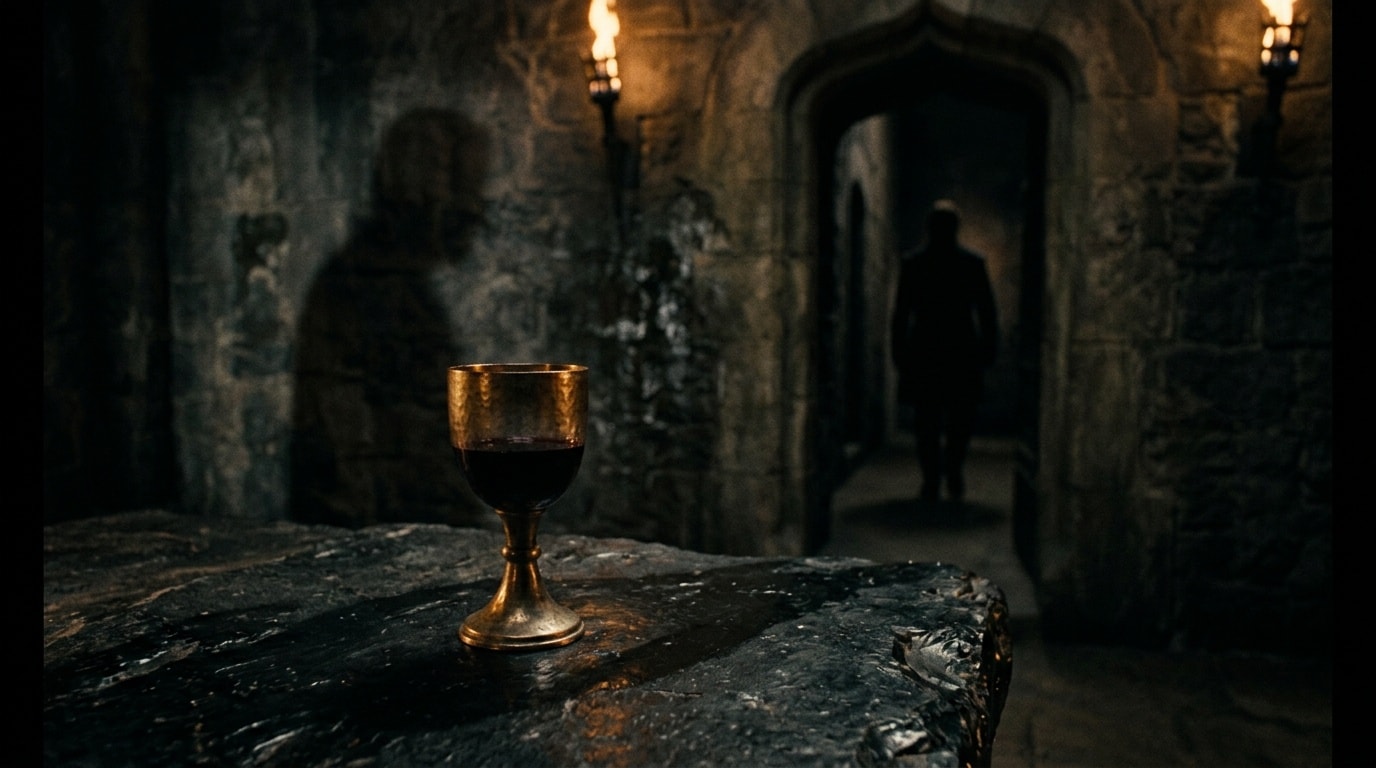
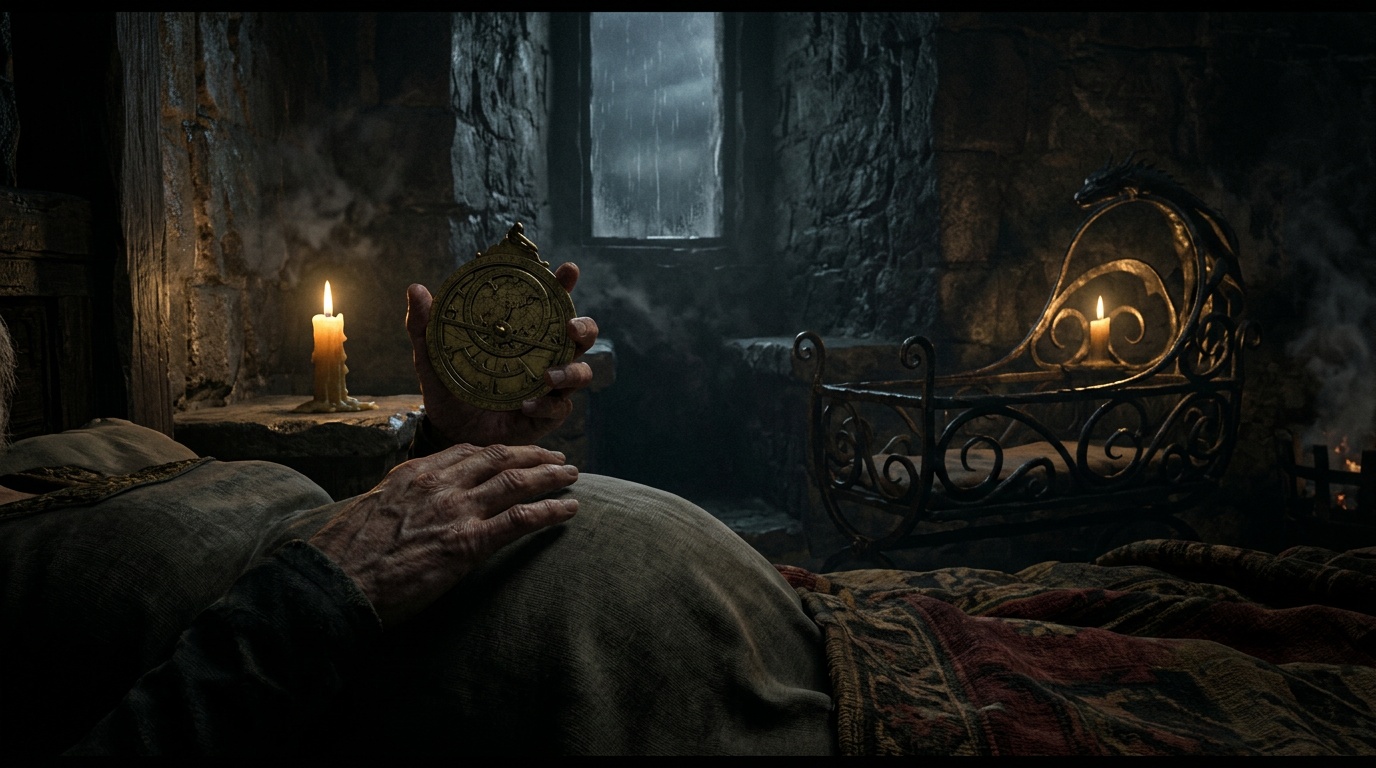
Viserys does not misread the prophecy because he is careless. He misreads it because he needs to, and because misreading counsel is what he does. The dream of a son wearing Aegon's iron crown arrives at the precise moment Viserys requires divine sanction for something he already wants: a male heir who will make his reign feel legitimate, continuous, and cosmically endorsed. The certainty is not prophetic confidence. It is desire operating as revelation. But the show does not confine this habit to the bedchamber or the dream. It distributes it across every institutional surface the first episode provides. Viserys absorbs Corlys's explicit warnings about the Triarchy without adjusting policy. He absorbs Daemon's provocations without consequence. Each time, the posture is identical: conviction substituted for information, professional counsel registered as formality rather than constraint. The prophetic misreading is not the exception. It is the pattern made lethal.
Grand Maester Mellos told Viserys plainly, in front of the full Small Council, that there is no way of determining the sex of an unborn child. Viserys heard the assessment and discarded it publicly. That is not private delusion. It is an institutional act, and its institutional consequence followed immediately: the Heir's Tournament. A tournament named for an heir who has not arrived, whose sex cannot be known, is not optimism; it is a king locking himself into a frame from which retreat is structurally impossible. By the time the procedure in the delivery room becomes a choice, it has already ceased to be one. Viserys did not face a decision between his wife and his heir in that room. He made the decision weeks earlier, in a council chamber, when he converted a personal wish into a public commitment requiring a specific biological outcome. The tournament is the mechanism. The delivery room is the consequence.
The parallel to Rhaegar Targaryen is where the theory achieves its sharpest analytical pressure. Rhaegar also concluded he knew which child the prophecy named. He fixed a symbolic inheritance to a specific body, a specific bloodline, a specific moment, and that conclusion generated dynastic catastrophe on a scale that ended his house's uncontested rule. Viserys is executing the same interpretive move: the dream imagery is vivid, but it is not self-interpreting. A crown on an infant's head does not specify a sex, a birth order, or a womb. Viserys supplies all three himself, in a single confident gesture that overrides the one expert in the room. The parallel matters not because it predicts a matching outcome but because it reveals that Viserys's error is structural rather than circumstantial. He is not making a mistake a wiser king would not make in the same situation. He is making the mistake that this kind of king always makes: mistaking the intensity of a conviction for evidence of its accuracy.
Rhaenyra is the theory's sharpest irony and its most uncomfortable weight. She is present at the episode's opening, not as background, but as its first image of Targaryen power: dragon-bonded, airborne over King's Landing, already in possession of Syrax. She holds a legal claim to succession at the exact moment Viserys is burying his interpretive certainty in Aemma's body. The theory does not require arguing that Rhaenyra is the prophesied heir. It only requires observing that Viserys's method of reading the prophecy cannot distinguish her from anyone else, because his method is not reading. The dream imagery he cites (the iron crown, the thundering hooves, the ringing swords) maps at least as plausibly onto a dragonrider who already commands the skies as onto an unborn boy whose existence depends on surviving a surgery Mellos has flagged as fatal to the mother. Viserys cannot see this because seeing it would require him to accept that the dynastic legitimacy he is seeking through a son is already present in the daughter he has named his heir. His need for male legitimation is not incidental to the misreading. It is the misreading.
What the show has not yet confirmed, and what the pattern predicts, is whether this mechanism ever becomes visible to Viserys himself. The evidence argues against it. A king who grieves Aemma as loss, rather than as consequence, will carry the prophetic certainty forward intact, applying the same interpretive habit to every subsequent crisis the series places in front of him. The Mellos exchange is the proof of concept. The tournament is the institutional crystallization. The delivery room is where the cost is collected. If the pattern holds, Viserys will never be required to know what he did, which means the catastrophe-generating habit will keep operating, compounding across every council chamber and every dream, long after Aemma is buried.
Is this theory convincing?
Key Evidence
Mellos's Explicit Sex Determination Denial
Grand Maester Mellos states directly in the Small Council meeting that there is no way of determining the sex of the unborn child, a professional assessment Viserys openly dismisses.
Tournament Named for Male Heir
Viserys organizes a public tournament called the Heir's Tournament in anticipation of the birth, a commitment so concrete it required a male outcome to be anything other than a category error.
Viserys Overrides Expert Counsel
Viserys's dismissal of Mellos's warning in front of the Small Council establishes a pattern of substituting personal conviction for informed advice at the moment of highest consequence.
Public Declaration of Son Confidence
Rather than holding his expectation privately, Viserys announces his certainty of a son in a formal council setting, transforming personal belief into institutional assumption.
This theory was evaluated using Theory Atlas editorial standards, including evidence review, narrative fit, and competing interpretation analysis. Learn how Theory Atlas evaluates theories →