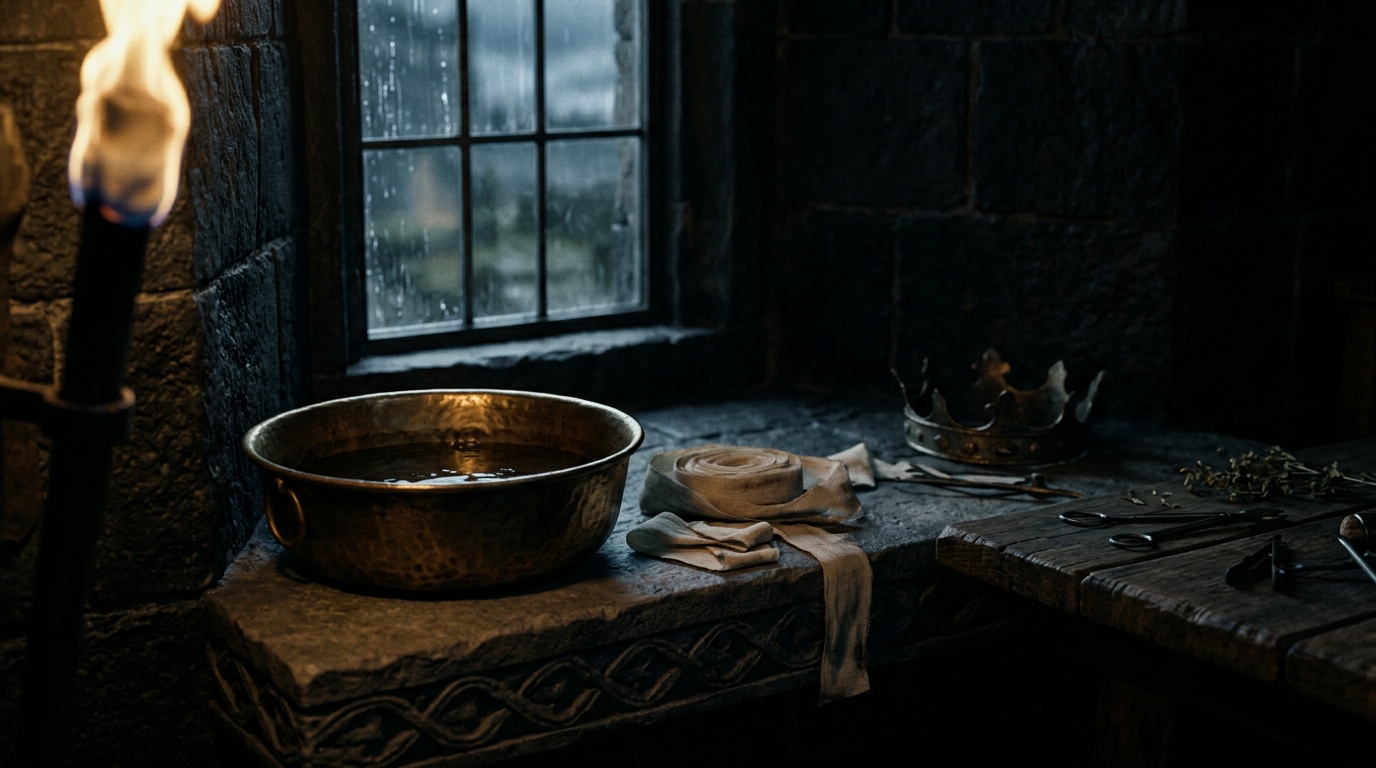
Rust and Rot: The Throne's Real Curse
THE ARGUMENT
Otto Hightower's order to suppress the origins of Viserys's wounds is not reputation management. It is the decision that transforms a treatable septic infection into a death sentence, because naming the throne as the source of harm would require removing the king from it. The concealment is the mechanism of harm.
How This Theory Works
The unconfirmed claim is not that the Iron Throne is cutting Viserys. That is visible. The claim is that the people managing his care have made a collective choice to withhold the one intervention that might slow his death, and that this choice is political rather than medical. Removing a king from his throne on grounds of physical danger is not a medical decision. It is a succession question. Otto Hightower knows this, and his suppression order to Mellos reflects it.
The evidence that makes this reading hard to dismiss is the pattern of wound progression. Non-healing wounds accumulating across episodes at a rate consistent with systemic infection is not ambiguous. The maester confirms on screen that the wound will not close. Alicent is personally tending the lesions rather than leaving them to trained medical staff. That division of labor is significant. It limits the number of people with clinical access to Viserys's condition, which limits the number of voices who might formally recommend a change in his behavior, including his proximity to the throne.
Otto's order targets the origin story, not the treatment. He does not suppress the existence of the wounds. He suppresses where they come from. That is a precise and deliberate choice. If the goal were simply to protect the king's dignity, concealing the severity would serve that purpose. Concealing the source serves a different purpose: it prevents anyone from drawing the conclusion that sitting the throne is an ongoing injury event and that the king should stop doing it.
The sharpest implication of this reading is that the concealment is not neutral. Every session Viserys spends on the Iron Throne after Otto's order is an injury event that the people closest to the king have actively chosen not to prevent. The deterioration is incremental. It is also, in principle, interruptible. What Otto's suppression order does is ensure it cannot be interrupted without someone naming what the order was designed to prevent anyone from naming. The king is being allowed to die on a throne whose danger has been classified.
Is this theory convincing?
Key Evidence
Alicent Tending Viserys's Wounds
Alicent is shown personally treating open lesions on Viserys's back, with the wounds visibly worsening across episodes rather than healing.
Maester's Admission of Non-Healing
The attending maester confirms on screen that the wound Viserys sustained from the Iron Throne refuses to heal, which is the clinical baseline for the infection theory.
Otto's Order to Conceal Origins
Otto Hightower instructs Mellos to keep quiet the fact that the king's wounds originate from the Iron Throne, suggesting awareness that the throne itself is the ongoing source of harm.
Progressive Wound Accumulation Over Time
The wounds on Viserys are shown multiplying and deepening across multiple episodes, consistent with systemic infection spreading rather than isolated injuries.
Rust-Contaminated Throne Composition
The Iron Throne is constructed from thousands of melted, corroded swords, making rust contamination of any cut a direct and repeatable physical hazard.
This theory was evaluated using Theory Atlas editorial standards, including evidence review, narrative fit, and competing interpretation analysis. Learn how Theory Atlas evaluates theories →
Other Theories for S1E04
Otto's Brothel Report Was Calculated Succession Move
Otto Hightower's brothel report was not intelligence offered to a king but a controlled detonation designed to make Viserys destroy his own daughter's succession while believing the choice was his.
Rhaenyra's Sacred Lie Will Break Everything
Rhaenyra's oath to Alicent is not a defensive lie but an act of exploitation: she identified the exact ground where Alicent was most vulnerable, her restored friendship and her trust, and used it as the foundation for a false statement that exceeds anything political survival required.
Daemon's Seduction of Rhaenyra Was a Scheme With a Beginning, Middle, and End
The necklace Daemon gave Rhaenyra in Episode 1 was not affection but the opening move of a calculated scheme to reach the throne through her, and his return in Episode 4 was triggered by visual confirmation: the necklace still on her throat had confirmed that the move had held.

Daemon Staged the Pleasure House as Fraternal Sabotage, Then Confessed to What He Did Not Do
Daemon orchestrated the pleasure house visit as a deliberate act of fraternal sabotage, removing Rhaenyra's disguise to guarantee her exposure, and then confessed to Viserys in a formulation that implied guilt without confirming any specific act.
Daemon Engineered Rhaenyra's Desire to Destroy Her Marriageability, and Cole Inherited the Damage
Daemon's Flea Bottom excursion was a premeditated political operation, not a seduction: it was designed to render Rhaenyra unmarriageable and position himself as the only viable match.

Daemon's Intelligence Operation: The Godswood Encounter Required Two Problems Solved Before It Began
The godswood reunion is framed as a convergence of accidents, but the logistics it required: advance knowledge of Rhaenyra's unplanned early return and prior intelligence on a hidden passage inside her own private chambers, cannot both have been improvised.
Mysaria's Double Transaction: How She Sold Rhaenyra to Otto and Bought Leverage Over Him
Mysaria did not passively leak the intelligence that nearly destroyed Rhaenyra's succession; she sold it to Otto Hightower through a chain she controlled and collected payment for it.
Viserys's Tea Implies Pregnancy Fear
Viserys sends Rhaenyra the tea not as a precaution but as a response to a pregnancy risk he believes is already real, and he does so without determining which encounter that night produced it.