Severance Fragments Its Subjects at Every Stage
THE ARGUMENT
Severance does not contain suffering within a partition; it transforms grief into a sourceless affliction the innie cannot name, then destroys the orientational architecture that would allow a reintegrated person to inhabit either life. The procedure was marketed as reversible containment, but each stage of it, including the exit, worsens the subject's condition. The evidence for this is Petey, whose testimony describes the damage at Stage 1 and whose body demonstrates the damage at Stage 2.
How This Theory Works
The theory's central claim is precise: severance is not a partition that holds, then lifts. It is a two-stage fragmentation engine that inflicts a specific wound at each stage, and the wounds compound. Understanding how requires reading Petey's testimony not as backstory but as a clinical report delivered by a man who is simultaneously the most qualified witness and the most urgent evidence.
The first wound occurs at the moment of severance and operates on a logic Lumon almost certainly never disclosed. When Mark tells Petey that the procedure helps him avoid his wife's death during work hours, Petey does not accept that framing. He corrects it. The hurt travels with the innie, Petey says, but without its name and without its origin. What the innie carries is not a memory of Gemma and not a feeling Mark can identify as grief. It is the raw emotional signal, stripped of its referent, arriving in a consciousness with no way to locate it, no way to process it, and no way to resolve it. The red eyes are the evidence. Coworkers composed a song about elevator allergies because the behavior was consistent enough to become a joke, which means Mark's innie was arriving at work in a state of visible distress that no one around him, including himself, had any framework to explain.
What makes this failure legible beyond Mark's case is that it is not individual. The procedure was designed with a known tolerance for emotional content, and Lumon has already anticipated that individual dependency can exceed what severance was built to suppress. Mark's photo removal at the start of the season is not a symptom of unusual attachment. It is the first visible proof that the system's baseline assumption, that grief can be cleanly partitioned from its carrier, is wrong at the architectural level. Grief that knows what it is mourning is painful but navigable. Grief that has been severed from its object and deposited in a self that cannot ask where the feeling came from is not a lighter version of the same experience. It is a permanent, inexplicable wound with no possible resolution, because the innie has no access to the loss that would allow any form of processing to begin. The procedure did not protect Mark from his grief. It engineered the conditions under which his grief can never end.
The second wound occurs at reintegration, and the June question is its sharpest evidence. When Petey asks Mark mid-conversation where June is, the failure visible in that moment is not retrieval. He retrieves June immediately. He knows she exists, knows she plays guitar, describes her as the greatest kid on earth. The emotional content of that relationship is completely intact. What is absent is any functional sense of where June is relative to the self now asking the question. That gap, affect present and orientation absent, is the signature of a specific structural damage. Severance did not merely suppress the outie's memories while Petey was severed. It severed the indexing system that makes those memories inhabitable rather than merely accessible. When the barrier drops, the emotional record floods back into consciousness, but the architecture that would allow the reintegrated person to anchor those memories to a present-tense self does not return with it. The result is not a restored person. It is a third person who holds two complete emotional histories and can navigate neither of them as a life.
Petey's own description of what reintegration feels like confirms the mechanism and makes its severity legible. Two lives suddenly stitched together with the relativity messed up, past and present blurring: that is not a metaphor for feeling disoriented. It is a description of a cognitive structure in which neither timeline has causal priority and events from both intrude on the present without contextual anchoring. The involuntary Lumon flashbacks that interrupt his time at Mark's house are not nostalgia or trauma response. They are the innie's timeline asserting itself at full present-tense urgency inside a consciousness that has no stable ground to push back from. The merged self is not integrating. It is oscillating between two incomplete systems that were not designed to coexist, and the oscillation is accelerating. The nosebleed at the gas station, the collapse into Lumon's internal logic, the request for tokens to eat, the final loss of responsiveness: this is not a man recovering from a difficult procedure. The trajectory from cogent testimony at Mark's house to neurological collapse at a convenience store describes a consciousness failing in real time, with the failure moving from cognitive to physiological to terminal inside a single episode.
The structural symmetry the show builds around this two-stage damage is the theory's hardest claim. Petey does not report that he is getting better after reintegration. He reports that the anti-Lumon group told him it would get better. That is a distinction the show renders visible by placing the reassurance against footage of a man who is visibly worsening. Either the group fundamentally misread what severance does, believing it is a suppression that can be lifted rather than a structural damage that cannot be repaired, or they understood the lethality and withheld it from Petey because a reintegrated worker who acts before collapsing is operationally more useful than one who declines the procedure after being told it will kill him. In both cases, the worker enters without the information that would allow genuine consent, and in both cases, the organization framing the procedure as beneficial is the one controlling the narrative of what it does. Lumon sends workers into a procedure whose psychological endpoint is withheld from the person consenting to it. The anti-Lumon group sends workers into a procedure whose physiological endpoint is either unknown to them or withheld from the person undergoing it. The map Petey leaves in Mark's basement looks like the opening move of a resistance. It may also be the only thing a disposable asset completed before the procedure finished him.
Is this theory convincing?
Key Evidence
Petey's Red Eyes Observation
Petey tells Mark that his innie used to arrive at work with red eyes, that coworkers joked he was allergic to elevators and even composed a song about it, and that Petey always suspected it was more than that.
Grief Travels Without Its Name
Petey directly tells Mark: 'you carry the hurt with you, you feel it down there too, you just don't know what it is,' explicitly asserting that severed emotional pain persists without its memory.
Mark's Stated Reason for Severance
Mark tells Petey he lost his wife a few years ago in a car accident and that severance helps him by allowing him to avoid that grief during work hours, framing the procedure as a coping mechanism.
Gemma's Crafts in the Basement
Cobel enters Mark's home and opens a box of Gemma's crafts, pulling out a candle, confirming the physical presence of grief-associated objects in Mark's domestic space.
Petey's Reintegration Testimony
Petey describes reintegration as two lives suddenly stitched together with messed-up relativity that blurs past and present, suggesting the emotional contents of both states are real and persistent.
This theory was evaluated using Theory Atlas editorial standards, including evidence review, narrative fit, and competing interpretation analysis. Learn how Theory Atlas evaluates theories →
Other Theories for S1E03
Cobel Lives Next Door to Watch Mark
Cobel did not simply accept a surveillance assignment.
Petey Was a Surveyor Not a Defector
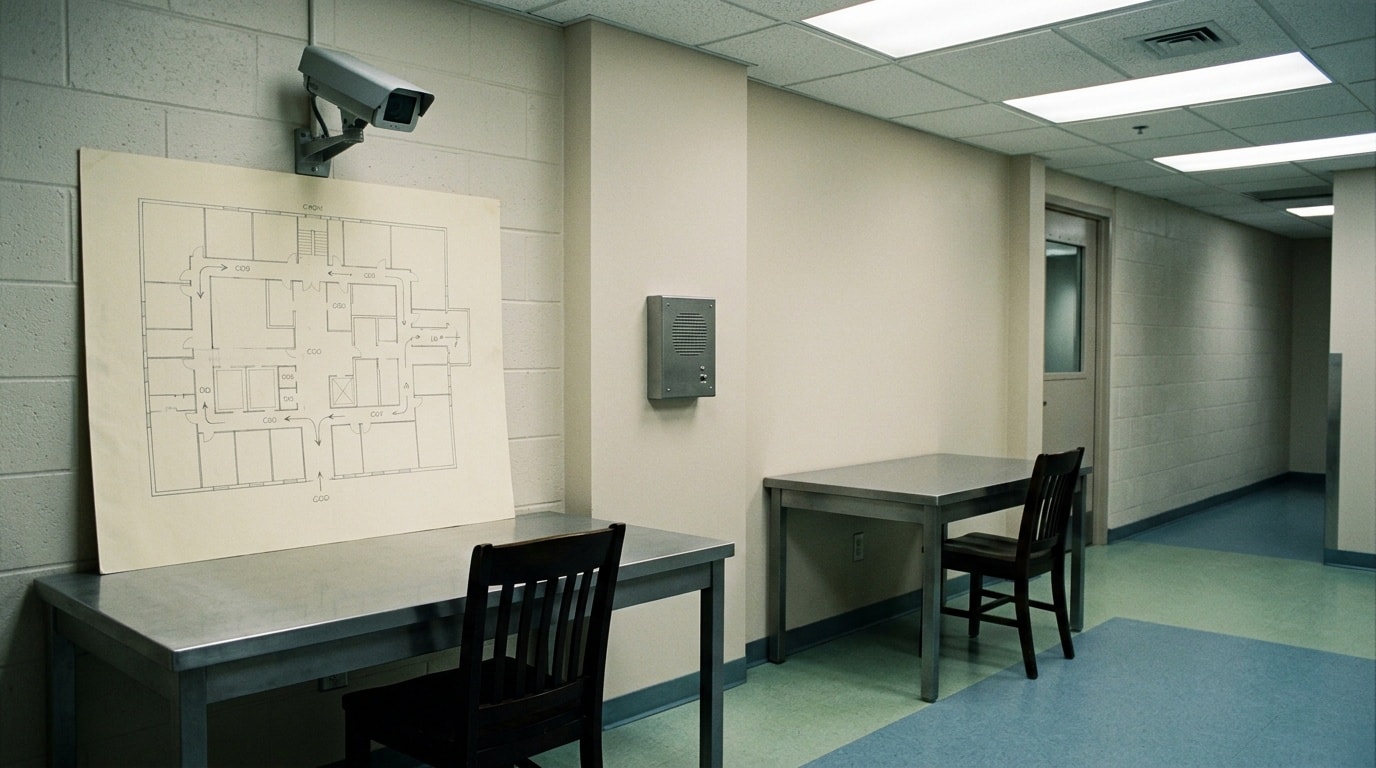
Petey's reintegration, his appearance at Mark's home, and his hand-drawn floor map constitute a single coordinated operation run by a covert second resistance group distinct from the Whole Mind Collective.
Lumon Controls Resignation Without Employee Consent
Lumon has veto power over severance resignations that it exercises before requests ever reach the outie, meaning the contract's apparent voluntariness is a structural fiction maintained by keeping the only person with legal standing to exit permanently uninformed.
Break Room Forces Sincere Confessions, Not Just Compliance
The break room is an engineered conversion apparatus, not a punitive space, built on the premise that behavioral compliance is insufficient and that the innie's internal state must be remade to match Lumon's approved ideology before release is granted.
The Perpetuity Wing Is a Permanent Prison Engineered to Recruit Its Own Inmates
The Perpetuity Wing operates simultaneously as a physical holding space for innies whose severance has been made total and irrevocable, and as a psychological conversion mechanism that replaces innie selfhood with Lumon-approved devotion.
Each MDR Worker Embodies a Lumon Temper
Lumon's four tempers are not corporate decoration.