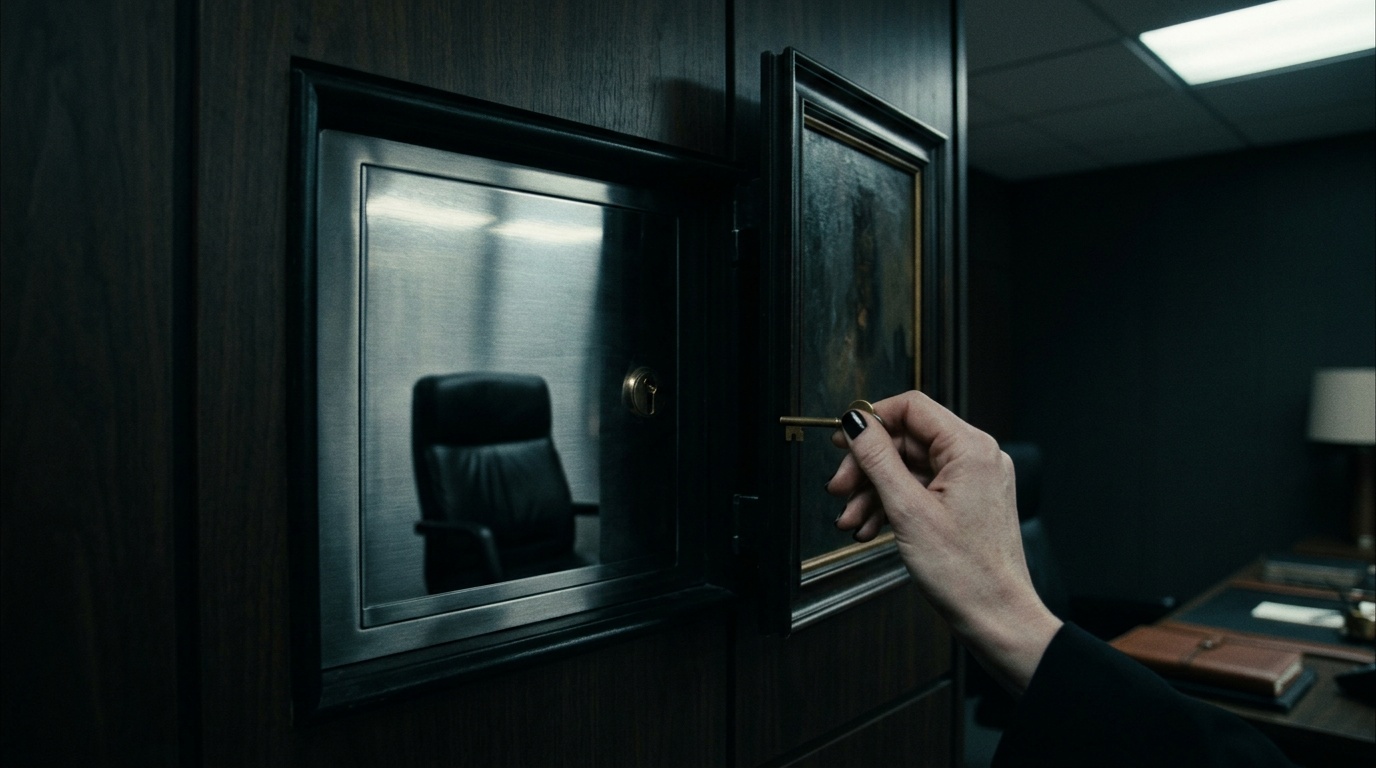
Cobel Operates at Two Registers Simultaneously: The Warning Scene Is the Strategic Architecture in Miniature
THE ARGUMENT
Cobel is not defecting from Lumon out of conscience but maneuvering to reclaim ownership of the severance program and settle a private score with the Eagans, using Mark as her instrument. Her manipulation operates at two registers simultaneously — the intimate and the strategic — and the moment she warns innie Mark about Helly's loyalties is where both registers become visible in the same gesture. The technique she uses in that room to dissolve his resistance is identical to the technique she applies to the entire rescue architecture: staging despair to produce compliance, then framing the outcome she has already designed as the only available salvation.
How This Theory Works
Cobel does not want to save Gemma. She wants to be the one who decides what happens to Gemma, and to Lumon's severance program, and to the Eagan family that raised and then discarded her. Her cooperation with Mark is real, but it is structured so that every critical decision passes through her hands and every critical moment of doubt is one she introduced. The Cold Harbor detail is the sharpest evidence of the strategic register: Cobel knows that completing the file triggers Gemma's scheduled termination, and she still frames the entire rescue around Mark finishing it first. A character whose goal is Gemma's survival does not insist on the act that ends it. She insists on it because completion serves something else — gaining leverage over Lumon's records, denying the Eagans a clean procedural conclusion, or ensuring that when Gemma's fate is finally decided, Cobel is the one holding the sequence. The lie about reintegration, that it does not have to end innie Mark's existence, a claim that contradicts everything both the innies and the audience understand about the process, is not reassurance. It is the last instrument of compliance she needs to keep him moving through an outcome she has already determined.
The warning scene is where the intimate register becomes visible, and where the two registers prove they are the same operation at different scales. Cobel removes Devon from the room before speaking. That is not the behavior of someone passing along uncomfortable information. It is the behavior of someone who understands that a witness changes the emotional physics of what she is about to do, who needs the message to land in an uncontrolled space. She arranges a private audience at his most vulnerable moment because the manipulation requires it — because what she is about to do is stage despair, and despair requires an audience of one. Then, directly after innie Mark refuses to cooperate, she delivers the claim: there will be no honeymoon ending for him and Helly, because Helly is an Eagan and Mark is nothing to that family. The timing is not incidental. The warning arrives at the precise moment his emotional attachment to Helly is the only thing keeping him still. She is not disclosing. She is removing the obstacle.
The more uncomfortable possibility, and the one the show has not resolved, is that Cobel may not know whether the warning is factually true. She may not care. Jame Eagan has already told Helly the next day is a special day without specifying what he wants from her, and Helly herself has acknowledged she is Helena without the episode treating that acknowledgment as reassurance. The Eagan loyalty question remains structurally open. But a manipulator with Cobel's documented history of operating outside Lumon's stated interests while pursuing her own agenda does not require factual confidence to deploy a claim this useful. She requires only that innie Mark cannot immediately disprove it — and she knows he cannot. If the claim is true, it saves her the embarrassment of a lie discovered later. If it is false, it still produces the behavior she needs right now. The weapon works either way.
Innie Mark runs rather than argues, and that response is the clearest confirmation of her method. Running is not the behavior of someone who has weighed the claim and rejected it. It is the behavior of someone who has weighed it and found he cannot afford to examine it closely — which means Cobel has successfully installed the claim as a possibility he must act around rather than a proposition he can refute. This is the intimate register operating at full efficiency: she has used a single sentence, delivered in private, to transform his emotional architecture. The rescue continues not because he trusts her but because she has made the alternative unthinkable. That is not protection. That is the same mechanism she applies to Cold Harbor, to the reintegration lie, to her control over the chip programming and the black hallway route. She does not need his trust to run the operation. She needs him moving through a sequence she has already designed, and she produces that motion the same way at every scale: by introducing a despair precisely calibrated to leave compliance as the only remaining option.
What this reading requires holding together is the possibility that Cobel's private wound and Mark's survival are not structurally compatible, but that Cobel has arranged the architecture so this incompatibility remains invisible to him until it is too late for it to matter. She has spent decades in service to the Eagans and been erased by them. She cannot be in a room with someone the Eagans are about to use without telling him what that means — which suggests the warning is not only tactical but confessional, a moment where the intimate and strategic registers fuse completely. She is using innie Mark the way she was used, deploying against him the exact false assurance she was handed, and the show is careful not to resolve whether she knows this. A character who has lived inside that institution long enough to build a severance religion in her basement, who monitors Mark's outie through a surveillance network she constructed independently, who controls every technical element of the rescue and still insists on Cold Harbor completion first, is not improvising. She is culminating. The question the show holds open is not whether Cobel is manipulating Mark. It is whether her culminating move and his survival happen to overlap, or whether she has simply made him believe they do.
Is this theory convincing?
Key Evidence
Cobel Insists Mark Finish Cold Harbor
Cobel's first priority upon meeting Mark is confirming whether he has completed Cold Harbor, and she frames the entire rescue plan around him finishing the file before acting, despite knowing its completion triggers Gemma's scheduled termination.
Destabilizing Innie Mark's Trust
When alone with innie Mark, Cobel volunteers that he and Helly will have no happy ending because Helly is an Eagan and Mark means nothing to them, a disclosure that nearly derails the rescue and serves no strategic purpose if her sole goal is saving Gemma.
Innie Mark Directly Questions Her Motives
Innie Mark asks Cobel directly why she is telling him all this and what she is really doing there, a question she does not answer to his satisfaction, and he immediately runs away from her.
Lumon Abandonment Driving Defection
Cobel's prior episode backstory establishes that Lumon raised and discarded her, suggesting her opposition to Lumon stems from personal grievance rather than principled objection to severance itself.
Cobel Controls the Rescue Information
Cobel manages all operational details of the plan given to Mark, including the chip programming, the black hallway route, and the testing floor mechanics, giving her structural leverage over how the rescue proceeds.
Ambiguous Final Position on Reintegration
Cobel tells innie Mark that reintegration does not have to end his life, a claim that contradicts what both innies and the audience understand about the process, raising the question of whether she is misleading him deliberately.
This theory was evaluated using Theory Atlas editorial standards, including evidence review, narrative fit, and competing interpretation analysis. Learn how Theory Atlas evaluates theories →
Other Theories for S2E10

Outie Dylan's Letter Leaves the Door Open
Outie Dylan's letter to his innie is not a rejection of resignation so much as a confession of inadequacy, one that grants innie Dylan autonomous decision-making authority the severance system does not permit and puts that grant in writing inside a Lumon facility.

Completing Cold Harbor Ends Innie Mark
Innie Mark has chosen to initiate a rescue that structurally requires his own dissolution into a reintegrated consciousness weighted toward outie Mark, and the show has not confirmed he survives it.

Outie Dylan's Letter Traps His Innie
Outie Dylan rejected his innie's resignation not out of institutional obligation but to preserve access to a version of himself he envies, making the innie a psychological resource the outie has chosen to keep captive.

Reintegration Means Losing Helly Forever
Innie Mark's resistance to reintegration is not a fear of erasure but a refusal to accept the permanent loss of Helly, the only version of her who will ever exist outside Helena Eagan's control.
Jame Sees Kier in Helly, Not Helena
Jame Eagan's preference for Helly over Helena is not paternal ambivalence but active substitution: he has identified his daughter's innie as the vessel carrying Kier's qualities that Helena lost in adulthood, and his visit to the severed floor the night before Cold Harbor's completion suggests he is preserving access to that vessel rather than managing a family liability.

Lumon Planned to Discard Everyone After Cold Harbor
Lumon designed the severance program as a closed experimental arc with a fixed endpoint, intending to dispose of Mark, Gemma, and every MDR employee the moment Cold Harbor was filed.

The Equator Is Where Innies and Outies Meet
The equator in Severance's season finale is not a romantic gesture.