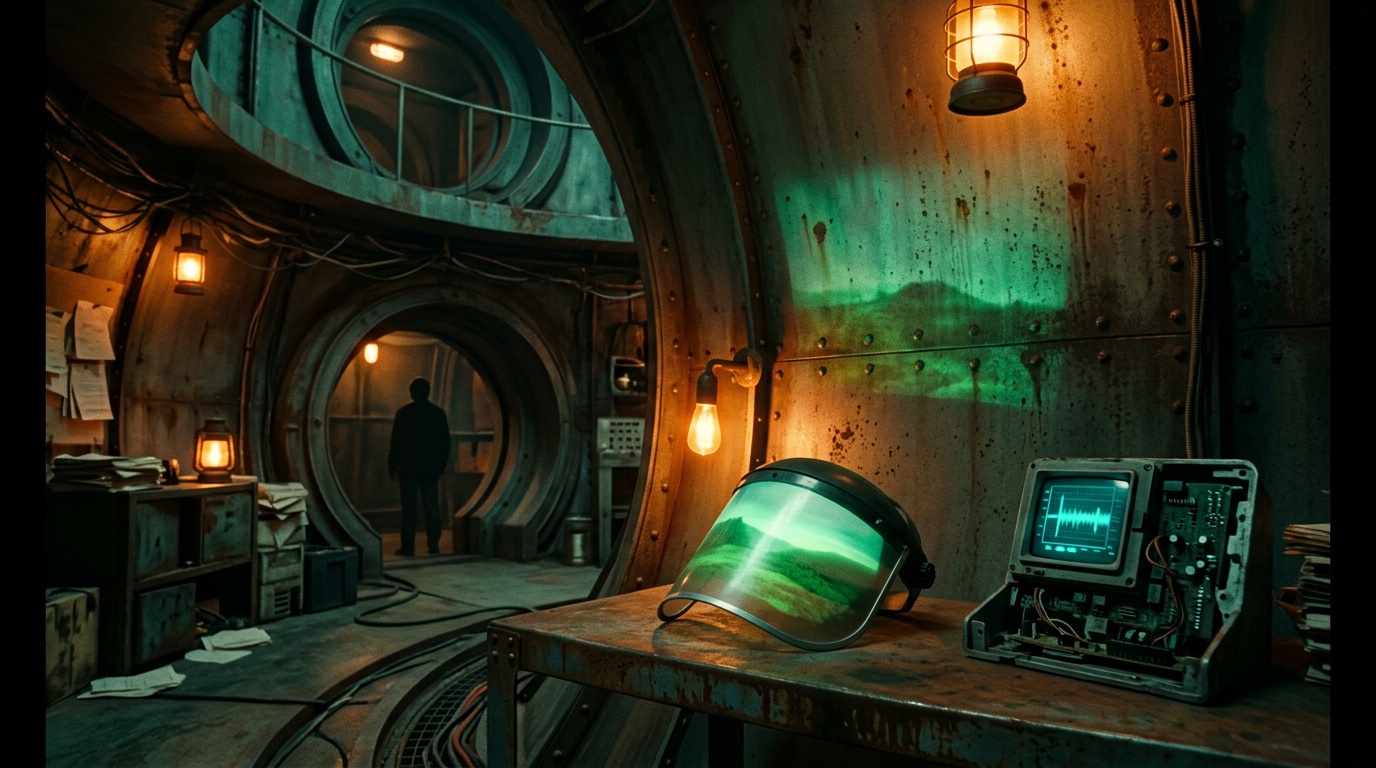
The Cleaning Runs Two Feeds: One for the Exile, One for the Silo
THE ARGUMENT
The cleaning ritual operates a dual-channel deception: the visor inside each suit projects a preloaded lush landscape to engineer the exile's compliance and labor extraction in their final moments, while the external camera feed transmits fabricated desolation to the silo population to manufacture consent to captivity among those who remain. The Jane Carmody footage — an identical landscape seen by cleaners separated by decades — confirms both feeds are fixed, coordinated, and have been running since the silo's founding. Exile is not a punishment appended to the system; it is the system's most efficient function, converting the population most likely to resist into the workforce that sustains the illusion keeping everyone else imprisoned.
How This Theory Works
The cleaning ritual's deception does not operate on a single channel. It runs two simultaneous feeds, each engineered for a different audience, each producing a different behavioral outcome, and each useless without the other. What the exile sees and what the population sees are not competing versions of the same transmission. They are coordinated instruments of the same architecture, one designed to extract a final act of compliance from the person being expelled, the other designed to ensure that no one watching from the cafeteria screens ever considers following them.
The visor is the first channel. The visual presentation Holston experiences — bloom-lit, verdant, populated by birds — is inconsistent with direct optical transmission through a faceplate in a toxic environment. It presents as a screen projecting imagery onto the exile's field of vision rather than a transparent window onto the world beyond. The Jane Carmody evidence makes the case nearly airtight: a video file recovered from the hard drive, labeled with a cleaner's name from Silo year 97, shows a landscape that matches what Holston sees outside decades later. Two exiles separated by generations cannot be receiving a live feed and arriving at an identical image. The feed is preloaded. The same fabricated tableau has been cycling inside those helmets since the silo began expelling people. Every cleaner who ever believed they were stepping into a survivable world was watching the same recording.
The behavioral logic of the visor points directly at its engineering purpose. Every cleaner, across every generation, wipes the external sensor before dying. This consistency is not explained by personal conviction or residual civic loyalty. If the visor presents a paradise, the system architects who designed it required one specific outcome: the exile must complete the sensor wipe before their death becomes a data point. The fabricated landscape is the reward structure for completing the task. It tells the exile the world is real, that there is somewhere to walk toward, that the act of cleaning is the threshold between expulsion and arrival. The system does not hope exiles will clean the lens. It guarantees they will, because the visor's entire function is to produce that guarantee. What looks from the outside like a psychological compulsion is, from the inside of the engineering, a labor contract the exile never had the chance to refuse.
The external camera feed is the second channel, and its function is the inverse. Where the visor tells the exile the world is livable, the cafeteria screens tell the population it is not. When Holston steps outside and perceives green, lush terrain, residents watching the screens see a white-suited figure moving against a barren, dusty exterior. These two simultaneous experiences cannot both be accurate, and the cleaning that follows confirms which feed is controlled: Holston wipes the lens believing he is transmitting the truth of what he sees, but the image the population receives after cleaning still matches the expected bleak exterior. Cleaning the lens changes nothing because the output residents receive was never determined by the lens. It was determined by whatever processing layer sits between the sensor and the cafeteria screen, and that layer was installed at the silo's founding. The ritual does not fail to communicate the truth. It was designed to fail. The architects did not need to stop cleaners from trying to send a different message. They only needed to ensure that no cleaner could succeed, and they built that failure into the infrastructure before the first exile ever walked out the door. Holston's removal of the helmet — the show withholds his unhelmed perspective entirely, a directorial choice that marks the moment without resolving it — suggests he recognized at some level that the visor and the actual world were showing him different things. But by then the sensor had already been cleaned, the population had already received the familiar barren image, and the second channel had already done its work.
Juliette's refusal to cheer when the lens is cleaned is not incidental. Her skepticism, shared by the mechanics around her, marks the population segment most likely to understand that images are produced rather than simply captured. The system's psychological architecture does not need to convince everyone. It needs to manufacture enough consensus that skeptics remain isolated rather than organizing. The cafeteria screen is not aimed at Juliette. It is aimed at the people around her, the ones whose belief in an uninhabitable exterior makes the silo's interior power structure stable. An uninhabitable outside world is the only thing that makes captivity feel like shelter, and the camera feed is the instrument that produces that feeling on demand, reset and renewed every time a cleaner walks into view and dies in the open air, visible on screen, their experience irrecoverable.
What this reveals about the silo's foundational design is the theory's hardest and most consequential claim: the silo's architects did not design exile as a consequence of dissent. They designed dissent as a pipeline for labor. The category of people most likely to resist the silo's control — to investigate its secrets, to push against its rules, to ask what the camera is actually showing — are precisely the people whose psychological intensity makes them the most reliable cleaners. The visor weaponizes their longing. The external feed weaponizes their deaths. Compliance and dissent are not opposites within this system. They are a single closed loop. The population that obeys is kept and contained by the fabricated desolation on the cafeteria screens. The population that questions is expelled and converted, through the helmet's preloaded paradise, into one final guaranteed service call. The cleaning ritual does not dispose of the silo's most dangerous residents. It harvests them.
Is this theory convincing?
Key Evidence
Visor Shows Lush Green World
Holston sees a verdant landscape with birds while the external sensor confirms a toxic, barren environment, a contradiction that makes optical transparency of the visor implausible.
Jane Carmody Video Match
A video file labeled with a cleaner's name from Silo year 97, found on the recovered hard drive, appears to show the same landscape Holston sees outside decades later, suggesting a fixed preloaded feed rather than a live view.
Allison's Body Absent from Holston's POV
While Holston wears the helmet, his point of view does not include Allison's body, which is visible to silo residents on their screens; he only moves toward her after removing the helmet.
Directorial Withholding After Helmet Removal
The episode never shows the audience what Holston sees after taking off his helmet, a deliberate choice that treats the unmediated outside world as information to be withheld.
Visor Appears as Partial Display
The visor's visual presentation, described as partially black and bloom-filtered rather than optically clear, is consistent with a screen projecting imagery rather than a transparent faceplate.
Cleaner Reliably Wipes Sensor
Every cleaner, despite going out to their death, performs the sensor cleaning before succumbing, a behavioral consistency that suggests the fabricated beautiful world is engineered to produce exactly this outcome.
This theory was evaluated using Theory Atlas editorial standards, including evidence review, narrative fit, and competing interpretation analysis. Learn how Theory Atlas evaluates theories →
Other Theories for S1E02
George Wilkins Knew Too Much to Live
George Wilkins was murdered to prevent him from disclosing what he found in the Silo's forbidden tunnels, and Allison Becker's handwriting on documents inside his hidden camp proves she was an active participant in the same investigation before her own death.
Jahns's Order Restarted the Sequence She Was Trying to Identify
By sending Holston to clean, Mayor Jahns did not merely repeat a historically dangerous precedent — she triggered the same institutional collapse sequence that produced the previous Rebellion, one she was actively researching before it was too late.
The Silo's Authorities Control What People See
The Silo's false feed of the outside world is not a passive inheritance but an actively maintained and institutionally refined deception, with each generation of leadership briefed rather than deceived.
The Suits Kill, Not the Sky
The suits, not the atmosphere, are the instrument of death for Cleaners sent outside the Silo.
Holston's Signal Was His Cleaning
Holston's Cleaning was a calculated communication modeled on what he realized Allison's cleaning had already been: a structured message delivered through the only channel Judicial could not suppress.