
Bernard Knew About Jahns and Marnes All Along
THE ARGUMENT
Bernard Holland possessed intelligence on the Jahns-Marnes relationship before anyone told him, and his 'always suspected' framing was a performance designed to conceal a surveillance-derived source. The speed and packaging of his cover story reveal not improvisation but a preexisting leverage file he repurposed when the deaths required it. Bernard was not protecting the Silo from scandal; he was spending an asset he had been holding against the two people most capable of obstructing him.
How This Theory Works
Bernard's 'always suspected' framing is not humility. It is the specific verbal move a person makes when they need to explain accurate knowledge without revealing its source. Bernard knew about Jahns and Marnes before the meeting, and his performance of vague suspicion was a practiced deflection designed to obscure that he had obtained this information through IT surveillance or another intelligence channel he could not acknowledge.
The speed and completeness of his cover story is the core evidence. Bernard does not hesitate, does not workshop alternatives, and does not ask for confirmation before committing to a plan that requires the relationship to be real enough to be believed by the Silo's population. He pairs it immediately with a race in Jahns' honor, a two-part public relations package so complete it implies prior assembly. A man improvising under pressure rarely produces something so polished. A man drawing on prepared materials does.
This implicates something more uncomfortable than surveillance access. If Bernard monitored a private relationship between the Mayor and her Deputy, he was not passively sitting on that information. He was holding it in reserve. The question is not whether he knew. The question is why he needed to know, and what he planned to do with it before circumstances forced his hand. The cover story was not created in response to a crisis. It was repurposed from a preexisting leverage position. Bernard had already identified the relationship as an asset with a specific use case. The murders did not prompt the strategy. They simply moved up the timeline.
Is this theory convincing?
Key Evidence
Bernard's Instant Cover Story
Bernard proposes the 'secret lovers' narrative almost immediately in the meeting, with no apparent deliberation, suggesting the idea was not improvised but drawn from prior knowledge of the relationship.
The 'Always Suspected' Deflection
Bernard characterizes his knowledge of the Jahns-Marnes relationship as mere speculation, saying he 'always suspected there was something between them,' a framing that distances him from appearing to have concrete intelligence.
IT Department Surveillance Access
Bernard's role as IT head gives him plausible access to surveillance or communication data that could have revealed a private romantic relationship, making his claimed ignorance structurally suspicious.
Paired Race Announcement
Bernard simultaneously proposes a Silo-wide footrace in Jahns' honor alongside the cover story, a two-part distraction package that implies advance preparation rather than spontaneous crisis management.
Bernard's Information Control Posture
Bernard dismisses Sims and Billings but keeps Juliette behind to discuss the Pact's subtext regarding Judicial authority, demonstrating he carefully calibrates who hears what and when.
This theory was evaluated using Theory Atlas editorial standards, including evidence review, narrative fit, and competing interpretation analysis. Learn how Theory Atlas evaluates theories →
Other Theories for S1E05
The Shadow Offer Was an Execution Protocol: How Judicial Designs Its Own Disappearances
Sims did not eliminate Trumbull because Trumbull became a liability — he eliminated Trumbull because Trumbull had fulfilled his function, and the function was always designed to end this way.

Judicial Planted Evidence in the Wrong Apartment
Judicial's frame-up of Patrick Kennedy collapsed because its surveillance records were stale enough that Trumbull planted evidence in an apartment Kennedy had vacated a year earlier, exposing the hard ceiling of the institution's actual reach.
Shadows: Silo's Hidden Enforcement Runs Through Janitors
The janitor class in the Silo is the institutional housing of a parallel enforcement structure that predates Sims and operates entirely outside Judicial and the Sheriff's Department.
Billings Is Judicial's Eyes Inside the Sheriff
Judicial's appointment of Billings is not an administrative imposition but the activation of a governance function the Pact was built to perform: converting the Sheriff Department's chain of command into a reporting structure for the institution it is supposed to check.

The Sky Is a Clock Someone Set
The lights Lukas Kyle has been charting follow a deliberate, organized circular orbit that cannot be explained by natural astronomical behavior, and the Pact's ban on high-level magnification exists to prevent residents from confirming exactly that.
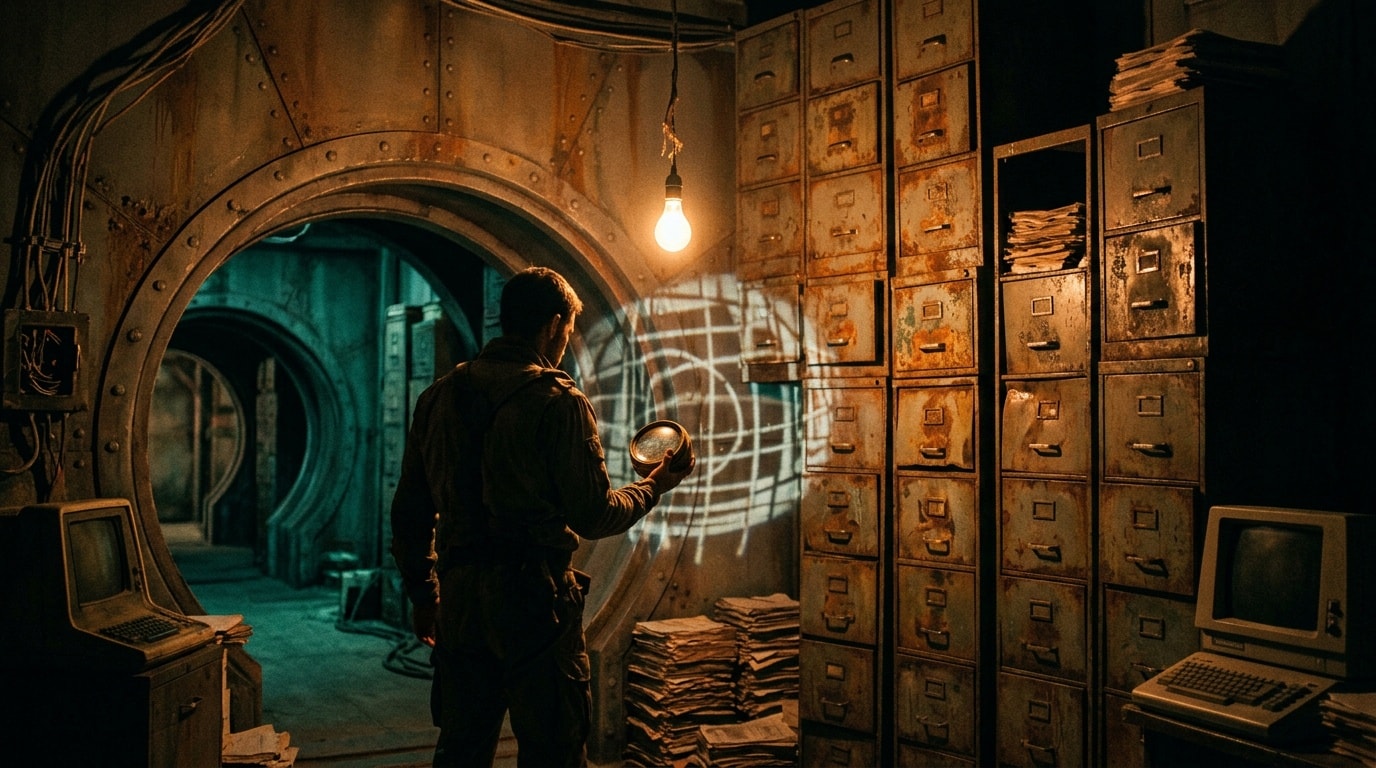
George's Hidden Relic as Juliette's Next Move
Juliette has retrieved a functional pre-Silo camera that Judicial does not know exists, and she intends to use that information gap as leverage rather than wait for Judicial to close it.

Bernard's Support Is a Strategic Leash
Bernard's pledge of support for Juliette is a co-option strategy, not a change of heart: he identified her as too capable to remove and too dangerous to leave unsupervised, so he made himself her patron instead.
Stars Unknown: The Silo's Engineered Ignorance
The absence of stellar knowledge in the Silo is an engineered deletion, not cultural drift, designed to remove the cognitive vocabulary residents would need to identify the outside world as survivable.