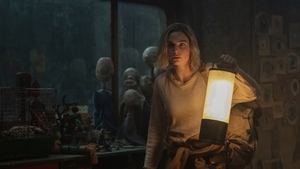
Solo Steps Outside His Walls
THE ARGUMENT
Solo is not recovering through connection with Juliette; he is being broken open by the first person to offer him recognition after decades of isolation, and his capacity to survive that contact is not established. The behavioral inversions the show presents as growth, the flooded dive, the unlocked latch, the circus animals disclosure, are better read as evidence that his psychological architecture has been so thoroughly reshaped by the vault that it can no longer hold against recognition. The Lapis backpack incident, in which Solo cannot register an impossible memory as false, confirms that what the vault preserved is not Solo intact but Solo altered beyond the reach of ordinary repair.
How This Theory Works
Solo is not warming to Juliette through accumulating trust. He is being undone by recognition, and the show has not yet decided whether that undoing is recovery or collapse. A man who has organized his survival around containment does not simply choose connection. The compulsion to reach outward is operating on him before he can account for it, and the behavioral inversions, the flooded dive, the unlocked latch, are evidence of that operation, not of deliberate growth.
The vault entrance scene is the theory's center. Solo crosses the threshold after Juliette has already started to leave, with no practical reason for the act, no negotiation, no request. He crosses it to tell her about circus animals, which is to say he crosses it for no purpose that survival logic can explain. The show offers no account of why this moment is the one that breaks through, and that silence is load-bearing. If Solo were recovering, there would be some legible internal movement toward the decision. There is not. The boundary dissolves, and he follows it out.
The Lapis backpack scene is where the argument turns hardest. Solo claims the backpack belongs to a girl he once knew, but the timeline makes this impossible. He does not correct himself. He does not register the inconsistency as Juliette names it. The episode does not resolve whether he is confabulating, protecting himself from something unbearable, or genuinely unable to separate memory from invention. All three possibilities point to the same structural fact: the vault did not preserve Solo. It reshaped what is real to him.
The parallel the show builds between Juliette's fear of the outside and Solo's fear of leaving the vault is doing quiet argumentative work. When Juliette describes what a cleaning felt like from inside her terror, she is not offering comfort. She is offering equivalence. Solo's response to being seen suggests that recognition has a specific and immediate effect on a psychology that has had no practice receiving it. The show frames this as the foundation of growing trust, but the Lapis incident sits directly beneath that framing and destabilizes it. A man whose memory has been reshaped by isolation, who cannot hold the boundary between a past that is real and one he has constructed, is not choosing Juliette from a recovered capacity for connection. He is attaching to her because she is the first person in decades to treat his interior life as worth addressing, and he has no remaining architecture to modulate what that does to him. The dive into water he has feared for years is not courage. It is what happens when someone without intact boundaries encounters a person who sees them.
Is this theory convincing?
Key Evidence
Solo Dives Into Flooded Levels
Despite being described as terrified of water, Solo enters the flooded levels to test Juliette's suit himself before she uses it, framing the act as a sacrifice driven by his bond with her.
Solo Emerges From the Vault
As Juliette walks away, Solo unlocks the vault latch and comes out to tell her about circus animals, a voluntary act of engagement that directly contradicts his previous refusal to leave his sealed space.
Juliette Mirrors Solo's Fear
Juliette describes her own experience of fear during a cleaning as a way to empathize with Solo's anxiety about leaving the vault, and the episode treats this as a meaningful connection between them.
The Lapis Backpack Incident
In what appears to be a classroom, Solo claims a backpack belongs to a girl named Lapis he once knew, but Juliette points out the timeline is impossible, suggesting Solo's memories of the past may be distorted by years of isolation.
Fear as Emotional Common Ground
The episode draws a structural parallel between Juliette's fear of the outside world and Solo's fear of leaving the vault, using shared vulnerability as the foundation for their growing trust.
This theory was evaluated using Theory Atlas editorial standards, including evidence review, narrative fit, and competing interpretation analysis. Learn how Theory Atlas evaluates theories →
Other Theories for S2E04
Judicial Erases Its Own Crime Scene
Judicial operates a two-track evidence removal system that converts institutional authority into the sole author of the official riot record, using formal procedure to claim Cooper's body and informal erasure to eliminate the instigator's.
Solo's Eye Hides a Rebellion Secret
Solo's heterochromia records a decision he made during the Silo 17 rebellion rather than an injury passively received, and his inability to speak about it after decades of solitude follows the pattern of guilt rather than grief.
Meadows Reduces Lukas's Sentence Strategically
Meadows reduces Lukas's sentence as an act of institutional management, not mercy or defiance: she transfers forbidden knowledge to a man whose death in the mines guarantees it goes nowhere, performing leniency that costs the system nothing.
Solo's Numbers Track Time in the Vault
Solo entered the vault knowing, not hoping, that someone would arrive within a specific window, and the chalkboard sequence is the record he kept to measure that window's close.
Quinn's Letter Broke Meadows From Within
Meadows had privately withdrawn from belief in the silo's legitimacy before Bernard poisoned her, and her choice to disclose the letter to him was not a slip but an act of quiet defection.
Where Did Meadows Go for Four Days?
Meadows used her four missing days to investigate something about the silo's machinery that made the Shadow role untenable, then spent twenty-five years managing that secret at close range rather than disclosing it.
Russell's Gift: A Title Without Substance
Russell almost certainly gave Solo the Shadow title as a psychological management strategy, not as institutional recognition, because keeping Solo functional inside a sealed vault with no exit required giving him a story about himself that made the isolation bearable.