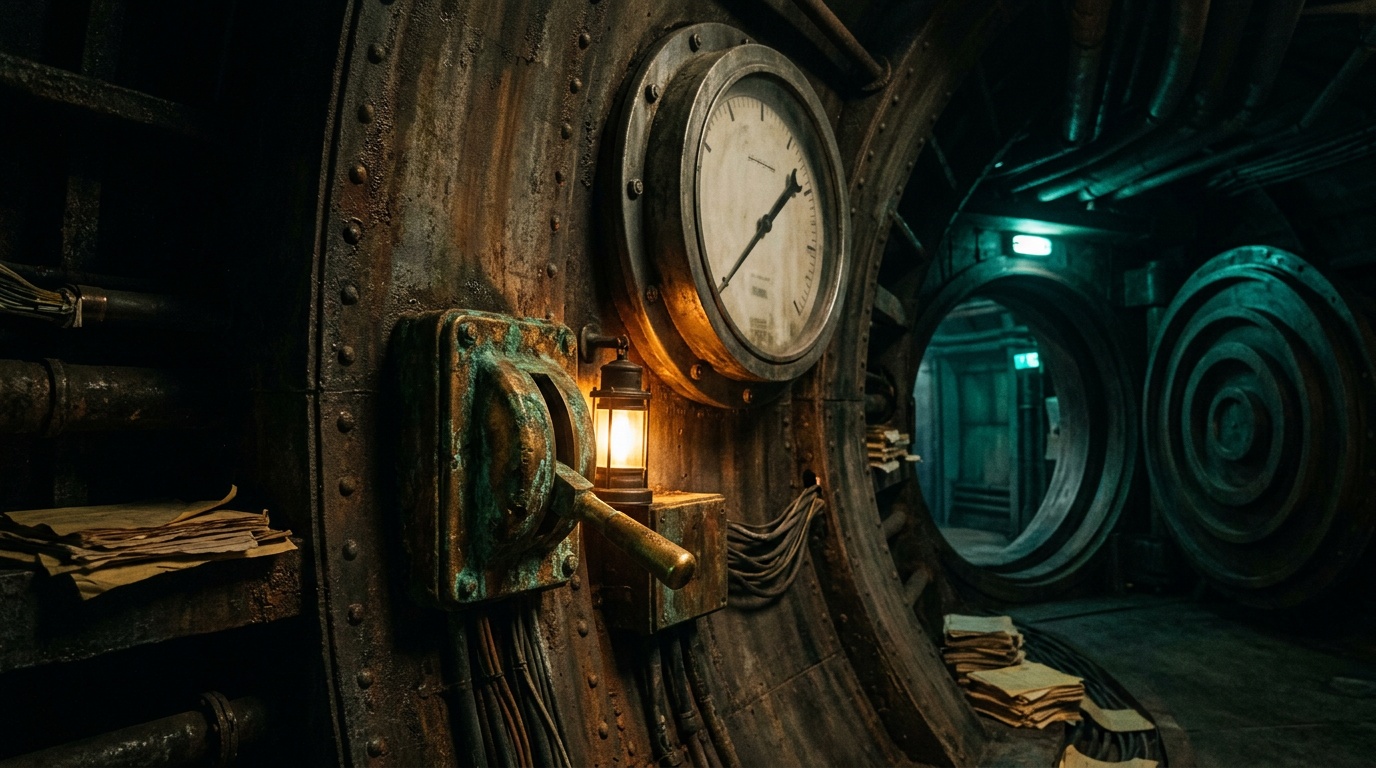
The Safeguard: Automated Extinction for Disclosure
THE ARGUMENT
The Safeguard is an automated extinction protocol, engineered by the silo founders to eliminate an entire silo's population the moment the existence of the multi-silo network risks spreading beyond its designated keepers. Its threat is not personal and not discretionary: it is a designed terminus condition that converts each keeper's silence into a continuous act of complicity in the potential murder of everyone they protect. The silos were not built to survive humanity. They were built to be disposable the moment they became inconvenient to the system that contains them.
How This Theory Works
The Safeguard is not a security warning in any ordinary sense. It is the founders' answer to a question they could not leave to human discretion: what happens when the wrong person learns that fifty silos exist? The computer voice at the tunnel door delivers its threat in institutional plural, 'we will have no choice but to initiate the safeguard,' and that phrasing is the theory's load-bearing detail. Automated systems do not use 'we' unless the 'we' was engineered in advance. The threat executes without deliberation because the founders removed deliberation from the equation at the point of design.
The scope of that protocol is where the theory sharpens. Killing a single person who learns the truth would be operationally simple and would not require a dedicated named system with its own warning announcement. The ceremonial weight of the warning, the fact that only three people before Lukas have ever reached this door, and the founders' explicit framing of the Safeguard as a designed response to disclosure all point toward a mechanism calibrated to eliminate the entire compromised population. Not the informant. The silo.
Quinn's letter guides Lukas to this door, which means at least one prior Silo Sheriff concluded that the system's own threat was the most important thing a keeper of this knowledge could ever encounter. Meadows received the same warning, and her subsequent behavior reflects someone operating under a constraint that cannot be spoken, transferred, or resolved. The Safeguard does not need to fire to function. The knowledge that disclosure triggers population extinction is sufficient to ensure silence across an entire institutional role, generation after generation. The founders did not build a weapon as a last resort. They built an obligation that transforms every keeper into an unwilling guarantor of mass death, and they built it first, before any of the silos' residents existed to consent to the arrangement.
Is this theory convincing?
Key Evidence
Computer Voice's Institutional Plural
The tunnel door's computer voice tells Lukas 'we will have no choice but to initiate the safeguard,' using a plural subject that implies an automated institutional system rather than an individual actor making a discretionary decision.
Only Three Prior Visitors
The computer voice specifies that only Salvador Quinn, Mary Meadows, and George Wilkins have previously reached this door, establishing the Safeguard warning as a rare and deliberately gatekept encounter with consequences severe enough to limit access to three people across the silo's history.
Quinn's Letter Leads Here
Lukas follows Quinn's letter to the tunnel and the door, meaning a prior Silo Sheriff deliberately directed his successor toward the Safeguard warning as the central piece of knowledge a keeper must possess, suggesting Quinn considered it the defining constraint of his role.
Founders Created the Safeguard
Quinn's letter references the founders creating the Safeguard, directly linking the system to the original architects of the silo network and framing it as a deliberate design choice rather than an emergency measure added later.
Showrunner's 'Big Bad Thing' Confirmation
Showrunner Graham Yost described the Safeguard as 'a big, bad thing' when asked about its nature, signaling that the show intends its consequences to be understood as catastrophic rather than merely personal or administrative.
Meadows's Constrained Behavior Pattern
Meadows, who received the same Safeguard warning before Lukas, exhibited behavior in prior episodes consistent with someone operating under an unshared and unresolvable constraint, suggesting the warning functions as a psychological control mechanism that shapes keeper conduct long after the encounter.
50-Silo Revelation as Trigger Condition
Lukas learns of the fifty other silos immediately before encountering the Safeguard warning, establishing that the existence of the multi-silo network is precisely the category of information the system is designed to prevent from spreading to the general population.
This theory was evaluated using Theory Atlas editorial standards, including evidence review, narrative fit, and competing interpretation analysis. Learn how Theory Atlas evaluates theories →
Other Theories for S2E09
Patrick Sees Through the Outside Screen
Patrick believes the silo's external display is a fabricated image showing a currently habitable world, not a historical record of a dead one, which means the silo's population is imprisoned rather than sheltered.
Knox Feeds Bernard a Poisoned Tip
Knox knows Walker is the informant and has reframed her from a liability into a tool, feeding Bernard precisely curated intelligence through her while the rebellion operates on tracks she cannot access.