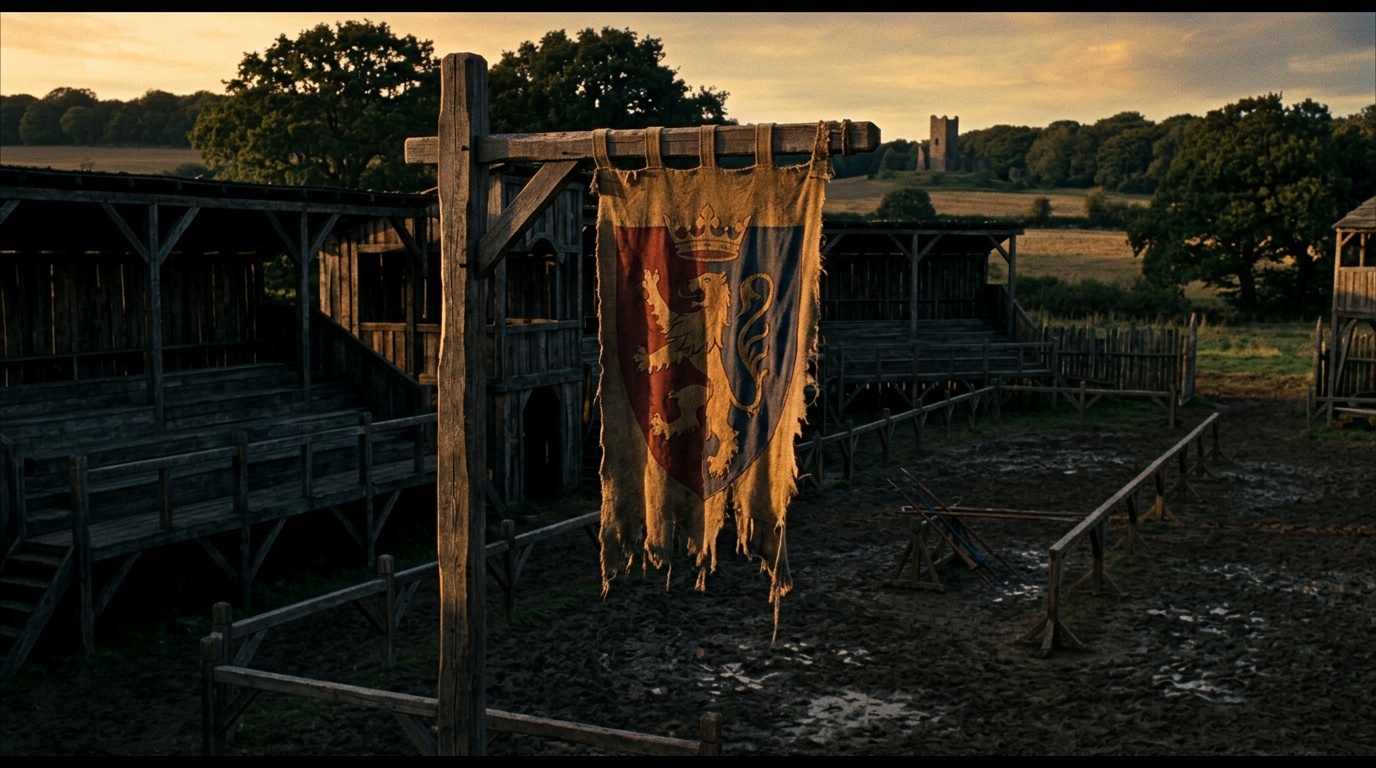
Maekar's Sons Are His Succession Gambit
THE ARGUMENT
Maekar has already lost the succession argument inside the royal family, and the Ashford tournament is his last available move to reverse a judgment that has already been made. His sons are not there to compete in a joust. They are there because Maekar needs Baelor to be publicly wrong about them, and he has no other arena left in which to prove it.
How This Theory Works
The telling detail is not Maekar's anger. It is where the anger lands. When Baelor asks why the princes are even present at Ashford, Maekar does not defend the decision on its merits. He accuses Baelor of implying that Daeron is better suited to riding a whore than a horse. That leap from a procedural question to a sexual insult is not a calculated provocation. It is the response of a man who hears Baelor's skepticism as a long-standing verdict being restated in public, not a fresh opinion being offered. The violence of the accusation reveals the shape of what Maekar believes he is fighting. This is not a new dispute. He arrived at Ashford already losing it.
Baelor's framing confirms how far that verdict has already traveled. He does not question Daeron and Aegon specifically. He groups them with their absent brothers Aerys and Rhaegel, collapsing all of Maekar's sons into a single category of dynastic irrelevance. That grouping carries the full weight of the Crown Prince's position behind it. Maekar receives it as a ranking, not a question, because that is what it is. His defensiveness is not disproportionate. It is scaled exactly to the size of the threat being delivered in a room that was supposed to be private.
The succession gambit reading depends on recognizing that gambits require a position of strength to deploy from. Maekar has none. His public insistence that Daeron will prove himself, issued in front of Baelor and Lord Ashford rather than behind closed doors, is not a confident dynastic assertion. It is a man forcing a confrontation he suspects he will lose because the alternative is accepting the loss without contest. A prince who believed his sons were genuinely competitive would not need to announce it to an audience. The announcement is the tell.
The missing piece is Aegon. Of all Maekar's sons present at Ashford, Aegon is the one who has been kept closest, stripped of his name, dressed as a servant's boy, and positioned where no one at court would think to look. If the succession verdict has already been handed down against Maekar's line, then Aegon's concealment is not simply a father hiding a favorite child from danger. It is the one son Maekar has not yet exposed to the judgment being made about his family. The others are already catalogued and dismissed. Aegon remains outside the accounting. That the concealment requires Aegon to actively evade recognition by his own kin suggests Maekar understands, at some level, that the moment Aegon is seen and placed, the verdict closes around him too. Gwin Ashford's observation that wars have started over less than missing princes is not a warning about what might happen. It describes the logic Maekar is already operating inside. His sons' absence from the tournament grounds is not a lapse of discipline. It is the gambit failing in real time, before the jousting has even begun, and Maekar is the last person at Ashford who cannot afford to see it clearly.
Is this theory convincing?
Key Evidence
Maekar's Explosive Accusation at Baelor
Maekar accuses Baelor of insinuating that Daeron is better suited to riding a whore than a horse, a reaction so disproportionate to a cautious question that it reveals a deeper anxiety about how his sons are perceived within the royal family.
Baelor Questions Princes' Presence
Baelor explicitly wonders why Maekar insisted on bringing his sons to the tournament, noting they have as much place there as their absent brothers Aerys and Rhaegel, framing all of Maekar's sons as unwelcome additions.
Maekar's Public Insistence on Daeron
Maekar declares that Daeron will prove himself at the tournament despite Baelor's skepticism, issuing this statement in front of Lord Ashford and Baelor rather than in private, suggesting it functions as a dynastic assertion rather than parental encouragement.
Missing Sons Raising Stakes
Gwin Ashford whispers to Dunk that Maekar's sons Daeron and Aegon have gone missing and that wars have started over less, establishing that the princes' conduct already carries political consequences that extend beyond their father's disapproval.
Brothers Arguing in Private Study
The confrontation between Baelor and Maekar takes place in Lord Ashford's private study rather than in a public setting, yet its content concerns dynastic worth and succession, suggesting the tension between the brothers runs deep enough to surface even in moments meant for courtesy.
This theory was evaluated using Theory Atlas editorial standards, including evidence review, narrative fit, and competing interpretation analysis. Learn how Theory Atlas evaluates theories →
Other Theories for S1E02

Two Princes, One Kingdom's Soul
Baelor and Aerion are not contrasting personalities but competing philosophies of what royal power is for, and the show is using Dunk as the instrument through which that competition is decided.
Honoring Arlan and Erasing Him Are the Same Act
Dunk is not grieving Ser Arlan so much as constructing him: converting a drunken hedge drifter whom every lord he served has already forgotten into a model of quiet chivalry, because that construction is the only foundation Dunk's claim to knighthood can stand on.
Donnel's Crabber Story Conceals Inherited Wealth
Ser Donnel's self-presentation as a humble crabber's son who rose to the Kingsguard through merit is a deliberately incomplete truth: his family owned half the crabbing fleets in Westeros, meaning wealth cleared the same path for him that highborn blood clears for others.

Aerion's Contempt Signals Dunk's Targaryen Enemy
Aerion Targaryen is not building toward a physical confrontation with Dunk.
Egg Knows Too Much About Blackfyres
Egg's knowledge of Kingsguard personnel and the Blackfyre Rebellion is not compatible with any lowborn or even minor highborn upbringing.