Helaena Is a Reliable Narrator, and That Is Why Both Clauses Must Be Believed
THE ARGUMENT
Helaena's accusation that Aemond burned Aegon at Rook's Rest is not grief or suspicion but a prophetic verdict, and the show has deliberately structured the scene to establish her accuracy before she names the God's Eye as the precise location of Aemond's death. Once the show forces the audience to accept her as a reliable witness through the Rook's Rest confirmation, both the fratricidal past and the death-sentence future become fixed events, not speculation. The wooden throne clause compounds this: Aemond dies at the God's Eye without ever securing the Green victory his fratricide was designed to deliver.
How This Theory Works
The scene between Helaena and Aemond is constructed in a specific sequence, and that sequence is deliberate. Before Helaena names the God's Eye, she tells Aemond she knows he burned Aegon and Sunfyre at Rook's Rest. She does not present this as rumor, inference, or the conclusion of a grief-addled mind. She presents it as witnessed fact. Aemond moves to deny it. She insists she saw it. His denial does not carry. The show stages this exchange first because Rook's Rest is the load-bearing device for everything that follows: Helaena had no ordinary access to what happened in that battle. She was not there. No testimony could carry the specificity of a direct accusation delivered with that authority. The only explanation the show offers is prophetic vision, and by confirming it through Aemond's failed denial, the show is instructing the audience on how to read Helaena. She sees real events. The next real event she names is his death. The God's Eye clause cannot be treated as metaphor once the Rook's Rest clause has been established as literal.
The God's Eye is not an abstract symbol in this context. It is a precise geographic address, and the war has already assigned that geography a specific meaning. Daemon holds Harrenhal, which sits immediately north of the God's Eye, and the Riverlord forces are concentrating there. Every major military mass on the land front is converging on that territory. Aemond, now operating as Prince Regent with no adult authority capable of constraining him, has just destroyed Sharp Point and threatened to kill his own sister in the same scene where she delivers the warning. He is not moving toward strategic patience. He is moving toward a single reckless engagement, and the war has already built the location where that engagement will occur. Helaena is not predicting a vague disaster. She is naming the destination Aemond is already traveling toward.
Helaena's credibility as a prophetic narrator is not accidental. The show has been building it across her appearances through the consistent accuracy of her oblique observations, but this scene marks the first time the show structures an explicit confirmation mechanism within the scene itself. The accusation, the failed denial, and then the death sentence: the sequence forces the audience to carry Rook's Rest as proof when they evaluate the God's Eye. A viewer who accepts the first clause on the evidence the scene provides cannot coherently reject the second on grounds of ambiguity. The show has closed that interpretive exit. Helaena is functioning here not as a grieving character whose words should be weighed against her emotional state, but as a prophetic narrator whose emotional state is itself a consequence of already knowing how this ends. She has been watching Aemond want the throne for years. The vision at Rook's Rest did not reveal a new character to her. It confirmed what she had already read in him.
The wooden throne clause is where the theory sharpens into something more uncomfortable than a death prediction. Helaena does not simply say Aemond will die and the Greens will win. She says Aegon will be king again, but on a wooden throne. Not the Iron Throne. The wooden throne detail is the kind of narrative specificity that distinguishes genuine prophetic vision from wishful thinking or political positioning. Helaena has no investment in this outcome. She is the only character in the Green faction who has already paid the full cost of the war and has nothing left to protect or strategize around. If the wooden throne clause is as reliable as the God's Eye clause, and the scene's construction argues it is, then Aemond's death does not even deliver the thing his fratricide was designed to secure. He burns his brother, seizes the regency, drives the war to its most destructive phase, and dies in the lake; and the result is a diminished Aegon sitting something broken, ruling by temporary or provisional claim rather than restored legitimacy on the seat that defines the victory.
Aemond's threat to kill Helaena crystallizes this dynamic. She tells him it will change nothing. This is not courage and it is not a performance of martyrdom. It is the particular indifference of someone who understands that she is not a variable in the outcome. Killing the witness does not unmake the event the witness has seen. Aemond cannot alter the God's Eye by silencing the person who named it, and Helaena knows this with the same certainty she knows Rook's Rest. His threat is structurally empty, and she tells him so to his face. That she survives the scene is itself part of the argument: the show does not resolve the moment through violence because Helaena has already established that violence against her is irrelevant to the outcome. The accusation has been delivered. The death sentence stands. The wooden throne waits. Aemond walks out of that room already moving toward the lake.
Is this theory convincing?
Key Evidence
Helaena's Direct Accusation to Aemond
Helaena tells Aemond directly that she knows he burned Aegon and let him fall at Rook's Rest, framing it not as suspicion but as witnessed fact.
Aemond's Failure to Deny
When Helaena accuses Aemond of burning Aegon, Aemond attempts to deny it but she insists she saw it, and his denial fails to carry conviction within the scene.
Prophetic Foreknowledge of Rook's Rest
Helaena was not present at the Battle of Rook's Rest, meaning her specific knowledge that Aemond burned Aegon can only be explained by prophetic vision, not testimony or rumor.
Prophecy of Aegon's Restoration
Helaena tells Aemond she has foreseen Aegon retaking the throne, framing his death in the war and Aegon's return as fixed outcomes she has already witnessed.
Wooden Throne Prophecy
Helaena's cryptic statement that Aegon will be king again and sit a wooden throne suggests his return to power will not be a conventional restoration to the Iron Throne.
Aemond's Threat Against Helaena
When Aemond threatens to kill Helaena in a moment of anger, she tells him it will change nothing, suggesting the foreseen outcomes cannot be altered by eliminating the witness.
This theory was evaluated using Theory Atlas editorial standards, including evidence review, narrative fit, and competing interpretation analysis. Learn how Theory Atlas evaluates theories →
Other Theories for S2E08

Alicent's Surrender Is a Confession: She Is Trading Aegon's Life to Protect the One Child She Never Fully Broke
Alicent's secret journey to Dragonstone is not a peace overture but a surrender negotiation in which she offers Rhaenyra a bloodless throne in exchange for her own survival, and accepts Aegon's death as the price without refusal.
The Weirwood Shows Daemon His True Role
The weirwood vision does not persuade Daemon through loyalty or love but through erasure: it shows him a future in which he is structurally absent, and Helaena confirms that absence is his role.
The Green Man Staged Daemon's Vision to Document the Three-Eyed Raven's Emergence
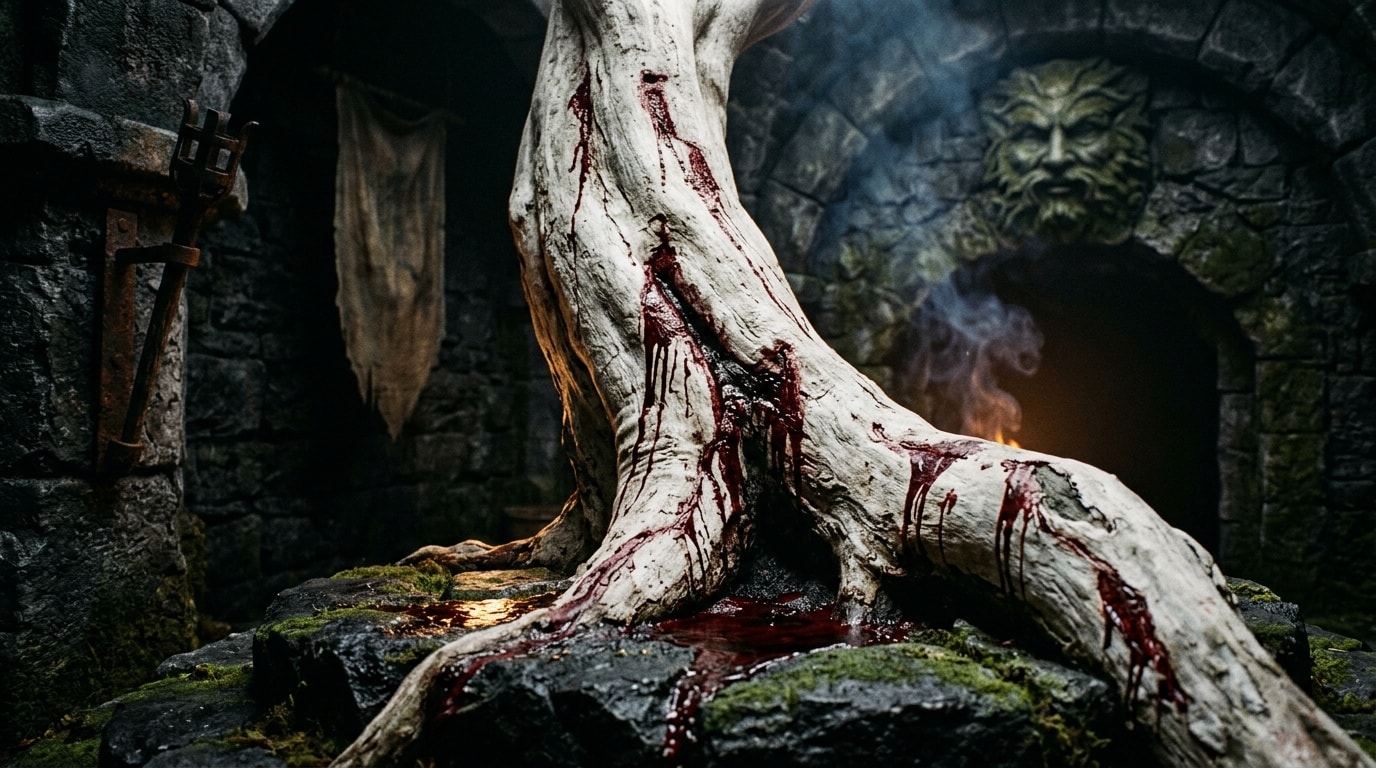
The horned figure that vanishes behind Harrenhal's heart tree immediately before Daemon's vision is a Green Man, an ancient guardian of the weirwood network, whose presence signals that the vision was a managed transmission rather than a passive haunting.

Larys Uses Aegon as His Escape Insurance
Larys Strong is using Aegon as a portable claim to the Iron Throne, a bargaining asset to be held in reserve in Braavos while the war consumes every other player.
Rhaenyra's Strike Will Cost Her the Peace
Rhaenyra's strike on Lannisport and Oldtown will fracture her coalition before it can win the war, because the dissent already on record at her own war council signals that the civilian casualties her dragonriders inflict will delegitimize her claim faster than any military victory can secure it.
Broome Tried to Flip Daemon Against Rhaenyra
Ser Alfred Broome attempted to flip Daemon against Rhaenyra at Harrenhal, and Daemon's decision to reject him privately rather than deliver him to Rhaenyra's custody left the treason alive inside the Black host.
Alicent's Peace Offer Conceals a Trap
Alicent's peace offer is a coordinated delay designed to neutralize Rhaenyra's dragon advantage while the Triarchy fleet and Green armies reach their positions, with the three-day deadline functioning as a military clock rather than a surrender condition.

Aemond's Rage Is Impotence Disguised as Power
Aemond's destruction of Sharp Point is not a military calculation but a psychological confession: turned back at Dragonstone and unable to strike what actually threatens him, he incinerates a defenseless city to restore a self-image that the war has already begun to destroy.