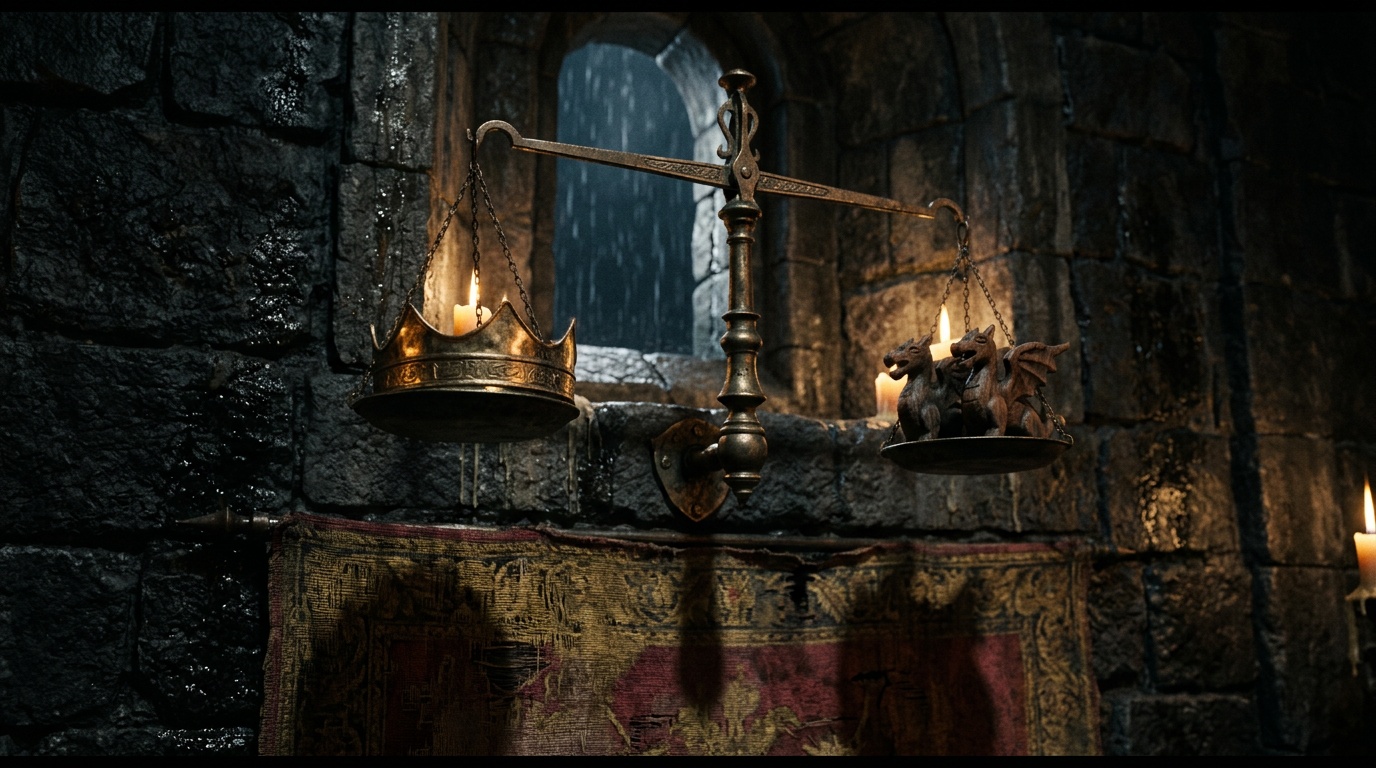
Alicent's Two-Son Operation: How She Weaponized One Child to Sell Another
THE ARGUMENT
Alicent executed a single premeditated strategic operation with two interlocking parts: she weaponized Aemond's emotional dependency on her — a dependency she spent years building — to remove him and Vhagar from King's Landing as the military precondition for surrender, then delivered Aegon to Rhaenyra's justice as the political transaction that would buy survival for herself, Helaena, and Jaehaera. This reframes Alicent not as a mother making terrible choices under pressure but as the war's most calculating agent, one who completed her moral accounting before she ever boarded the boat to Dragonstone and used both sons as instruments in the same prepared operation.
How This Theory Works
Alicent's visit to Dragonstone is the visible transaction, but the theory's real weight sits in what had to happen before it. A deal offering Aegon's life and the Red Keep's gates is worthless if Vhagar is still roosting in King's Landing when Rhaenyra's ships arrive. Aemond would never permit a quiet surrender, and no Rhaenyra loyalist is going to take Aegon from a room that Vhagar can reach in minutes. The military precondition for the deal's survival was Aemond's absence. Alicent knew this before she proposed the deal. Which means the seduction was not a separate act of desperation — it was Part One of the same operation, executed first, in sequence, because nothing else worked without it.
The mechanism she chose to move Aemond was not persuasion or command. It was a dependency she had spent years constructing. Aemond has shown a consistent pattern of seeking validation through maternal figures, and Alicent is that pattern's origin. She did not discover this vulnerability; she built it. What the show renders as incremental physical intimacy — each escalation calibrated to his responses, each moment of closeness reading and adjusting to his emotional state — is not a woman losing control of a situation. It is a woman operating with practiced fluency in a skill she honed across two decades managing Viserys. The asymmetry between them is the tell: he is more invested in the moment than she is. She is performing, and the performance is working exactly as designed. The show draws this parallel explicitly through the grammar of false favor — Alicent tells Aemond he should have been king, that he is her truest son — the same technique the show marks as deliberate manipulation when Alysanne deploys it against Daemon in the Harrenhal vision. Alicent is not expressing love. She is activating an architecture she built and knows with precision how to dismantle.
Once Aemond is dispatched to the Riverlands with Vhagar, Part Two becomes executable. Alicent proposes the deal to Rhaenyra: open the gates, surrender Aegon, and receive safe conduct for herself and the women of her line. The internal logic of the deal then explains every subsequent action she takes that otherwise appears contradictory. She sends a search party for the missing Aegon — not because she wants him safe, but because Rhaenyra cannot claim what cannot be delivered. She needs him found because her own survival is contingent on handing him over. She is not managing grief in those scenes. She is managing inventory. More damning still is the forged letter to Ormund Hightower, instructing the Hightower army to halt its march for three days under a false claim of Aegon's authority. This is sabotage aimed at her own faction, dressed as military coordination. The episode offers no other reason for her to write it. The deal explains it completely: Green reinforcements arriving before Rhaenyra's terms can be honored would make a quiet surrender impossible, so Alicent eliminates that possibility herself. She is running an operation against her own side, and she is doing it with the same methodical precision she used to move Aemond. Both acts are the same act: clearing the board so the transaction can close.
The plan has one structural vulnerability Alicent cannot control, and it is not Aemond or Ormund. It is Rhaenyra. Alicent struck her bargain with a Rhaenyra who wanted a measured victory — a queen taking her seat through negotiation rather than ash. Jacaerys's death at the Gullet gives Rhaenyra a reason to discard those terms entirely and take King's Landing by fire rather than surrender. A grieving mother with dragons is not the counterparty Alicent negotiated with. If Rhaenyra burns the Red Keep rather than accepts its gates, Alicent will have sacrificed one son as a military instrument and arranged the other son's death as a political payment — deliberately, with clear eyes, before any of it began — for terms that no longer exist. The deal failing does not make Alicent a tragic figure caught by events. It makes her a woman who destroyed both relationships permanently, on purpose, for a price that has since evaporated.
Is this theory convincing?
Key Evidence
Alicent's Dragonstone Peace Visit
Alicent traveled to Dragonstone under a banner of peace and proposed opening the Red Keep's gates and surrendering Aegon to Rhaenyra, in exchange for her own safety and that of Helaena and Jaehaera.
Aemond's Departure as Precondition
The deal required Aemond to leave King's Landing on Vhagar to join Criston Cole in the Riverlands, removing the one figure who would have violently blocked Alicent's surrender plan.
Forged Letter to Ormund Hightower
Alicent sent Ormund Hightower a letter falsely claiming Aegon's authority, instructing him to halt his march for three days, buying time against Green reinforcements that would make a quiet surrender impossible.
Alicent's Search for Aegon
Alicent insists that a search party be sent for the missing Aegon, which is consistent with needing him found not to protect him but to deliver him to Rhaenyra as the deal requires.
Aemond Seizing the Throne
When Alicent returned from Dragonstone expecting to execute her plan, she discovered Aemond had already seized the throne in Aegon's absence, immediately disrupting the conditions her deal depended on.
Jacaerys's Death at the Gullet
Rhaenyra's grief over losing Jacaerys creates a credible reason for her to abandon her agreement with Alicent and pursue a destructive rather than negotiated conquest of King's Landing.
Alicent Excluded from Green Power
Both of her surviving sons previously dismissed Alicent from the small council, establishing that she had no path to influence within the Green faction and motivating her to seek terms with Rhaenyra instead.
This theory was evaluated using Theory Atlas editorial standards, including evidence review, narrative fit, and competing interpretation analysis. Learn how Theory Atlas evaluates theories →
Other Theories for S3E01

Aemond Names Himself King, Not Regent
Aemond has declared himself king outright rather than regent, using Aegon's flight from King's Landing as invented legal cover for a throne seizure he has long pursued.
Sheepstealer's Loyalty Ends Where Battle Begins
Sheepstealer has not accepted Rhaena as a rider but as a dependent, which means the bond is structurally incapable of producing combat control regardless of how much time they spend together.
Jace's Treason: Son Supplants Queen
Jace does not believe Rhaenyra is capable of leading the war, and the imprisonment at the Battle of the Gullet is the operational proof: he converted the Queen's Guard into his instrument and removed the queen from command on strategic grounds he judged for himself.

Rhaena Riding Sheepstealer Erases Nettles
By replacing Nettles with Rhaena as Sheepstealer's rider, the show has permanently closed the narrative slot reserved for a dragon bond that Targaryen lineage cannot explain.