
The Arteta Family Is Lumon's Proof of Concept: Capture Looks Like Friendship
THE ARGUMENT
Lumon's relationship with the Arteta family operates simultaneously at the macro level of Angelo's legislative advocacy and the micro level of Gabby's deliberate erasure of Devon, and both registers serve the same institutional function. The birthing cottage is not a wellness benefit but an enrollment mechanism, a site where Lumon builds intimacy it can later leverage, leaving the severed party holding a relationship they cannot read and the captured party holding a liability they must manage. Devon's wrong guess about the name Bradley is not a social awkwardness but an evidentiary record of the gap Lumon designed and the Artetas have agreed to maintain.
How This Theory Works
Lumon does not need political allies who are persuaded. It needs political allies who are compromised. Angelo Arteta's vocal public support for severance legalization is not an independently held position that happens to align with Lumon's interests. It is the return obligation in a transactional relationship secured through his family's access to a Lumon-adjacent institution. The structure this reveals is not influence in the ordinary sense but capture: Lumon extends a benefit, the benefit creates a dependency, and the dependency makes defection costly enough that compliance becomes self-enforcing. Angelo cannot credibly oppose a system his family has accepted benefits from without implicating himself. He is not an ally. He is an asset whose value increases precisely because he cannot exit.
The micro-level evidence for this structure is Devon's park encounter with Gabby, and its most precise exhibit is a single detail: Devon guesses the baby's name is William. The name is Bradley. This is not a social miscalculation or a failure of memory. It is the specific failure mode of someone reasoning from zero information about a conversation she was never part of. Devon's innie was present at the birthing cottage through labor and its aftermath, and would have known the chosen name before anyone outside that room did. The outie who stands in the park has inherited the physical fact of having been somewhere and none of the relational content of what happened there. No name. No intimacy. A stranger where a friend should be, with no framework for understanding why the stranger does not recognize her.
What makes the birthing cottage a more precise instrument than it first appears is that it does not simply partition memory after the fact. It produces a relationship between two innies, a bond formed under the shared extremity of childbirth, that exists entirely below the threshold either outie can access. Lumon does not need to monitor or enforce that gap. The gap monitors itself. Devon's outie cannot claim what her innie experienced. Gabby's outie carries the knowledge of an intimacy she cannot explain and cannot safely acknowledge. The institution created a relationship it can invoke or suppress as needed, and neither party can contest its terms because neither party holds the record.
The more unsettling question the show leaves open is whether Devon's innie was switched on for childbirth by institutional design, or whether Devon entered the birthing cottage already switched with no outie present during the birth of her own child at all. One version means Devon's outie missed a relationship her innie formed incidentally. The other means someone made an explicit structural decision that Devon's outie would not be present for her own labor. The evidence does not eliminate either reading. But both versions expose the same mechanism: severance does not only partition work from life. It partitions the self from the moments that constitute the self, and the birthing cottage is a site purpose-built to accomplish that partition at its most consequential.
Gabby's behavior in the park is not confusion or rudeness. It is compliance, and it is where the macro and micro registers of Lumon's capture converge. When Devon approaches, Gabby sees her, registers her, and turns away. That is avoidance with intent, and the private social media profile extends the same logic: Gabby is not simply a private person but a managed surface. Devon exists at the boundary of Lumon's institutional world, and proximity to that boundary is now a liability the Arteta family has been integrated into policing. When Devon's post-encounter search surfaces Angelo as a leading public voice for severance legalization, the trap closes. Gabby did not turn away out of cruelty or confusion. She turned away as someone who understood exactly what the gap was, who had known Devon's innie through the shared vulnerability of childbirth, and who has publicly committed to preserving the architecture that made that gap permanent. The wave Devon offered was not ignored. It was assessed and declined by someone who has already decided the system that erased what they shared is worth protecting.
The mechanism that makes this durable is the same one visible in how Lumon manages its innies: the institution engineers the conditions under which the subject experiences its constraints as self-chosen. Angelo's advocacy reads as conviction. Gabby's avoidance reads as social awkwardness. Devon's bewilderment reads as her problem to solve. The Arteta family has not been coerced into this arrangement. They have been made to feel that maintaining it is simply what responsible, politically engaged people do. Compliance that feels like values is the more stable form of control, because the subject will defend it without being asked.
Is this theory convincing?
Key Evidence
Gabby's deliberate park avoidance
When Devon approaches Gabby in the park, Gabby sees her and turns away rather than acknowledging the shared birthing cottage experience, indicating intentional avoidance rather than simple non-recognition.
Angelo's pro-severance public record
Devon's online search reveals Angelo Arteta is a prominent figure in the severance legalization debate and a vocal public supporter of the program, establishing a direct link between Gabby's family and Lumon's political interests.
Birthing cottage as shared Lumon-adjacent space
Both Devon and Gabby used the same birthing cottage, which the show has framed as connected to Lumon's sphere of influence, making the Arteta family's presence there more than coincidental.
Gabby's private social media profile
Devon finds that Gabby's social media profile is set to private, reinforcing the pattern of deliberate concealment around her identity and associations.
Angelo reelection and severance support alignment
An article Devon finds connects Angelo's reelection to his support for severance legalization, framing his political platform as inseparable from Lumon's legal standing.
This theory was evaluated using Theory Atlas editorial standards, including evidence review, narrative fit, and competing interpretation analysis. Learn how Theory Atlas evaluates theories →
Other Theories for S1E06
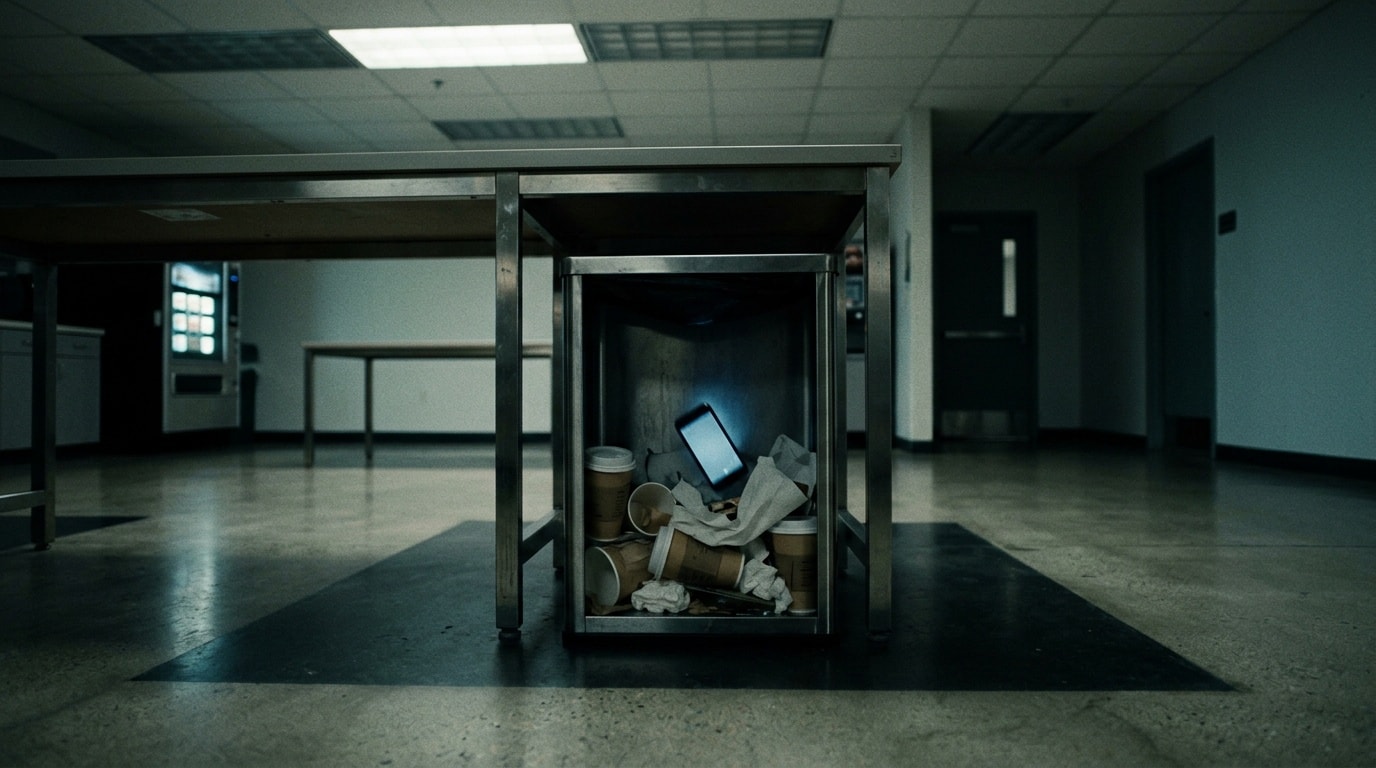
Mark Buries the Evidence to Bury Himself
Mark's outie is as much an obstacle to his own liberation as Lumon is, and the phone disposal proves it: he reviews the missed calls, understands what he is suppressing, and destroys the evidence anyway.
Cobel Serves Kier Before Lumon
Harmony Cobel's obedience to Lumon is conditional on her private judgment that the company remains aligned with Kier's true teachings, making her a theological agent using corporate power rather than a corporate loyalist who happens to be devout.

Mark's Disposal Signals Deliberate Evidence Burial
Mark's disposal of Petey's phone is not evidence destruction but a performance of it: the battery separation, the review of missed calls, and the return to his own curb all indicate someone staging closure while unconsciously ensuring the connection remains traceable.

Lumon Preempts Coordination It Cannot Survive
Lumon's control over its severed employees is not primarily maintained through surveillance and punishment but through designed attention fragmentation: every person with dangerous knowledge is simultaneously obligated to a local, pressing problem that prevents them from pooling that knowledge with anyone else.
Irving's Devotion Accidentally Drives Resistance
Irving's Kier-worship is not a cover for resistance but its accidental engine and its automatic suppressor: he breaches institutional isolation through doctrinal logic and then recants through the same logic, leaving Lumon's control intact.
Kier's Philosophy Condemns Lumon's Own Secrecy
Lumon's leadership did not fail to implement Kier's philosophy of 'illumination beyond all.
Dylan's Son Makes Him Lumon's Leverage
Dylan's innie is now structurally the most dangerous member of MDR, not the most compliant, because Lumon's documented leverage over him and his own radicalization were created by the same witnessed moment.
O&D Is a Conditioning Program With a Leak
Lumon's O&D department is not a manufacturing operation but a physical-conditioning curriculum, and its most portable artifacts, the pictogram cards, are already moving through an active internal smuggling channel financed by an unknown Lumon insider.