Cobel Has Transferred Loyalty to Herself, and Her Help Is the Protocol's Architect Still Calibrating Outcomes
THE ARGUMENT
Cobel has not switched sides from Lumon to Mark — she has switched sides from Lumon to herself, and Mark is only useful to her because she can no longer enter the building. As Cold Harbor's inventor, her cooperation with the rescue is structurally indistinguishable from the protocol's architect managing which version of its completion she prefers. The unresolved question is not whether she has turned against Lumon, but whether she has any intention of letting Mark walk away with what he came for once those two goals stop pointing in the same direction.
How This Theory Works
The sharpest way to read Cobel's arrival at the meeting point is not as a defection from Lumon but as a promotion of herself. When she tells Mark 'we're allies now,' she is not announcing a conversion. She is announcing new terms of employment — her own. The distinction the show has been careful not to press is this: Cobel does not care whether Mark succeeds. She cares whether Lumon loses. Those goals currently overlap, and as long as they do, the alliance is real. But Cobel has spent her career instrumentalizing people she claims to protect, and Mark is not her partner in this operation. He is her mechanism — the only remaining vector of influence she has inside a company she can no longer enter.
Her authorship of Cold Harbor is what makes that mechanism so precise and so dangerous. Cobel did not just defect from a company that runs a disturbing protocol. She defected from a company that runs a protocol she invented, which means every piece of intelligence she offers the rescue — what the file's completion means, what the threshold is, what happens to Gemma if it is crossed — is information she controls at the source. When she tells Mark that a completed Cold Harbor file means Gemma is already dead, she is not delivering a neutral warning from the outside. She is the person who designed that threshold, and her warning is also a demonstration of how much she still holds. Her help does not erase that authorship. It reframes it as a second layer of control, operated from within the architecture she built.
The structural tell is the building access instruction. Cobel insists Mark call Milchick and claim illness, preserving his credibility with Lumon and his ability to re-enter the building the following day. The show frames this as tactical necessity, and at the surface level it is — Mark locked out of Lumon is a rescue that stalls permanently. But it is also the move that keeps Cold Harbor completable on Cobel's terms. If Mark stays functional, the file can still be finished. And if Mark is locked out, Cobel loses her only remaining reach inside the company. Keeping him credible keeps her relevant. A genuine defector who wanted Lumon to fail decisively might expose Mark's insubordination and collapse the operation entirely. Cobel does not make that trade because she is not interested in Lumon's failure as an end in itself. She is interested in being present at Lumon's unraveling on terms she controls. Devon's concession — that the group has no choice but to follow Cobel's lead — confirms the structure Cobel has assembled around the operation. Their dependence on her is total. She sets the conditions.
Her refusal to move before nightfall follows the same logic. Delaying access to the Damona Birthing Retreat is not mere caution. It is Cobel maintaining operational tempo on her own schedule, ensuring that Mark's innie is contacted at a moment Cobel chooses rather than one desperation forces. Combined with her inside knowledge of Cold Harbor's design, her precise framing of what completion means, and her management of every access point the rescue depends on, this is not the behavior of someone who has aligned her interests with Mark's. It is the behavior of someone who has decided, in advance, how much information to release and when — which is exactly what the protocol's architect would do.
What the show has not yet shown is what Cobel stands to lose if Gemma survives. That is the only question that determines whose side she is actually on, and it is the question Cobel's position allows her to defer indefinitely. As long as saving Gemma and damaging Lumon point toward the same outcome, her cooperation is genuine enough to be useful and ambiguous enough to be lethal. The moment those trajectories separate — the moment Gemma's survival requires something that costs Cobel her relevance, her leverage, or her control over how the story of Cold Harbor gets told — Cobel holds the lever. It does not matter, on her terms, whether Mark walks away with Gemma. It only matters that Lumon loses. And Cobel, as the protocol's architect, is the one person in this alliance who can decide what losing looks like.
Is this theory convincing?
Key Evidence
Cobel Declares Mark Her Ally
When Cobel arrives at the meeting place, she tells Mark directly that they are allies now, which is the show's clearest on-screen articulation of her allegiance shift away from Lumon.
Cobel Protects Mark's Building Access
Cobel instructs Mark to call Milchick and claim illness so that Milchick does not lock him out of the building, a move that actively serves Mark's rescue mission rather than Lumon's interest in completing Cold Harbor.
Cobel Withholds the Birthing Cabin Location
Cobel refuses to take Mark and Devon to the birthing cabin until nightfall, citing peril, which frames her as an operational planner managing a real extraction risk rather than an informant running a controlled meeting.
Cold Harbor Completion as Gemma's Death
Cobel reveals that if Mark's innie has already completed the Cold Harbor file, Gemma is already dead, positioning Cobel as someone with inside knowledge of Lumon's program who is now using that knowledge against the company.
Cobel No Longer Enters the Building
Cobel's inability to enter Lumon herself means her only path to influence inside the company now runs through Mark, which structurally aligns her interests with his success rather than Lumon's.
This theory was evaluated using Theory Atlas editorial standards, including evidence review, narrative fit, and competing interpretation analysis. Learn how Theory Atlas evaluates theories →
Other Theories for S2E09
Outie Dylan's Threat Erases His Innie's Only Life
Outie Dylan's resignation is an act of self-protective erasure driven by his inability to tolerate proof of his own deterioration, and the severance system is designed to let him commit it without experiencing it as harm to anyone.

Burt Severed to Buy His Own Innocence
Burt chose severance as a private act of conscience management, using the procedure to manufacture a version of himself clean enough to love and be loved.

Dylan Chose Oblivion Over an Empty Existence
Dylan's innie resigned not because his outie forced him to but because he had privately concluded that existence without Gretchen was not worth sustaining, making his departure the first act of deliberate self-termination an innie has chosen rather than had imposed.
Burt Was the Driver Who Let Irving Go
Burt has been functioning as a Lumon operative whose role is to transport people to outcomes he does not acknowledge, and his decision to put Irving on a train was not a defection but a managed exit Lumon may have designed from the start.
Smashing the Toy Destroys Miss Huang's Childhood
The ring toss ritual is not an isolated moment of cruelty.
Helly Knows She Is Helena Eagan
Helly has already concluded she is Helena Eagan and has been performing innie ignorance while holding that knowledge.

Lumon Used Gretchen to Kill Irving's Message
Lumon deployed Dylan's relationship with Gretchen as a precision instrument to neutralize Irving's map before Dylan could act on it.
Helly Inherits Irving's Secret Investigation
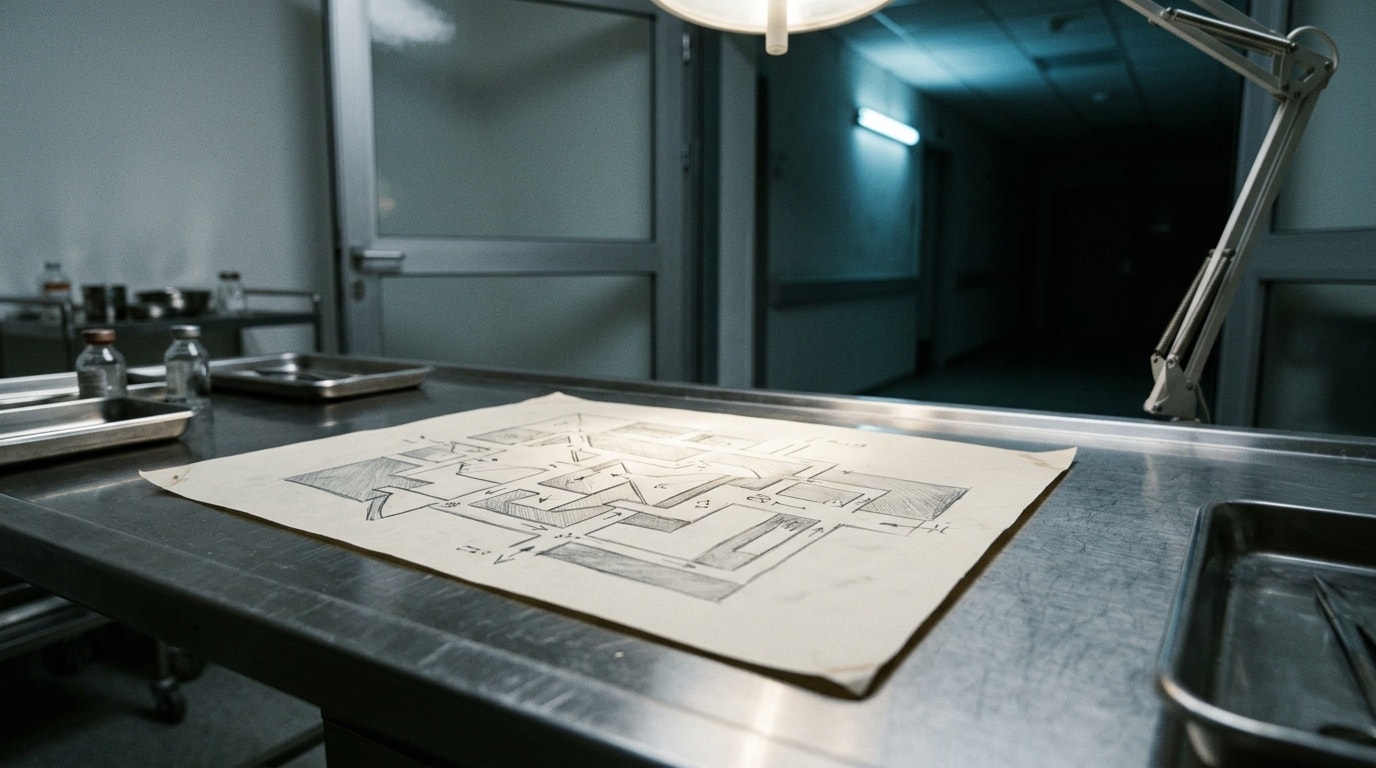
Helly is not preserving Irving's map as a memorial gesture.