The Poisoning and the Apartment Attack Are Two Phases of One Operation — and Marnes Is the Unresolved Mistake
THE ARGUMENT
The poisoning of Mayor Jahns was designed to eliminate both Jahns and Marnes simultaneously, using insider knowledge of upper-tier customs to make the method invisible. Marnes' survival is the conspiracy's one operational failure, and every subsequent move — the Billings offer, the apartment attack — is the same apparatus trying to finish what it started. Marnes is not investigating the system; he is the system's one unresolved mistake, using the system's own tools to find it.
How This Theory Works
Marnes does not yet understand that he was always the primary target. The choice to poison Jahns' water bottle is not the signature of a Mids criminal or an opportunist. It is the signature of someone embedded in upper-tier silo culture, because Marnes himself establishes the operational logic directly: porters and officials in positions of authority share water bottles, and anyone who knew that would know the poison would reach both of them. A petty criminal does not have that cultural intelligence. A member of the upper structure does. The killer was not trying to murder a mayor. They were trying to eliminate a partnership, and Marnes walking away from that trip is the conspiracy's one unresolved variable — an error the apparatus has been actively correcting ever since.
The political pressure came first, and its sequencing is the argument. Robert Sims does not arrive at Marnes' apartment after the investigation is already dangerous. He arrives the moment it becomes possible. Within hours of Juliette and Marnes formalizing their partnership — agreeing that Jahns' death and George Wilkins' death are connected threads that must be pulled together — Sims visits Marnes privately to propose installing Paul Billings as Sheriff. The offer is framed as administrative convenience. It is a burial. Juliette's removal kills the Wilkins thread. Marnes' compliance kills the Jahns thread. Both inquiries disappear inside a routine personnel change, and no coercion needs to be visible. Sims is offering this deal to the man the operation already tried to kill, which means he knows Marnes is the surviving target, and he is giving him one last institutional exit before the next phase begins.
When Marnes refuses, the transition is seamless. A system that can move from a forged personnel offer to a loaded gun in a single evening does not improvise. It has infrastructure. The intruder is already inside Marnes' apartment when he returns — not arriving after him, waiting for him — which means someone with real-time knowledge of his movements, his state, and his schedule placed that attacker there before Marnes came home. Operational speed at that level is not a crime at the margins. It is the system functioning as designed, and the design has been tested before. Sims also controls the investigative apparatus Marnes would use to find any of this: the list of Mids suspects, the channels through Judge Meadows, the brokered deals that pass through him first. The fox is not adjacent to the investigation. He is the investigation, which means every resource Marnes deploys to find the killer runs through the structure that is still actively trying to finish what it started.
The attacker's staging of the scene is the most structurally significant detail the show has produced. Marnes is positioned at the barrel of his own shotgun — the weapon he retrieved earlier in the episode precisely because he understood the danger — in a configuration that reads, in the silo's cultural grammar, as grief made terminal. A man who could not survive losing Jahns. The Pact. The investigation closes before it opens, and the official story writes itself without requiring a single fabricated document or a single visible lie. That this specific staging was prepared, rather than improvised, means the people who designed this kill did not merely acquire the capacity for violence. They acquired control over the interpretive framework that surrounds violence. The silo's grief rituals, its suicide mythology, its cultural silences around the Pact — these were not corrupted into instruments of suppression. They were built to function as instruments of suppression from the beginning, so that sanctioned murders would be permanently invisible inside legitimate sorrow.
Marnes is using the system's own tools — its investigative offices, its informants, its institutional authority — to locate the people who built those tools for this purpose. That is the operational irony the show is constructing. He is not a reformer attacking a corrupt institution from outside. He is the institution's one unresolved mistake, moving through its corridors with its own credentials, looking for the architecture that was designed to make him disappear. His survival after the poisoning, after the Billings offer, and now after the apartment attack is not luck. It is an accumulating problem. And the upper tier's willingness to escalate through three distinct instruments — poison, bureaucratic coercion, physical violence — in a compressed window suggests the problem is approaching the point where a fourth instrument will be required.
Is this theory convincing?
Key Evidence
Porter water-sharing as insider knowledge
Marnes explicitly notes that porters and people in positions of authority drink from their partner's water bottle, meaning the killer's choice to poison Jahns' bottle demonstrates knowledge of internal silo customs that a petty criminal from the Mids would not possess.
Sims offers Billings deal to Marnes
Directly after Juliette and Marnes form their investigative partnership, Sims visits Marnes privately to propose that Judge Meadows is ready to install Paul Billings as Sheriff if both Marnes and Bernard sign off, a move that would terminate Juliette's investigation into Wilkins and, by extension, the Mayor's death.
Juliette and Marnes' joint investigation pact
Over coffee, Juliette and Marnes strike an explicit deal: he helps her find who killed George Wilkins, she helps him find who murdered Mayor Jahns, treating both deaths as related threads worth pulling together.
Marnes attacked in his own home
The episode ends with Marnes facing a shotgun in his own apartment, confirming that whoever is behind the Mayor's death views him as a continuing threat rather than a grieving bystander.
Sims controls access to suspects list
Sims offers to provide Marnes a list of criminals in the Mids who might have cause to harm him, positioning himself as the gatekeeper of information in the very investigation he may have reason to obstruct.
This theory was evaluated using Theory Atlas editorial standards, including evidence review, narrative fit, and competing interpretation analysis. Learn how Theory Atlas evaluates theories →
Other Theories for S1E04
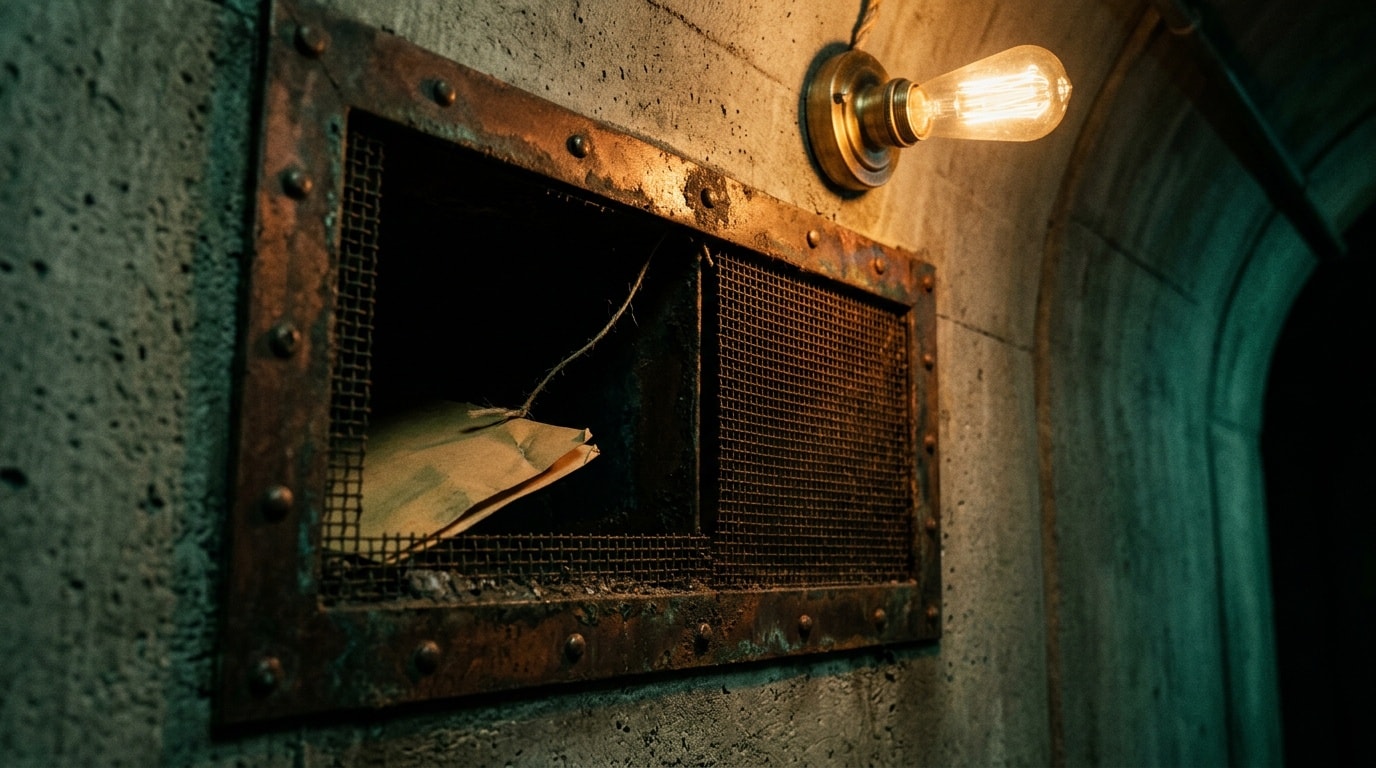
Holston Buried the Truth in the Vents
Holston Becker hid George Wilkins' case file inside the air vent of the Sheriff's apartment before walking to his death, using a string mechanism to ensure his successor would eventually find it.

Holston's Clues Point to Hidden Evidence
Holston Becker built a deliberate information chain for his successor: a note directing Juliette to George Wilkins' file hidden in the Sheriff's apartment vent, and a hard drive whose absence from Recycling suggests either a second hidden cache or active interception.

Grief Drove Juliette Down to Mechanical
Juliette's escape to Mechanical as a teenager was not simply a career choice but a deliberate flight from grief and a fractured relationship with her father, whom she blamed for the deaths of her mother and brother Jacob.

The Relic Martha Repairs Holds Dangerous Answers
Martha Walker will be intercepted with an operational forbidden recording device before Juliette can reach her, because the passive surveillance already monitoring their communication gives authorities a pretext that requires no knowledge of the device's contents.