Iran's Dirty Bomb Built the Silos
THE ARGUMENT
The dirty bomb attributed to Iran was not the event that made the silos necessary. It was the event that made them possible, providing the political emergency required to seal a construction program that had already been decided. The Washington D.C. flashback is not showing us how the catastrophe began. It is showing us how the cover story was managed.
How This Theory Works
The silo system required an enemy. Without a foreign threat and a radiological crisis, no government authorizes the construction of underground cities and no civilian population accepts being selected, sorted, and sealed inside them. The Iran dirty bomb provided exactly that enemy, and the D.C. flashback places us inside the political moment when that framing was being stress-tested against public opinion. Helen's question about retaliation is not an act of civic engagement. It is a measure of how far the narrative had already traveled through the population, and whether it had traveled far enough.
The environmental details in that scene are doing more work than atmosphere. A bar conducts radiation checks at the entrance. A magazine sits in frame with suited figures labeled 'The New Normal.' These details establish that the detonation had already occurred before Helen and the congressman speak, which means the scene is not about whether to respond to a crisis. It is about managing the aftermath of one that has already been framed for public consumption. The congressman's question about whether Helen personally knew anyone affected is not empathy. It is calibration. He is checking how emotionally activated the civilian population already is, and whether the threat still needs amplification or has done sufficient work on its own.
The congressman's background in the engineer corps is the detail that pulls this out of conspiracy and into structural logic. Engineer corps officers do not accumulate congressional seats through political talent. They move into legislative bodies because someone needs a technical hand that can authorize construction budgets without requiring explanation of what is being built or for whom. His district is Georgia's 15th. The silo contains a book titled 'Amazing Adventures in Georgia.' That connection is too specific to be decoration. If this man had knowledge of the silo program before the dirty bomb detonated, then the sequence of events inverts entirely. The silos were not built because Iran attacked. Iran's attack was the rationale used to close the window on anyone who might have asked where the construction budget was going.
What the show has not confirmed, and what the evidence is pointing toward, is that the congressman is not a witness to the crisis. He is one of its architects. The dirty bomb served a dual function for whoever built the silos: it created the emergency that demanded underground infrastructure, and it created a foreign enemy that absorbed all available public outrage and redirected it away from the program itself. Helen's skepticism about the 'supposed' Iranian attack is the most uncomfortable detail in the scene. It means the attribution was already contested in the pre-silo world. Someone in that bar knew the story was contested and chose to be there anyway, and one of them is in Congress with an engineer corps background and a district that left artifacts inside the silo.
The silos were not a response to what Iran did. They were the plan that Iran's attack, real or manufactured, finally made undeniable. And if that is true, the operational logic inside the silos becomes legible in a different way. The controls on memory and history, the management of rebellion, the ruling class that privately hedges while publicly enforcing the official line: none of this is emergency hardening. It is the original architecture, carried forward by people who inherited the deception without inheriting the certainty of those who built it. The founders needed a crisis to seal the doors. Their successors need a different kind of management to keep them sealed. The cover story that made the silos possible is still running, just at a different altitude.
Is this theory convincing?
Key Evidence
Helen Questions Congressman on Retaliation
In the Washington D.C. flashback, a woman named Helen directly questions a new congressman about whether the United States plans to retaliate against Iran for supposedly detonating a dirty bomb on American soil.
Radiation Checks at Bar Entrance
The bar setting in the D.C. flashback scene shows radiation checks being conducted at the entrance, establishing that a radiological event had already occurred in the world above ground before the silo system was constructed.
The New Normal Magazine Cover
A magazine visible in the flashback scene depicts suited figures with the label 'The New Normal,' visually confirming that radiation exposure had already become an ambient feature of pre-silo life.
Congressman's Personal Question to Helen
The congressman asks Helen whether she personally knew anyone affected by the dirty bomb attack, a question that signals both emotional weight and insider knowledge, suggesting he understands the scale of what has already happened.
Congressman's Engineer Corps Background
The congressman is identified as having a background in the engineer corps and representing Georgia's 15th district, details that connect him inferentially to the technical and geographic specifics of silo construction.
Georgia Geographic Echo in the Silo
A book titled 'Amazing Adventures in Georgia' has been noted among silo relics, creating a pattern connection between the congressman's Georgia district and artifacts preserved inside the silo system.
Scene Framed as Pre-Silo Flashback
The Washington D.C. setting, period visual details, and the nature of the conversation collectively frame this scene as occurring before the silos were sealed, positioning it as the show's first direct depiction of the historical origin moment.
This theory was evaluated using Theory Atlas editorial standards, including evidence review, narrative fit, and competing interpretation analysis. Learn how Theory Atlas evaluates theories →
Other Theories for S2E10
Pete's Sacrifice Permanently Splits the Silo
Pete Nichols did not destroy three levels of stairs to win a battle.
Bernard's Surrender Was Psychological Collapse, Not Calculation
Bernard's transfer of the vault key and its code to Sims is psychological collapse disguised as institutional handover: a man who built his identity around managing the silo discovering, through Lukas's disclosure, that the system he served was structured against the survival he thought he was protecting.
The Duck Dispenser Traces the Silo's Founders
Helen carried the rubber duck Pez dispenser into Silo 18 at its founding, making her a direct link between the silo's creators and the rebellion Juliette now leads.
The Silos Are Secretly Connected Below
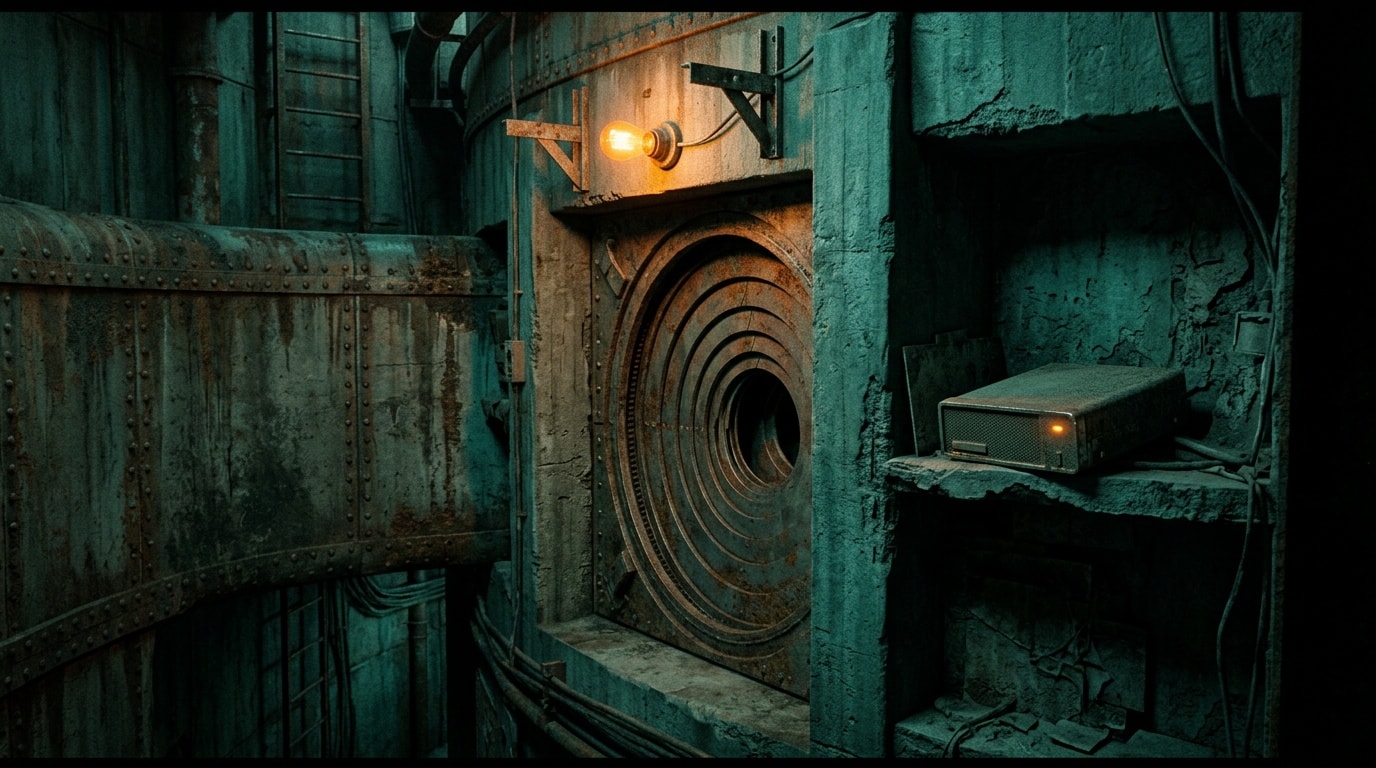
The steel door George discovered at the silo's base, documented in hard drive blueprints before anyone in Silo 18 could explain its purpose, points to designed inter-silo infrastructure that the governing structure has suppressed rather than sealed.
Bernard Walks Out of the Fire
Bernard survived the incinerator, and the show's deliberate refusal to confirm his death on screen is a structural commitment to his return in season 3.