Bernard's Ignorance Is Load-Bearing: How the Silo's Master of Information Governs by Not Knowing
THE ARGUMENT
Bernard does not merely control what others know — he has structured his own ignorance as a precondition for authority, deliberately insulating himself from the full truth of the systems he governs. The same epistemic architecture he deploys to shape Lukas Kyle has already been deployed on Bernard by the silo itself, making him not a puppet master who happens to be uninformed, but a man whose capacity to believe in his own authority depends on never fully testing it.
How This Theory Works
Bernard's power has always looked like information control, but the harder claim is that it runs in both directions. He does not examine Juliette's hard drive himself. He assigns Lukas to it. The standard reading treats this as delegation — Bernard trusting a capable subordinate. The more precise reading is that delegation is Bernard's primary instrument of self-insulation. By routing the discovery through Lukas, he preserves deniability not from institutional rivals but from himself. When Lukas decodes the external power connections and the cross-silo infrastructure encoded on the drive, Bernard's visible response is not the controlled confirmation of a man releasing information he already held. It registers as encounter. That distinction matters enormously. A head of IT managing a deliberate secret relaxes when his agent reports back on schedule. A man confronting the edge of his own architecture does not.
This is what makes the Lukas recruitment the central piece of evidence rather than a parallel story. Bernard selects Lukas with documented precision: he cites Lukas's independent reconstruction of astronomical science, his willingness to work toward hidden truths without being directed toward them. He explicitly passes over Sims, who is already legible — already maneuvering, already performing ambition Bernard can read at a glance. A Shadow built from someone who sees the appointment coming is a liability because that person has a map of the transaction. Lukas, intellectually isolated and not yet fluent in IT's actual stakes, is valuable because he can be shaped before he understands the shape being imposed. Bernard needs a mind capable of reasoning its way toward the silo's hidden logic, because only that kind of mind will eventually choose to protect those secrets rather than merely obey an instruction to do so. A Shadow who has arrived at institutional loyalty through his own reasoning requires no further management. He has, in Bernard's framework, coerced himself.
But the architecture Bernard builds for Lukas is a mirror of something that was already built for Bernard. The commuted sentence is the first link in a dependency chain, yes — but the hard drive assignment is also, functionally, Bernard's own first link in a chain he did not construct. If IT operates on independent external power, if cross-silo connections exist that bypass the authority structures Bernard believed he controlled, then the leverage he thought he held over Mechanical and the conflict he was managing had stakes he never fully grasped. He was not running the board. The board was larger than he knew, and the players who built it had reasons to ensure that the man administering IT's day-to-day authority would find it easier, more functional, more psychologically sustainable to not look at certain things directly. Bernard drew the boundary around his own knowledge, but he drew it where the system had already prepared the line.
The hard drive is the hinge that locks both readings together. It is the object through which Bernard simultaneously deploys managed ignorance on Lukas and discovers he has been subject to the same management himself. Salvador Quinn's coded letter to his wife — recovered from a drive that survived official destruction — represents precisely the kind of layered information that silo leadership, in the ordinary chain of succession, would never access. It did not survive by accident. It survived inside an architecture that predates Bernard, that was not designed for him to find, and that his own governing instinct led him to route through a subordinate rather than encounter directly. The letter is evidence that the silo's epistemic structure has always been recursive: secrets embedded in secrets, accessible only to those who reason toward them without being handed a map. Bernard built Lukas to be that kind of reasoner. He did not build himself to be one, because being one would have required him to hold knowledge he could not act on without consequences he was not willing to face.
This is the distinction the theory requires holding without collapsing: Bernard is not simply ignorant, and he is not simply a deceiver. He is a man who has made ignorance into a governing philosophy and applied it so consistently that it became the condition of his own belief in his authority. The silo's actual infrastructure exceeds what he controls, and he could have known this. He chose the boundary that let him govern as though it did not. That choice was not passive self-deception. It was the same deliberate, architectural move he is now making with Lukas — building a relationship to knowledge that produces functional loyalty rather than paralyzing clarity. The recursion is not ironic. It is structural. The system reproduces itself through exactly the people who believe they are running it.
Is this theory convincing?
Key Evidence
Soft Duty Offer for Hard Drive Work
Bernard explicitly offers to commute Lukas's hard labor sentence to soft duty in exchange for rebuilding the data on Juliette's destroyed hard drive, framing the assignment as a conditional reward.
Bernard Cites Lukas's Intellectual Aptitude
Bernard tells Lukas he is being chosen because he figured out the science of astrology and was independently working on concepts similar to those on the hard drive, indicating Bernard has evaluated Lukas as a specific intellectual asset.
Sims Denied Shadow Role
Bernard explicitly refuses to make Sims his Shadow despite Sims's maneuvering, instead appointing him Judge, which leaves the Shadow position functionally open and creates narrative space for a successor.
Hard Drive Reveals Silo's Hidden Secrets
The recovered hard drive contains hidden connections between silos and a coded letter from Salvador Quinn to his wife, meaning Lukas is now exposed to information that Bernard could use as both a test of loyalty and a lever of control.
Lukas's Vulnerability as Leverage
With Lukas facing hard labor as punishment, Bernard's offer creates a dependency relationship that mirrors the kind of institutional leverage typically used to bind a Shadow to IT leadership.
This theory was evaluated using Theory Atlas editorial standards, including evidence review, narrative fit, and competing interpretation analysis. Learn how Theory Atlas evaluates theories →
Other Theories for S2E05
Camille Sims Runs Her Own Shadow Game
Camille Sims has quietly taken over her household's political strategy because she has concluded Robert cannot execute it himself.
Hidden Maps Reveal Silos Are Connected
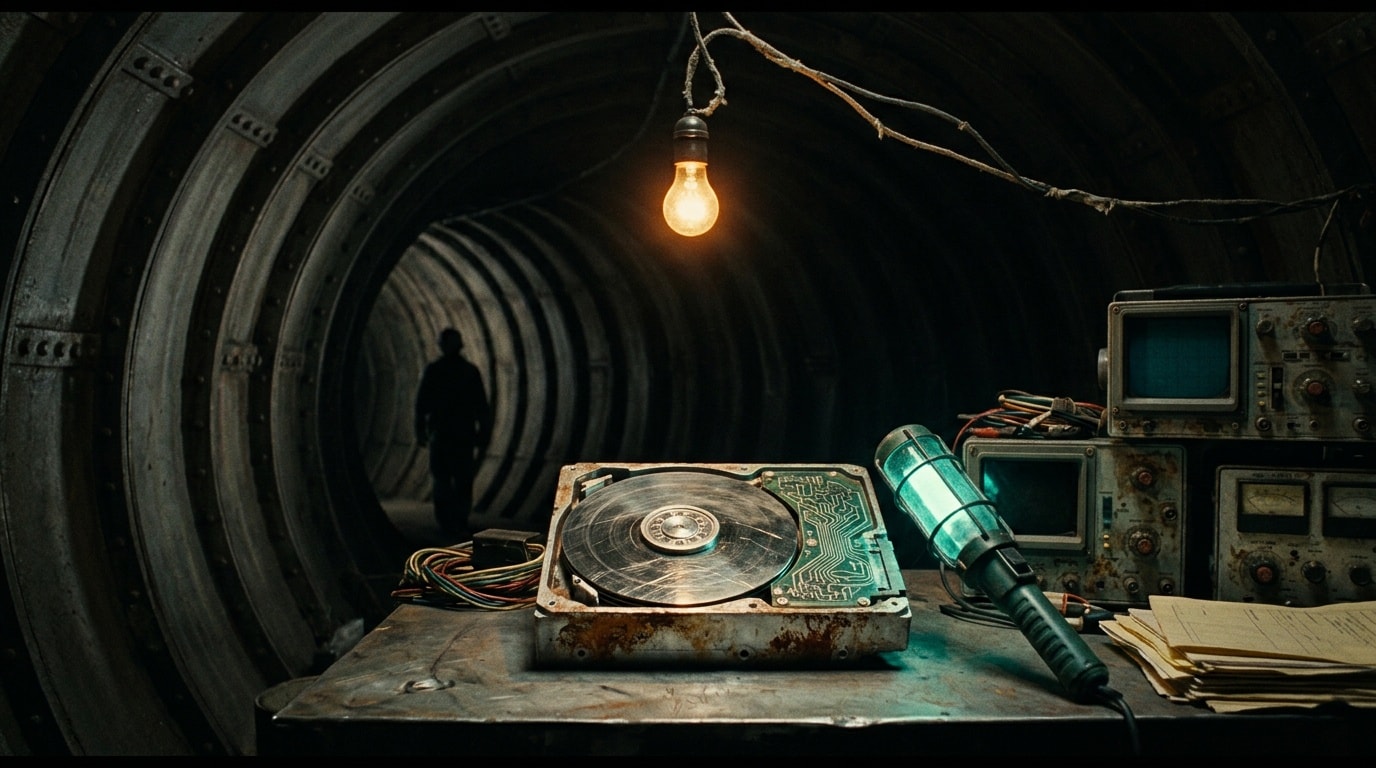
The hard drive Lukas repairs for Bernard contains schematics showing tunnels and power lines extending from Silo 18 at multiple levels, suggesting the silos are physically linked to each other or to an external control structure.
Bernard's Authority Was Always Coercion Without Comprehension — and the Architecture Is Collapsing
Bernard Holland has never governed Silo 18 through genuine authority; he has governed it through institutional coercion applied to people he cannot accurately read.
Billings Edges Toward the Rebellion
Billings has not edged toward the rebellion -- he crossed into it at the level of decision-making the moment he chose to hear Patrick out rather than arrest him, and has since been managing how long he can sustain the surface of compliance.

The Silo Rewrote Romeo and Juliet's Ending
The silo authorities distributed different edited versions of Romeo and Juliet to different silo populations, removing the suicide pact ending in at least one version, and designed the distribution asymmetrically so that the censorship would remain undetectable without cross-silo contact.
Juliette's Old Wound Finally Catches Up
Juliette's infected arm wound is about to make Solo's leverage inescapable: if he controls the medical supplies she needs to survive, the pump repair she has refused becomes the price of getting home.
Bernard Tests Nichols, But Nichols Is Already Gone
Pete Nichols had committed to an irreversible course before Bernard's recruitment pitch began, and the implant removal is the proof.