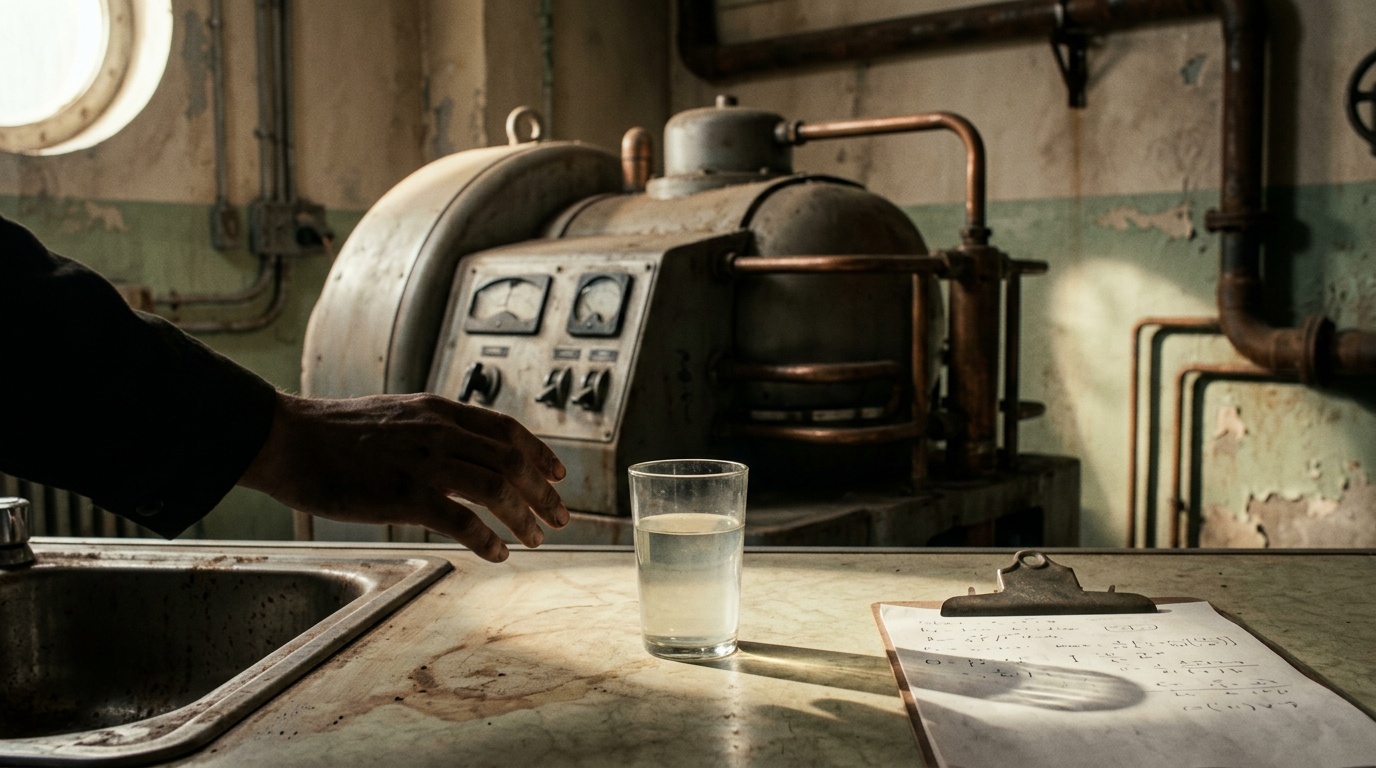
Lucy Is Already on the Ghoul Path
THE ARGUMENT
Lucy is not in danger of becoming the Ghoul in a metaphorical sense; she is already in the early stages of the same physiological process he underwent, and her inability to stop herself from drinking irradiated water is the first clinical sign. Her closing declaration that she will never be like him repeats the exact category of moral confidence that Roger and Martha held before ferality stripped it away. The show is not staging a question about her character; it is staging dramatic irony about her body.
How This Theory Works
The Ghoul does not say Lucy will become cruel or pragmatic. He says she will become him, and that is a physiological claim before it is a philosophical one. When Lucy drinks irradiated water from a contaminated trough not under duress but because her body overrides her principles, the Ghoul is not enjoying a moral compromise. He is recognizing a symptom in someone whose transformation has already started.
The episode's treatment of ghoulification makes the biological reading harder to dismiss. Roger has been staving off full ferality for twenty-eight years using the same chemical vials the Ghoul depends on. The vials are not a cure for an exotic condition; they are a maintenance regimen for something that happens to humans over time in the wasteland. Martha repeated her own name as her identity dissolved. The show frames both as people losing a battle of attrition. Lucy is a person who has just stepped into that same environment and already cannot stop drinking irradiated water when she is thirsty enough.
Her final line, 'I may end up looking like you. I'll never be like you,' is the sharpest evidence the theory has. She concedes the physical transformation is possible. She draws the line at the moral one. But the moral and physical processes are not separable: the Ghoul's callousness is downstream of survival at any cost, which is downstream of needing the vials, which is downstream of what the wasteland does to a body over time. The distinction Lucy draws is precisely the distinction Roger and Martha once believed they could hold. The show has already shown what happened to them. Lucy is not choosing between two futures. She is restating a promise the narrative has already set up to break.
Is this theory convincing?
Key Evidence
The Ghoul's Direct Transformation Claim
When Lucy asks 'What are you?', the Ghoul responds 'I'm you, sweetie. You just give it a little time,' framing himself not as an aberration but as Lucy's probable future state.
Lucy Drinks Irradiated Water
Despite her Pip-Boy confirming the trough water is irradiated, Lucy cannot stop herself from drinking, and the Ghoul watches with visible pleasure, treating it as confirmation of a process already underway.
Lucy's Conditional Denial
At the episode's end, Lucy tells the Ghoul 'I may end up looking like you. I'll never be like you,' explicitly acknowledging physical transformation as a real possibility while only contesting the moral dimension.
Roger's Twenty-Eight Year Decline
Roger tells Lucy and the Ghoul he has been showing signs of going feral for twenty-eight years, establishing that ghoulification is a slow, chemical process that long-term wasteland exposure accelerates.
Martha's Identity Dissolution
The ghoul Martha repeats 'My name is Martha' as she loses coherence, mirroring Roger's earlier 'My name is Roger,' showing that ferality is a gradual erosion of self rather than a sudden state change.
Vials as Physiological Maintenance
The Ghoul's dependence on chemical vials to stay rational, established in prior episodes and confirmed here, frames ghoulification as an active biological process requiring continuous suppression, not a fixed categorical state.
This theory was evaluated using Theory Atlas editorial standards, including evidence review, narrative fit, and competing interpretation analysis. Learn how Theory Atlas evaluates theories →
Other Theories for S1E04
Vault 32's Collapse Was Phase One — Vault 33 Is Phase Two
Vault 32's population discovered the nature of the experiment being run on them, destroyed themselves from within, and had been dead for roughly two years before the raiders from Vault 33 ever arrived.
Rose MacLean Let the Raiders In
Rose MacLean opened Vault 32 from the outside using her own registered Pip-Boy, directly enabling or completing the massacre that killed its population two years before the raid on Vault 33.
The Ghoul Is Not Lucy's Antagonist — He Is Her Most Accurate Narrator
Lucy is not losing her principles under wasteland pressure.
The Vials Are a Supply Chain, Not a Cure — and the Ghoul Is Managing His Own Ferality the Same Way He Managed Roger's
The vials that keep ghouls human do not treat feralization as a medical condition but sustain a chemical dependency that the vials themselves create, making every human-presenting ghoul an active user managing supply rather than a survivor managing illness.
The Ghoul Is Engineering Lucy's Transformation
The Ghoul is engineering Lucy's psychological transformation not as cruelty or instruction but as a compulsive attempt to re-witness his own collapse from the outside, using her as a mirror for a process he cannot otherwise examine.

The Ghoul Knows the MacLean Name
The Ghoul's visible break in composure at hearing Lucy's surname is recognition, not surprise, and it positions their pairing as a reunion between his buried pre-war history and her unknowing inheritance of it.