Vault 32's Collapse Was Phase One — Vault 33 Is Phase Two
THE ARGUMENT
Vault 32's population discovered the nature of the experiment being run on them, destroyed themselves from within, and had been dead for roughly two years before the raiders from Vault 33 ever arrived. Those raiders entered with foreknowledge of Vault 32's vacancy that could only have come from an experiment operator with real-time oversight of both vaults. The active block on Vault 32's records inside Vault 33's own terminal system is the evidence that Vault 33's administration is not an innocent neighbor but a witting participant in whatever comes next.
How This Theory Works
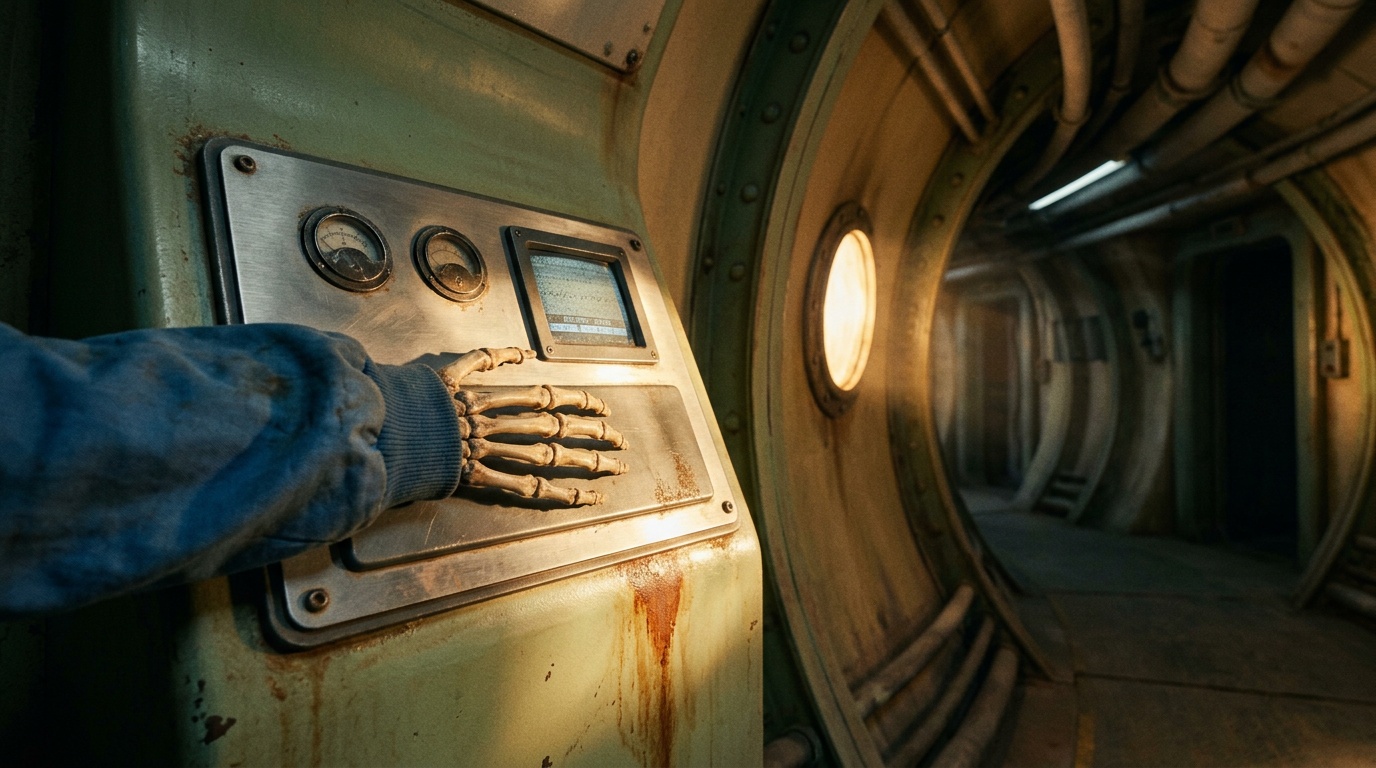
The physical evidence in Vault 32 establishes a precise sequence. The Pip-Boy biosignal on one of the corpses places the last death approximately two years before the raiders from Vault 33 arrived. The causes of death — strangulation, suicide, apparent mutual violence — contain nothing consistent with an external military assault. The vault destroyed itself, and it did so with a specific, articulable understanding of why. 'WE KNOW THE TRUTH' written in blood on the wall is not a distress signal. It is a declaration of comprehension, a statement that distinguishes between what the vault claimed to be and what it actually was. Read alongside 'DEATH TO MANAGEMENT' sprayed above the overseer's bound corpse, the two messages form a coherent arc: the population identified the nature of their situation, directed their rage upward at the person administering it, and then turned inward. The overseer tied to his chair was not a casualty of chaos. He was the local face of whoever was watching from outside, and his residents knew it.
The television looping a documentary about overcrowded mice is the experiment's most uncomfortable artifact. The parallel is structural and undeniable — a sealed population that exhausts its environment turns on itself — but the show has not resolved whether that program was planted by vault management as an observational instrument, or whether the residents found it, recognized themselves in it, and used it to articulate what they had already concluded. Either possibility is damning. If management planted it, they were taunting a population they expected to collapse. If the residents found it, it means the mechanism of their own destruction was available to them as entertainment before they understood what they were watching. The mouse program is not ambient detail. It is the experiment's thesis statement, and someone put it there.
The imprisoned raider's exchange with Norm is where the theory's second phase begins. When Norm accuses the raiders of killing Vault 32's people, the raider does not simply deny the charge — he volunteers that the dwellers were already dead on arrival and insinuates they were 'anything but innocent.' That is not the language of a raider describing a routine target. It is the language of someone who received a briefing. Vault 32 sits behind a sealed blast door with no visible exterior signage of its vacancy. For the raiders to have known the vault was empty, habitable, and safe to occupy as a staging ground, they required either a functioning communication channel to its interior or a direct handoff of information from someone with experimental oversight. Opportunistic raiders do not assume a Vault door opens onto a cleared facility. Someone told them it did, and that someone had to have been watching Vault 32 deteriorate in real time to know when it finished.
The access tunnel connecting Vaults 32 and 33 exists because they were designed as a paired experiment — which means whoever designed that pairing had structural sight lines into both vaults simultaneously. The tunnel is not incidental architecture. It is the experimental apparatus, the means by which populations can be introduced, variables can be shifted, and outcomes can be observed without either population understanding the other's relevance to their own situation. The raiders who moved from Vault 32 into Vault 33 did not breach a wall. They moved through a channel that was built into the original design, and they did so on a timeline that someone outside the vault had the information to provide.
The sealed records are where the argument reaches its hardest conclusion. When Norm attempts to access Vault 32's files from Vault 33's own terminal, he is blocked — and that block exists inside Vault 33's administrative system, not Vault 32's. The residents of Vault 33 have been living adjacent to a two-year-old mass death event without any administrative notification, and the lock on that knowledge was placed by their own vault. This is not a data corruption artifact or a legacy access error. Someone with authority over Vault 33's records structure decided its population should not know what happened next door. The experiment did not conclude when Vault 32's last resident died. It entered a new phase, one in which Vault 33's population is now the active variable, its administration is a knowing participant, and the conditions being maintained — sealed, overcrowded, uninformed — are precisely the ones that destroyed its neighbor two years ago. The raiders are not aggressors. They are instruments. The true antagonist is whoever is still holding the clipboard.
Is this theory convincing?
Key Evidence
Two-Year-Old Biosignal on Corpse
A Pip-Boy found on one of the Vault 32 corpses indicates its wearer has been dead for approximately two years, confirming the population died long before the raiders from Vault 33 ever arrived.
Blood Message Declares Known Truth
Norm discovers the words 'WE KNOW THE TRUTH' written on the wall in blood in Vault 32, a declarative statement that implies the residents reached a specific understanding about their situation before they died.
Looping Mouse Overpopulation Broadcast
A television in Vault 32 loops a program about mice in an overpopulated experiment who begin killing each other, found playing in front of a dead resident in a scene that directly mirrors the vault's murder-suicide collapse.
Overseer Killed by Own Residents
The Vault 32 overseer is found dead and tied to his chair in his own office, with 'DEATH TO MANAGEMENT' graffitied on the wall above him, suggesting the population's final acts included an uprising against vault leadership.
Raider's Insinuation About Vault 32
When Norm calls the Vault 32 residents innocent, the imprisoned raider contradicts him and insinuates that the people were 'already dead when they arrived,' corroborating the internal collapse timeline independent of any raider involvement.
Sealed Vault 32 Records in Vault 33
When Norm attempts to access Vault 32's records from his own vault's computer terminal, he is denied access, indicating that someone within Vault 33's administrative structure has blocked knowledge of what happened next door.
Deaths by Suicide and Mutual Violence
Chet and Norm find multiple Vault 32 dwellers dead from either self-inflicted causes or apparent strangulation and violent assault by other residents, with no evidence consistent with an external military-style raider attack.
This theory was evaluated using Theory Atlas editorial standards, including evidence review, narrative fit, and competing interpretation analysis. Learn how Theory Atlas evaluates theories →
Other Theories for S1E04
Rose MacLean Let the Raiders In
Rose MacLean opened Vault 32 from the outside using her own registered Pip-Boy, directly enabling or completing the massacre that killed its population two years before the raid on Vault 33.
The Ghoul Is Not Lucy's Antagonist — He Is Her Most Accurate Narrator
Lucy is not losing her principles under wasteland pressure.
The Vials Are a Supply Chain, Not a Cure — and the Ghoul Is Managing His Own Ferality the Same Way He Managed Roger's
The vials that keep ghouls human do not treat feralization as a medical condition but sustain a chemical dependency that the vials themselves create, making every human-presenting ghoul an active user managing supply rather than a survivor managing illness.
Lucy Is Already on the Ghoul Path
Lucy is not in danger of becoming the Ghoul in a metaphorical sense; she is already in the early stages of the same physiological process he underwent, and her inability to stop herself from drinking irradiated water is the first clinical sign.
The Ghoul Is Engineering Lucy's Transformation
The Ghoul is engineering Lucy's psychological transformation not as cruelty or instruction but as a compulsive attempt to re-witness his own collapse from the outside, using her as a mirror for a process he cannot otherwise examine.

The Ghoul Knows the MacLean Name
The Ghoul's visible break in composure at hearing Lucy's surname is recognition, not surprise, and it positions their pairing as a reunion between his buried pre-war history and her unknowing inheritance of it.