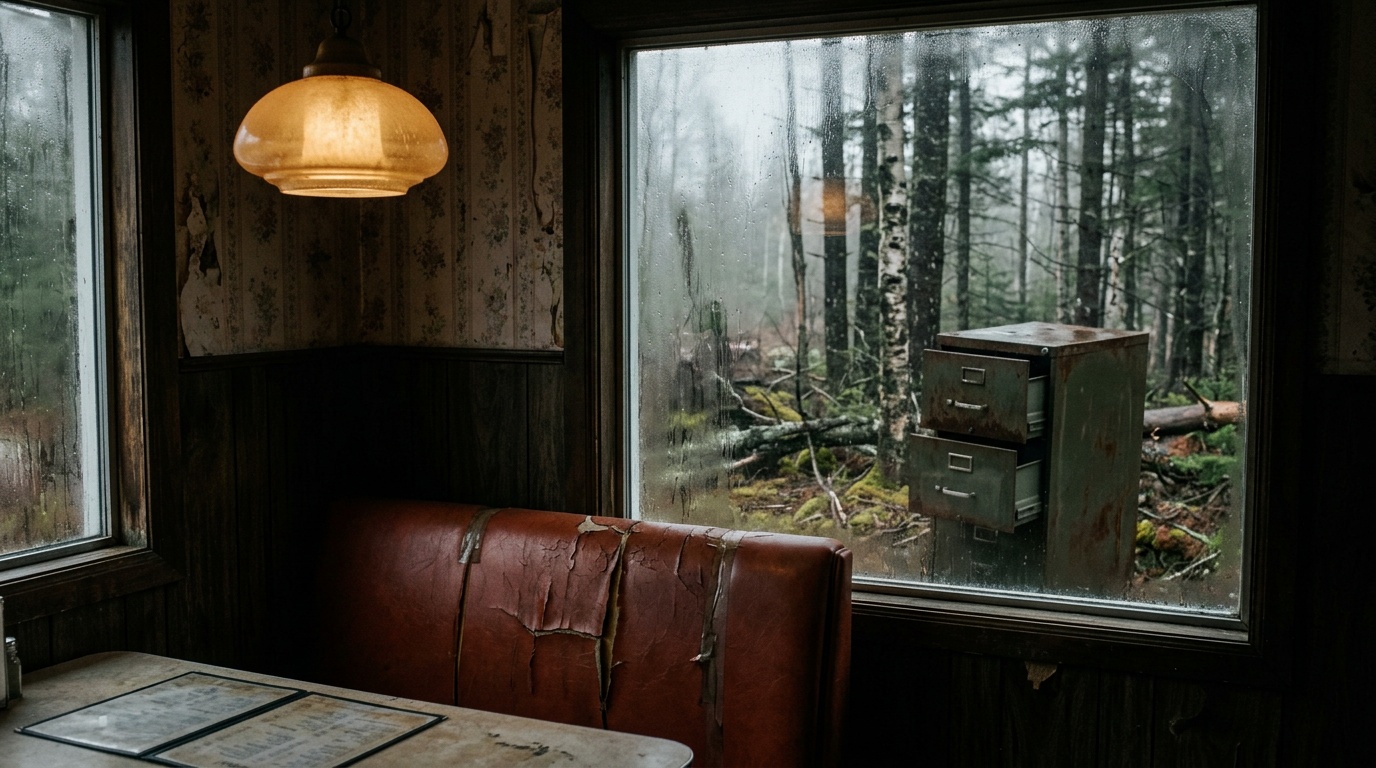
The Choosing Ceremony Launders a Compact No One in the Town Authored
THE ARGUMENT
The Choosing Ceremony converts imposed survival discipline into apparently chosen lifestyle, but the rules residents are asked to claim as their own may not be locally derived survival knowledge at all. They may be terms of a compact with the outside threat, passed down through survivors who inherited them without access to their origin. Victor's private step-counting reveals a second layer of the deception: the perimeter those rules were calibrated to has already shifted, meaning the town is performing compliance theater against conditions that no longer exist. Victor's silence is not paternalistic protection but preservation of the only social architecture that keeps the ceremony's fiction intact.
How This Theory Works
The Choosing Ceremony is a consent mechanism, and consent mechanisms are what institutions use when they cannot afford open coercion. Khatri's tour makes the underlying uniformity immediately visible: windows must be nailed shut, talismans must be maintained, curfew is absolute, and the same box used to punish rule-breakers in the town governs Colony House as well. When Khatri insists that failing to enforce the box against Frank will cause the rules to lose all weight, he is not describing a community norm. He is describing a survival law that requires periodic visible punishment to sustain the credibility of every other constraint. Colony House's apparent permissiveness is surface texture over an identical structural skeleton. Jade wakes up tied to a bed there. Donna controls his access and movement from the first moment he arrives. The two communities are not different lifestyles. They are the same apparatus with different upholstery, and the Choosing Ceremony exists to prevent that equivalence from becoming visible to the people it governs.
The deeper problem is what the ceremony actually asks residents to choose. The protective protocols are presented as hard-won collective wisdom, the accumulated survival knowledge of a community that worked out, through trial and error, how to stay alive. But there is no evidence the rules were derived that way. They were inherited: terms passed down through survivors who had no say in the original arrangement and no access to its actual scope. If those rules originate in a compact with the creatures, or some force structurally adjacent to them, then the ceremony does not ask residents to ratify community norms. It asks them to claim authorship over conditions they never authored, enforced by a threat they do not understand, on behalf of an arrangement that predates every person currently inside the town. The institution generates, automatically and without anyone planning it, exactly the ideological mystification required to make that fiction hold. A resident who understands themselves as captive is a resident the creatures can work with. The ceremony converts potential captives into volunteers, and that conversion is not cosmetic. It is the town's primary threat mitigation strategy.
Victor's step-counting introduces a second and materially more urgent layer of the deception. Victor is the town's longest-surviving resident, and his measurement of the distance from Colony House to the tree line is not general vigilance. It is a longitudinal private record that no one else in the community holds. When Ethan presses him, Victor states directly that he is checking to see if the trees have moved, not as an abstract anxiety but as a real and serious possibility he is monitoring against a known baseline. That distinction matters precisely because a first check is curiosity, while a repeated check against a baseline is documentation of an ongoing process. Victor is not wondering whether the perimeter can shift. He already knows it can, and he is tracking whether it has.
If the tree line has been contracting incrementally across the years or decades Victor has been present, then the community's entire system of behavioral precautions is calibrated to a boundary that has already moved. The window-nailing, the curfews, the routes residents consider safe: every rule is spatially anchored to a perimeter that may no longer exist at the coordinates the town assumes. The creatures are not simply hunting; they appear to be maintaining positional control over an enclosure, and if that enclosure has been resizing, the endgame advances whether or not anyone inside acknowledges it. The rules that feel like survival knowledge would then be something worse: compliance theater performed against terms that have already changed. Victor counting steps is the act of someone who has watched the town shrink without anyone else noticing, and the Pratt family's bloody room, which Khatri deploys as an argument for strict compliance, may be evidence not of deviation from the rules but of rules that had already become inadequate to the actual perimeter.
This is why Victor's silence is not paternalism and not ordinary protective caution. If the tree line has shifted, then disclosing that fact does not merely frighten residents. It dismantles the behavioral architecture the community depends on to function. Every enforcement mechanism Khatri describes, the box, the ceremony, the visible punishment of Frank, rests on the premise that following the rules is sufficient to survive. Victor's private record, if accurate, implies that sufficiency has already been revoked. A community that understood itself as already inside a shrinking enclosure, following terms it never authored, enforced by a compact it cannot renegotiate, could not be kept functional by any iteration of the Choosing Ceremony. Victor carries that knowledge alone not because he is protecting others from fear but because sharing it would collapse the only social architecture capable of sustaining even the partial compliance the protection currently requires. He is not keeping a secret. He is maintaining the load-bearing fiction on which everyone's survival, including his own, still depends.
Is this theory convincing?
Key Evidence
Khatri's Window-Nailing Instructions
During the tour, Khatri specifies that windows must be nailed shut in any residence, including Colony House where children are present, revealing that the same security mandates govern both communities.
The Box as Legal Deterrent
Boyd tells Khatri the box was meant as a deterrent, not an actual punishment, but Khatri insists that failing to enforce it will cause the town's rules to lose all weight, illustrating how the town's order rests on coercive threat.
Jade Physically Restrained at Colony House
Jade wakes up tied to a bed in Colony House, demonstrating that the supposedly permissive community exercises direct physical control over newcomers who do not comply.
Donna's Authority Over New Arrivals
Donna controls Jade's movement and information access from the moment he arrives, functioning as an authority figure whose decisions govern Colony House behavior rather than leaving residents to do as they please.
Choosing Ceremony as False Binary
Father Khatri presents the Choosing Ceremony as a meaningful lifestyle decision between two distinct communities, but the security rules he outlines apply equally to both locations, making the choice cosmetic rather than substantive.
Pratt Family as Rule Consequence
Khatri shows the Matthews the bloody room where the Pratt family was killed, using it as a direct argument that deviation from the rules produces death, reinforcing that both communities ultimately enforce the same survival discipline.
This theory was evaluated using Theory Atlas editorial standards, including evidence review, narrative fit, and competing interpretation analysis. Learn how Theory Atlas evaluates theories →
Other Theories for S1E03
The Box Works Because Both Men Let It
Boyd built the Box as a deterrent he never intended to activate, and Frank's punishment forces him to confront whether he can sentence a man he respects to death.
Jim Heard the Creatures Before Believing
Jim's acceptance of the town's nightmare is not a matter of rationalization or resignation.
Day Versus Night: How Creatures Divide Their Presence
The creatures are not predators constrained by biology.
Sara Works the Morning Shift to Avoid Suspicion
This theory holds that Sara deliberately returns to her diner shift the morning after her actions caused the deaths of the Pratt family, prioritizing the appearance of normalcy over staying home as Nathan urged.