Boyd Was Selected for the Infection, and the Infection Is Building a Weapon
THE ARGUMENT
Boyd's worm infection was not a consequence of exposure but of evaluation: his sustained pattern of mercy across Martin, the creature, and Sara constitutes a behavioral profile the town's forces appear to have been actively assessing, with the infection as the outcome of meeting the criterion. The parasites are not degrading him toward helplessness but executing a structured conversion (the same agenda they ran on Martin, now accelerated) that ends with Boyd functional, trusted, armed, and capable of killing creatures with his own blood. The mercy that selected him is being repurposed into the delivery mechanism.
How This Theory Works
Boyd did not acquire the worms despite his mercy. He acquired them because of it. His refusal to kill Martin, his deliberate offering of his own blood to the Smiley-Faced Creature, and his sustained protection of Sara are not separate acts of situational compassion. They are a behavioral record, consistent enough across high-pressure encounters to constitute a profile, and the town's forces appear to be the ones keeping score. What makes this reading harder to dismiss than generic 'chosen one' logic is the specificity of the disposition being selected for. Boyd does not experience his mercy as strategy. He experiences it as the only morally tolerable option available in each moment, which is precisely what makes him reliable rather than merely useful. A person who chooses restraint because they calculated the odds is a conditional asset. A person who cannot do otherwise, even when it costs them, is a structural one. Boyd's request to Kristi to end his life if he becomes dangerous is not a sign of defeat. It is an act of mercy directed inward, performed under maximum personal dissolution, with no obvious supernatural audience. If the town's forces are selecting for a disposition that holds even when the holder is the one dissolving, that request may be the moment his selection was confirmed.
The worm infection itself provides the first evidence that whatever is running this process operates on a timescale and with a patience that rules out accident. Boyd tells Kristi plainly: the worms fed on Martin for years in the dungeon without letting him die. That is not the behavior of a parasitic organism consuming its host. It is the behavior of something with an agenda that requires the host intact and functional over an extended period. Martin did not survive conditions that should have been fatal despite the infection. He survived because of it, sustained by organisms that had a use for him that had not yet concluded. The infection now inside Boyd is not a different mechanism with different priorities. It is the same process, running on a new host, and it has already demonstrated what it can do when given sufficient time.
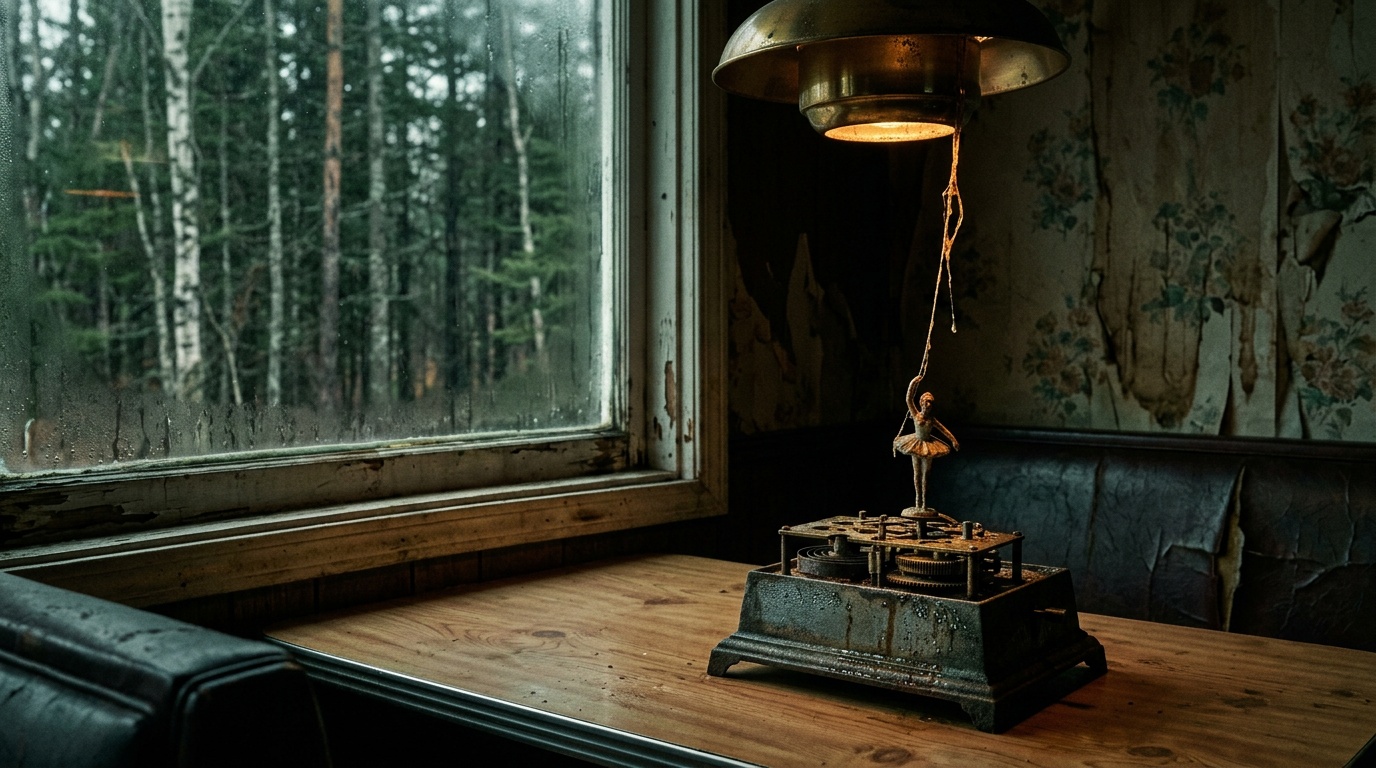
The structure of Boyd's hallucinations confirms the infection is not degrading randomly but progressing according to a legible sequence. The music box appears before every vision: on a rock in the physical world, heard by Boyd alone, functioning not as a symptom of neurological collapse but as a consistent trigger, a scheduled interface. The Ballerina who follows is not static: graceful and inviting in the church, then opening her mouth to release worms, then strangling Boyd in the clinic until he draws his weapon on Mari. The escalation tracks precisely with Boyd's attempts to analyze and resist rather than yield, which means the calibration is responsive. Something is adjusting its approach based on his behavior. Kenny sees nothing at the root cellar despite Boyd reacting visibly, a detail the dementia hypothesis can absorb, but dementia cannot account for a music box appearing on a physical rock, and it cannot account for an infection documented to sustain a human body through years of conditions that should have been fatal. The Khatri apparition marks where this sequence crosses a structural threshold. Unlike the Ballerina, which Boyd experiences as an intrusion, something happening to him against his will, the Khatri conversation is not experienced as an attack at all. Boyd holds a full conversation with a dead man, accepts the vision's presence as natural, engages it as a thinking interlocutor, and requires the apparition itself to point out that he is speaking to a construction of his own mind. That is not hallucination. That is confabulation: the clinical failure of the mechanism that distinguishes real from constructed. Once that mechanism fails, the infection no longer needs to force visions on a resisting mind. It can build the reality it wants, and Boyd will inhabit it without raising an internal alarm.
The third movement of this argument is where the evidence becomes most uncomfortable, and where the blood-lethality data locks the weapon thesis into place. Boyd's entire identity in Fromfield is organized around a single function: he keeps people safe. He holds the gun, the institutional authority, Kenny's unconditional trust, and the tactical training to back all of it. The draw on Mari during the clinic hallucination is the proof-of-concept moment: Boyd's infected mind directing his trained hand at the first real person to enter the room, not a stranger but someone he is sworn to protect. But the weapon is not only internal. When Boyd deliberately cut his hand and introduced his infected blood into the Smiley-Faced Creature's body, the result was not deterioration. It was immediate, catastrophic seizure and apparent death. The asymmetry between what the parasites do inside a human host (suffering, visions, escalating confabulation) and what they do when introduced into creature biology is the argument's climactic evidence. Something about what the organisms become inside a human body makes them a lethal foreign agent when transferred into creatures. The creatures present at the collapse did not pursue Boyd afterward. They gathered around the fallen body, exchanged glances, and let him walk: a categorical break from every prior behavioral pattern in the series, in which creatures hunt without hesitation or apparent doubt. Boyd was standing there. He was accessible. They did not move. The only variable that had changed was what they had just witnessed his blood do to one of their own.
Read against the selection thesis, this asymmetry is not a lucky accident. If the infection was introduced into Boyd through a deliberate sequence, one that began with his mercy toward Martin, continued through his blood offering to the creature, and is now progressing through structured perceptual conversion toward full confabulation, then the lethal effect his blood has on creature biology is either a designed feature of what the parasites become inside a chosen host, or it is a genuine malfunction in a system that never anticipated its own weapon being redirected by the person carrying it. Both possibilities converge on the same conclusion. The endpoint the infection is building toward is not a broken, helpless Boyd. It is a Boyd who remains functional, trusted, and armed, whose mind the infection can operate whenever the music box plays, and whose blood can kill the very creatures the town uses to maintain control. Death would remove Boyd from the board entirely. Corruption keeps him on it, pointed at the people who depend on him most. The mercy that made him eligible for selection is precisely what makes him dangerous: no one will see the weapon until it has already been used, because the man carrying it has spent every moment in Fromfield being the reason people survive.
Is this theory convincing?
Key Evidence
Worms falling from Ballerina's mouth
In the church vision, the Ballerina opens her mouth in a blood-curdling shriek and worms fall out, directly linking the hallucinatory figure to the parasitic infection Boyd described acquiring from Martin.
Boyd describes worms under his skin
Boyd tells Kristi that he can feel worms crawling underneath his skin and that they had been feeding on Martin for years in the dungeon without letting him die, establishing the infection as the episode's explicit explanation for his symptoms.
Ballerina strangles Boyd in clinic
The Ballerina's visions escalate from dancing to violence: she pushes Boyd onto the clinic bed and begins strangling him, causing him to draw his gun on Mari when she walks in, showing the infection's psychological grip tightening.
Kenny cannot see the Ballerina
When the Ballerina emerges from the root cellar during Boyd and Kenny's walk, Kenny sees nothing despite Boyd clearly reacting to her presence, confirming the vision is visible only to the infected Boyd.
Music box precedes every vision
Boyd hears the music box in the church before the first Ballerina appearance, then hears it again on a nearby rock just before the Ballerina emerges from the root cellar, establishing the sound as a consistent trigger or herald tied to the infection.
Khatri acknowledges deterioration is real
In the clinic basement, Boyd's vision of Father Khatri confirms that Boyd himself acknowledges the thing inside him is getting worse, and Khatri agrees, lending the infection a weight the dementia hypothesis alone cannot account for.
Kenny raises dementia parallel
Kenny tells Kristi that Boyd's mental decline echoes his father's dementia, introducing the alternate medical reading that the show neither confirms nor dismisses, keeping the infection's supernatural nature ambiguous at this stage.
This theory was evaluated using Theory Atlas editorial standards, including evidence review, narrative fit, and competing interpretation analysis. Learn how Theory Atlas evaluates theories →
Other Theories for S2E06
Whoever Watches Wants Them Desperate
The food shortage in FROM is not an accident but a deliberate instrument, engineered by whatever force controls the town to drive psychological breakdown and social fracture among the residents.
Fatima's Secret Predates the Sara Crisis
Fatima has been using Ellis's failure to disclose Boyd's secret as cover for her own concealment, one that originates from the night the bus arrived and predates the Sara crisis entirely.
The Clinic's Drug Supply Is Already Compromised
Mari's admission that she took 'a bit of morphine to even herself out' is not a confession to a single lapse.
One Month, Not One Year
The town's food supply will last approximately one month, not the year Donna claimed when rationing began.

Disbelief Traps Witnesses in Isolation
The town's instinct to interpret supernatural experience as mental illness does not merely fail its witnesses.

The Town's Frozen Season Finally Breaks
The leaves changing for the first time in the town's history indicate that whatever has held its environment in stasis is no longer holding, and the food crisis arriving simultaneously suggests the two disruptions share a cause rather than a coincidence.

The Pas de Deux Is the System's Fatal Design Flaw
The worm infection is not tormenting Boyd but dancing with him, running a structured conditioning protocol whose intimacy and sophistication are visible in the music box's causal role and the Martin/Boyd parallel.