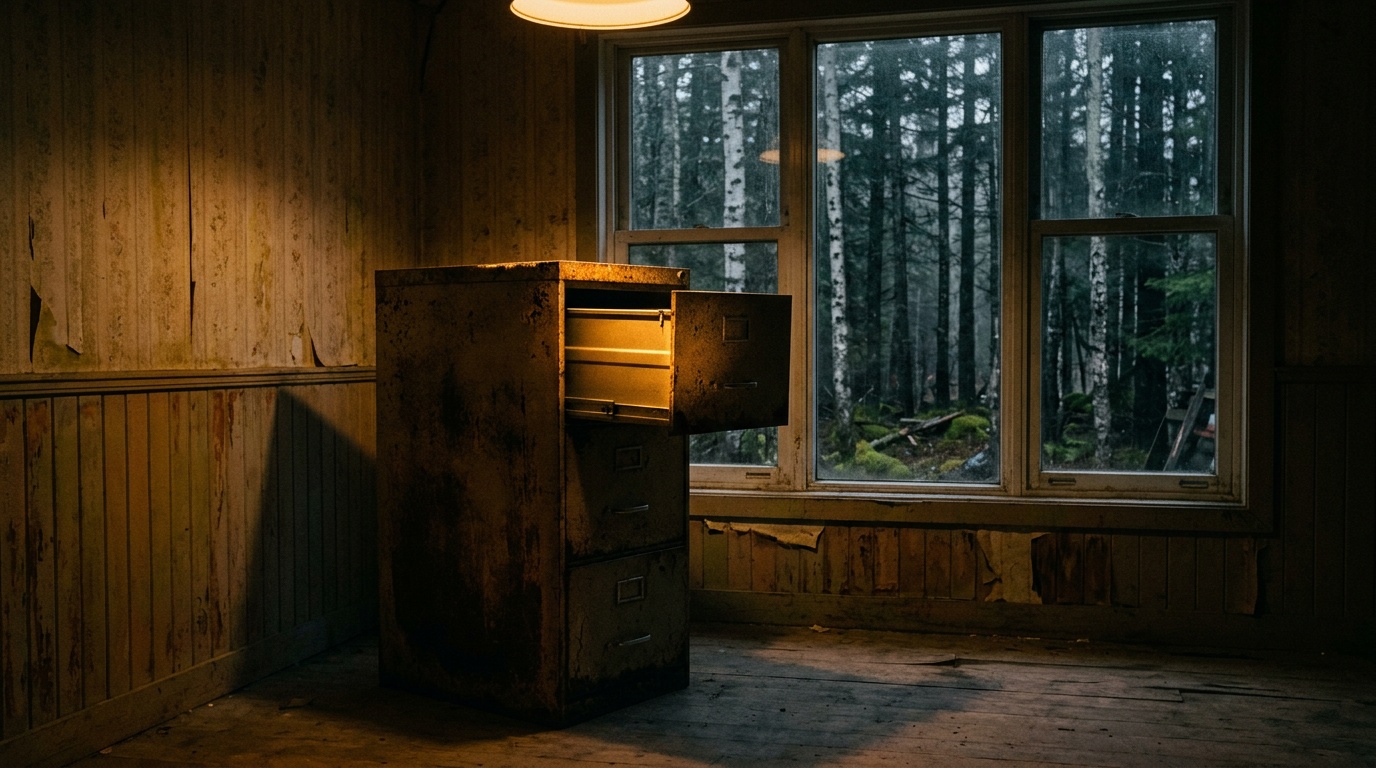
The Bottle Tree Was the Keystone of a Single Integrated System, and Its Removal Was the Ignition
THE ARGUMENT
The Bottle Tree was not one layer among several independent protections but the load-bearing anchor of a unified defensive architecture in which daylight, talismans, and creature behavioral constraints were interlocking outputs of one system. Its removal did not weaken the architecture; it triggered automatic cascade failure, converting every remaining talisman from a shield into a countdown. Smiley's surgical breach of the clinic was not an opportunistic escalation but the activated consequence of two simultaneous failures in a system that had no redundancy left to absorb either one.
How This Theory Works
The sky darkens before a single creature advances. That timing is the theory's foundation. Daytime safety was not a passive ambient condition the town inherited from geography or habit; it was a structural output the Bottle Tree was actively producing, and the moment the tree was uprooted, the output stopped. Instantly, and regardless of what anyone did next. This means the town's defensive architecture was never a collection of parallel, independent protections. The tree was the keystone. Talismans, daylight, and the behavioral constraints governing where and when creatures could act were all downstream products of the same integrated system, and the system could not survive the removal of its central component. The earthquake that followed is best read not as a defense but as the architecture convulsing: a dying reflex from infrastructure that no longer had an organizing center. Victor's testimony sharpens this reading into something close to confirmation. The show's longest-surviving resident, a man who has outlasted every other inhabitant by learning the town's rules well enough to live by them for over four decades without talismans, says he has never seen anything like what follows the uprooting. That statement is not generalized alarm. It is a specific assessment from the one character whose survival record gives him genuine authority to distinguish between disasters the town can absorb and disruptions it cannot. The crimson lightning erupting from the chasm and the storm that follow are the town validating his reading, not decorating it.
Sophia's movements after the tree falls confirm the system's interdependence from a different angle. She does not flee, consolidate, or wait to observe what the uprooting produces. She moves immediately and in sequence to the church, the sheriff's station, and the bar, collecting every talisman she can locate, because she understands that the tree's removal began a process and the talismans are what remains of it. Her statement that she will now light the match and watch it all burn, delivered while holding a talisman, is not rhetorical. It identifies talisman removal as the ignition step of a dismantling the tree's destruction already initiated. The talismans were always the distributed, household-level layer of the same architecture, never a separate parallel mechanism. Once the keystone was gone, every remaining talisman became a point of failure rather than a point of protection, and Sophia knew this before Boyd's group understood what they had sacrificed.
Smiley's entry into the clinic is where the cascade failure becomes lethal and where the theory's operational logic presses hardest. The earthquake dislodged the clinic's talisman from its mounting. The tree's removal had already collapsed daytime protection. These were not two independent misfortunes arriving simultaneously; they were two simultaneous failures inside a system that had no redundancy remaining to catch either one. Mari races to rehang the talisman. Fatima perceives Smiley's approach through their shared sensory link at the precise moment she registers the talisman's absence. The warning and the failed protection arrive together because the system that should have made the warning actionable is already gone. Mari cannot close the gap in time, and Smiley crosses the threshold before she can restore the barrier. This precision is the evidence that the vulnerability was not discovered opportunistically. It was activated. The compounded failure window, the simultaneous removal of the tree and the earthquake's physical disruption of the household layer, was not a coincidence the creatures stumbled into. It was a gap that the integrated system's collapse made available, and something or someone capable of recognizing it moved through it with surgical exactness.
Smiley's behavior inside the clinic makes that selectivity impossible to dismiss. He kills Mari. He spares Fatima, addressing her as 'mother' before leaving. The talisman's absence did not grant him license to kill indiscriminately. He exercised selection, which means the breach was never about access to any target. It was about access to a specific outcome. This is the talisman's true function stated in its negation: not a wall that kept creatures physically out, but a constraint that kept their choices bounded. Once the constraint failed, the creature did not rage through the room. He chose. That distinction, between keeping creatures absent and keeping their agency constrained, reframes every talisman in Fromville. Each one is not a lock on a door. Each one is a governor on a decision. A hanging object on a wall, contingent on its mounting, subject to earthquakes, to deliberate removal, to any well-timed environmental disruption. The protective architecture the residents depend on is one coordinated interruption away from becoming a room where Smiley gets to choose who dies.
The theory's forward edge is the one mechanistic question the evidence raises but cannot resolve, and it is the sharpest question the show has yet posed about its own rules. Was the Bottle Tree actively generating the conditions it maintained, daylight, behavioral constraint, the night's reliable boundary, or was it a seal, and something was waiting behind it? The distinction determines whether the darkness is reversible. A generator that is gone is simply gone. A seal implies that what it contained is now loose, and that the darkness the town is experiencing is not an absence but a presence. Sophia's framing of the darkening sky as a sign that they are getting close to the end, treating it as a milestone she anticipated, possibly engineered, suggests she understood the tree's structural function before Boyd's group did. If the uprooting was steered toward this outcome, the town did not lose a shield through tragedy. It surrendered the last natural defense it still possessed at the exact moment its antagonist was expecting it to.
Is this theory convincing?
Key Evidence
Sky Darkens Immediately After Uprooting
As soon as the Bottle Tree is uprooted, the sky rapidly turns dark mid-operation, before the creatures have advanced, indicating the loss of daytime protection is automatic and structural rather than a response to creature behavior.
Earthquake Forces Creatures Back
When the creatures advance after the Bottle Tree is removed, an earthquake strikes and forces them back, suggesting the town's systems are convulsing rather than defending, consistent with a destabilized protective architecture.
Smiley Enters Clinic After Talisman Falls
The earthquake knocks the clinic's talisman from its mounting, and Smiley immediately enters and kills Mari, demonstrating that creature access is directly gated by the talisman system rather than any other factor.
Sophia Systematically Collects All Talismans
Immediately following the Bottle Tree's destruction, Sophia moves to the church, the sheriff's station, and the bar in sequence, collecting every talisman she can locate, treating their removal as the next phase of dismantling the town's defenses.
Crimson Lightning Erupts From the Chasm
A red bolt of lightning emerges from the chasm where the Bottle Tree stood, marking the site as an active rupture point in the town's system rather than simply an empty hole, implying the tree was anchoring something that is now discharging.
Sophia's Match-Lighting Declaration
Sophia states she will now light the match and watch it all burn while holding a talisman, framing the talisman removal as the ignition step that follows the tree's destruction rather than an independent act.
This theory was evaluated using Theory Atlas editorial standards, including evidence review, narrative fit, and competing interpretation analysis. Learn how Theory Atlas evaluates theories →
Other Theories for S4E10
The Bones Are the Exit Price: Escape, Ritual, and Boyd's Convergence as One Mechanism
The Township has always required Jade and Tabitha to spend their daughter's remains as the cost of leaving, and using the children's bones to physically break open the barred archway is not a desecration of the ritual but its completion.

Sophia Harvested Elgin to See the End
Sophia is executing a two-phase endgame she has attempted and failed at least once before: stripping the town's passive talisman defenses to replicate the Clinic breach at scale, while using a hand-contact ritual to extract specific capacities from key individuals.

Sophia Engineered the Bond Smiley's 'Interesting' Ratified
Sophia used the herbal mixture, administered through Clara, to initiate Fatima's transformation long before Smiley reached the Clinic, writing her into his perception as something categorically distinct from prey.
Henry Armed Himself to Escape Reality by Force
Henry's vision has been directing him toward killing Victor as a deliberate mechanism of escape, not as an emotional breakdown.
The Boy and Sophia Have Done This Before
Sophia and the Boy in White have contested control of the township across multiple prior cycles, both carry memory of those iterations, and Sophia has won each one until now.
Smiley Spared Fatima Because She Is Mother
Fatima's unborn child has already been assigned a function within the town's supernatural system, and Smiley's visit to the clinic was not predatory but transactional, a formal acknowledgment of that claim.
The Town's Earthquakes Are Deliberate Interventions
Something is actively timing earthquakes to protect Jade and Tabitha specifically, targeting the creatures while leaving the humans unharmed, and has been doing so across multiple episodes.
The Man in Yellow Wears the Dead
The Man in Yellow selects its stolen identities based on knowledge of surviving grief, not random availability of the dead.