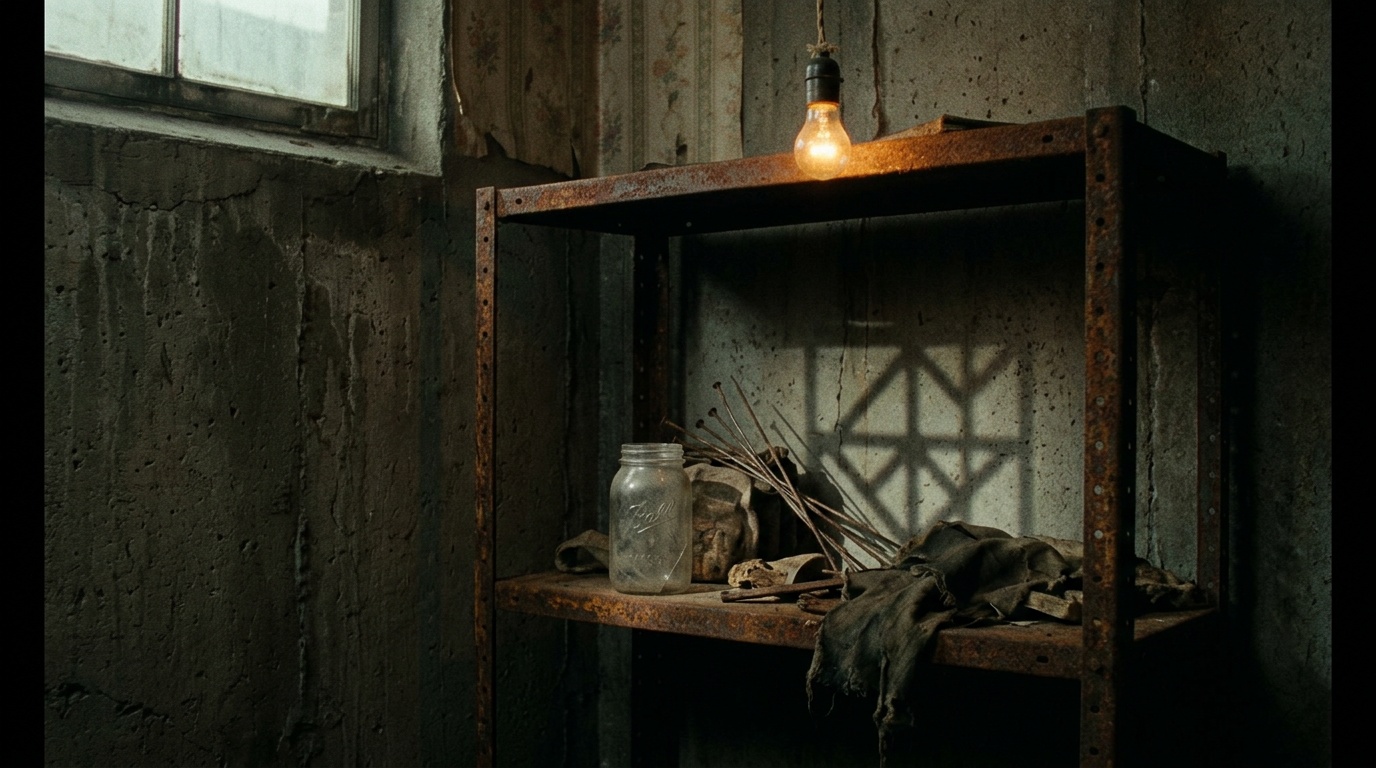
Acosta's Crime Scene Eye Unlocks Colony House Secrets
THE ARGUMENT
The Colony House basement contains overlooked cross-arrival evidence that only a trained investigator would recognize, because the survivors have been filtering objects through their own assumptions about utility for years. Boyd's assignment of Acosta is a deliberate bet that her police instincts will surface something that has been sitting unexamined in plain sight. If Acosta completes the analysis, the show has a structural mechanism to reveal that the survivors' own cognitive filters have been the primary obstacle to understanding their situation.
How This Theory Works
The accumulated belongings of years of township arrivals, examined with a trained investigator's framework rather than a grieving survivor's, will produce a pattern or artifact that reframes what the survivors think they know about their situation. Boyd articulates this when he tells Acosta the stuff no one thought useful ended up in the basement. That framing matters. It suggests the survivors have been curating evidence by intuition, discarding material that did not fit their existing mental model. A police analyst approaches the same objects without that filter.
Boyd's motivation layers the therapeutic and the strategic in a way that makes both readings valid. He tells Acosta she reminds him of someone he could have helped but did not, a direct reference to his failure with Abby. That confession is Boyd recognizing the pattern in himself: he withholds purposeful engagement from people in crisis and loses them. Assigning Acosta to the basement is an attempt to break that pattern. But Boyd is also a pragmatist. He would not spend the emotional capital of that admission on a task he thought was merely occupational therapy. He believes the basement holds something.
The sharpest implication is that the township's survivors have been their own worst investigators for years, and the show has been waiting for a character with Acosta's specific training to make that structural failure legible. If the basement contains objects with connections across multiple arrivals, or items whose significance only becomes visible when arranged as a timeline rather than a supply inventory, what Acosta finds will not just be new information. It will be an indictment of every assumption the survivors used to decide what counted as evidence in the first place. The colony has not been unable to solve its situation because the answers are hidden. It has been unable to solve it because no one with the right framework has looked.
Is this theory convincing?
Key Evidence
Boyd's Basement Crime Scene Assignment
Boyd instructs Acosta to analyze the Colony House basement belongings as if it were a crime scene and come up with a story, framing the task as an application of her police training to materials the survivors have overlooked.
Discarded Items as Overlooked Evidence
Boyd explains that items the survivors did not think would be useful were deposited in the basement, implying a de facto filter that may have excluded significant objects from scrutiny.
Abby Parallel and Boyd's Guilt
Boyd tells Acosta she reminds him of someone he could have helped but did not, signaling that his investment in this assignment goes beyond strategy and reflects a personal reckoning with past failure.
Acosta's Police Training as Narrative Asset
Boyd specifically cites Acosta's training as a cop as the reason he wants her for this task, positioning her investigative background as a capability the township has never had access to before.
Task as Leverage Over Acosta's Will to Live
Boyd conditions the discussion of Acosta's requested bullet on her completing the basement analysis, using her suicidal ideation as leverage to keep her engaged and functional.
Boyd Applying Acosta's Own Advice
The assignment mirrors a principle of giving people purposeful tasks to prevent helplessness, which Boyd had previously absorbed and is now directing back at Acosta herself.
This theory was evaluated using Theory Atlas editorial standards, including evidence review, narrative fit, and competing interpretation analysis. Learn how Theory Atlas evaluates theories →
Other Theories for S4E03
Victor Has Met the Man in Yellow Before
Victor has a prior suppressed encounter with the Man in Yellow that he buried so thoroughly he convinced himself it never happened.
The Lake of Tears Is Already Real
The Lake of Tears is a real location inside the Township that Victor knows and refuses to approach, and Jade has already been placed in contact with it before being recruited to find it.
Jade's Suppressed Knowledge Needs a Key
Jade already holds the critical knowledge about the township and requires a psychedelic mechanism to retrieve it, and the show is positioning the township itself as the force making that mechanism available.

Ethan's Storybooks Are a Township Field Manual
Ethan's storybooks contain actionable rules about the Township specific enough to instruct someone in controlling story-walking, which is why Julie treats their retrieval as worth serious physical danger.

Two Cars, One Breaking Point
The dual-car arrival of the Matthews family and Jade did not merely coincide with the Township's escalating danger but likely caused it by violating a configuration-sensitive intake logic the Township enforces.

Tabitha's Drawing Encodes Pre-Arrival Knowledge
Tabitha's childhood lighthouse drawing encodes accurate pre-arrival knowledge of a real Township location, meaning the Township was operating on her consciousness long before she arrived.

Sophia's Bible Lesson Targets Tabitha
Sophia uses the Achan parable to convert the township's ambient suspicion about the Matthews into a structured theological accusation, giving the community a moral framework to hold Tabitha responsible for their collective suffering.

Boyd Sees Abby Every Time He Looks at Acosta
Boyd's drive to recruit Acosta rather than confine or ignore her is not strategic calculation but a guilt-driven compulsion to rewrite his failure with Abby through a woman who mirrors her exactly.