
Ethan's Storybooks Are a Township Field Manual
THE ARGUMENT
Ethan's storybooks contain actionable rules about the Township specific enough to instruct someone in controlling story-walking, which is why Julie treats their retrieval as worth serious physical danger. If the books carry story-walking instruction that predates Julie's ability manifesting, then whoever produced them knew this situation was coming. That makes the books not a child's fiction but a prepared document, and the Township's manipulation of its occupants longer-running and more specific than the show has so far admitted.
How This Theory Works
The storybooks encode genuine rules about the Township specific enough to teach someone how to consciously control story-walking. Julie does not go back to the ruins out of sentiment. She goes for a specific blue bag containing specific books, knowing the structure is unstable, and she frames the retrieval explicitly as a method for gaining agency over her abilities. That level of deliberate risk signals a belief that the books contain something no other source in the Township has provided.
The evidence for this belief predates Julie's decision. Ethan's insistence that the Lake of Tears exists was treated as a child's fantasy until Jade and Victor walked him to the Brundles and found it. Ethan draws the parallel himself: his mother thought she invented the red rocks from her dreams, and they turned out to be real. The storybook logic and the Township's physical reality have now overlapped enough times that treating the books as fiction is the less defensible position.
The precise mechanism the show has not resolved is this: how did story-walking-specific instruction end up in books a child wrote or assembled before story-walking was known to be possible? If the books contain functional rules for an ability Julie only recently manifested, then either Ethan had foreknowledge he cannot account for, or the books were shaped by something outside him. That is the question the retrieval arc cannot avoid. A document that anticipates a reader's exact situation is not a fairy tale. It is a prepared brief, and the Township or something operating inside it has been running this scenario longer than anyone inside it has suspected.
Is this theory convincing?
Key Evidence
Julie's deliberate retrieval mission
Julie explicitly tells Randall she is returning to the ruins of her family's house to find Ethan's books, stating her goal is to learn whether she can control her story-walking abilities to save her father.
Lake of Tears confirmed as real
Ethan insists the Lake of Tears from his storybook exists in the Township, and Jade, Victor, and Ethan find what appears to be it at the Brundles, validating at least one piece of storybook geography as factual.
Ethan's red rocks precedent
Ethan argues that his mother believed she invented the red rocks from her dreams but they turned out to be real, presenting this as evidence that storybook elements he describes are not invented but discovered.
Risk level of the retrieval
Randall descends into structurally compromised rubble to recover the book bag, and encounters Brick's corpse in the process, underscoring that Julie considers the books worth significant physical danger.
Books as exclusive information source
Julie frames the books not as comfort objects but as a potential tool for gaining agency over her abilities, treating them as a category of knowledge unavailable anywhere else in the Township.
This theory was evaluated using Theory Atlas editorial standards, including evidence review, narrative fit, and competing interpretation analysis. Learn how Theory Atlas evaluates theories →
Other Theories for S4E03

Victor Has Met the Man in Yellow Before
Victor has a prior suppressed encounter with the Man in Yellow that he buried so thoroughly he convinced himself it never happened.

The Lake of Tears Is Already Real
The Lake of Tears is a real location inside the Township that Victor knows and refuses to approach, and Jade has already been placed in contact with it before being recruited to find it.

Jade's Suppressed Knowledge Needs a Key
Jade already holds the critical knowledge about the township and requires a psychedelic mechanism to retrieve it, and the show is positioning the township itself as the force making that mechanism available.

Two Cars, One Breaking Point
The dual-car arrival of the Matthews family and Jade did not merely coincide with the Township's escalating danger but likely caused it by violating a configuration-sensitive intake logic the Township enforces.

Tabitha's Drawing Encodes Pre-Arrival Knowledge
Tabitha's childhood lighthouse drawing encodes accurate pre-arrival knowledge of a real Township location, meaning the Township was operating on her consciousness long before she arrived.
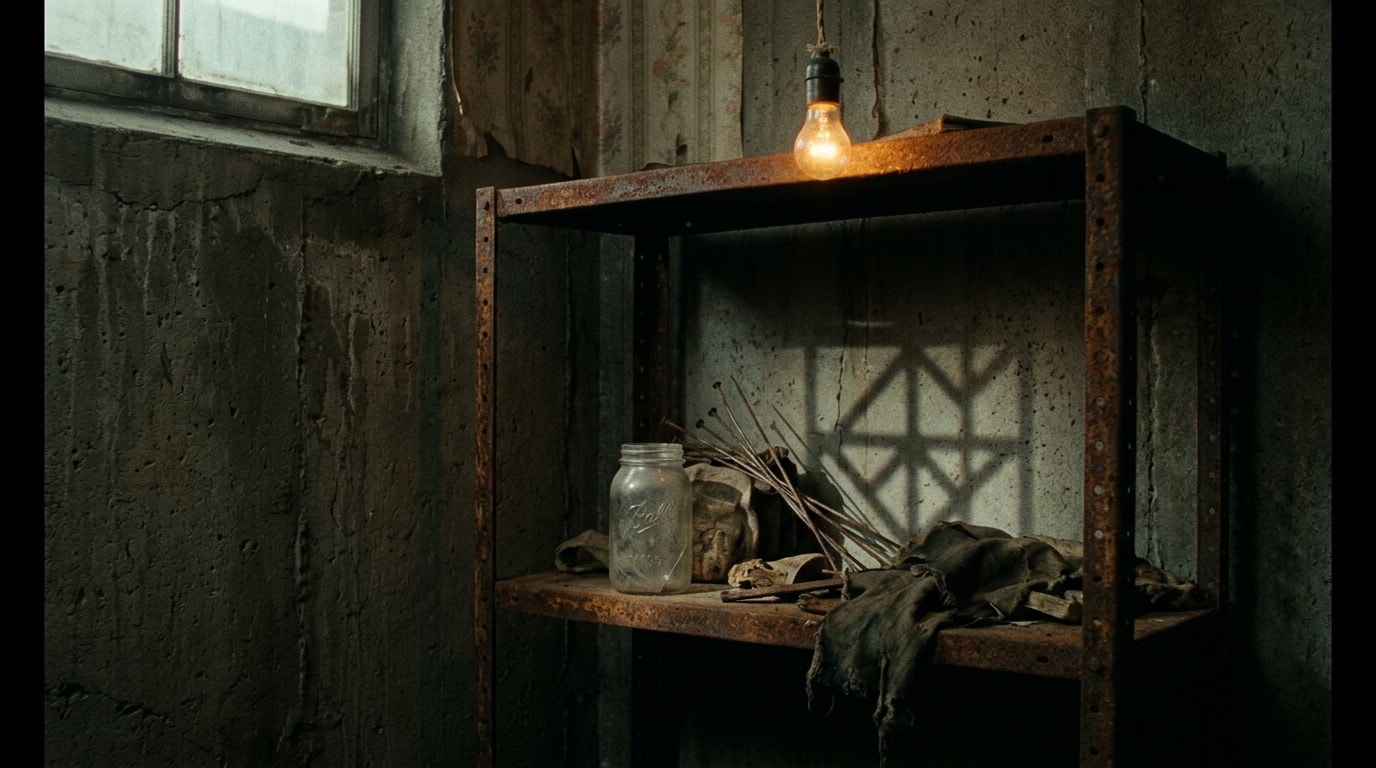
Acosta's Crime Scene Eye Unlocks Colony House Secrets
The Colony House basement contains overlooked cross-arrival evidence that only a trained investigator would recognize, because the survivors have been filtering objects through their own assumptions about utility for years.

Sophia's Bible Lesson Targets Tabitha
Sophia uses the Achan parable to convert the township's ambient suspicion about the Matthews into a structured theological accusation, giving the community a moral framework to hold Tabitha responsible for their collective suffering.

Boyd Sees Abby Every Time He Looks at Acosta
Boyd's drive to recruit Acosta rather than confine or ignore her is not strategic calculation but a guilt-driven compulsion to rewrite his failure with Abby through a woman who mirrors her exactly.