
Tabitha's Drawing Encodes Pre-Arrival Knowledge
THE ARGUMENT
Tabitha's childhood lighthouse drawing encodes accurate pre-arrival knowledge of a real Township location, meaning the Township was operating on her consciousness long before she arrived. Her treatment of the drawing as a working navigational document rather than a personal artifact confirms she has reached this conclusion herself. If the drawing proves accurate, it is not the first time the Township planted structural knowledge in her childhood interior life, which means the Lighthouse is not a destination she found but one she was given.
How This Theory Works
Tabitha's childhood lighthouse drawing contains accurate information about a real location inside the Township, and she has begun treating it as such. The show has not confirmed this. What it has confirmed is that Tabitha rediscovered the drawing at the moment she resolved to find the Lighthouse, immediately turned it over, and began writing on the back. That sequence is purposeful. She is not preserving the drawing as a memento. She is using it as a working document.
The Township has already demonstrated the capacity to plant exact physical details into a target's childhood dreams before any proximity to the boundary is established. Architectural specifics of the Settlement appeared in Tabitha's nightmares years before her family arrived. The lighthouse drawing fits that same operational pattern, but it escalates it. Where the earlier planted imagery was passive, something Tabitha received and could not act on, the drawing is something she made. If it proves accurate, the Township was not merely feeding her images of a place. It was directing her hand.
That distinction matters for what the drawing reveals about the mechanism. A received image is surveillance or preparation. A produced artifact is something closer to authorship. If Tabitha drew an accurate lighthouse as a child without having seen one, the Township was not shaping her dreams. It was using her as an instrument to create a document she would need later. The drawing's utility as a navigational tool only becomes available in adulthood, at the moment she needs it. That timing is not coincidental. It suggests the Township was operating across a long horizon, staging materials rather than simply conditioning a subject.
If the drawing proves accurate, Tabitha's entire adult trajectory toward the Lighthouse is a prepared condition. Every step she takes toward it now would be a step the Township already mapped, and the map was drawn by her own hand before she understood what she was drawing.
Is this theory convincing?
Key Evidence
Drawing Rediscovered at Decision Moment
Tabitha deposits Victor's drawing in a drawer and immediately finds her old lighthouse drawing underneath it, at the precise moment she has decided to return to the Lighthouse.
Writing on Drawing's Reverse
Tabitha takes the lighthouse drawing and begins writing on its back, treating the image as an active document rather than a personal artifact.
Tabitha's Stated Lighthouse Goal
Tabitha tells Henry directly that she is trying to return to the Bottle Tree and the Lighthouse, confirming she is treating the drawing as connected to a real navigational objective.
Pre-Arrival Dream Architecture Pattern
Earlier catalog evidence establishes that Tabitha's childhood dreams contained accurate architectural details of the Settlement, suggesting her lighthouse drawing may follow the same pattern of pre-arrival encoded knowledge.
Drawing as Navigational Document
The act of writing on the back of the lighthouse drawing implies Tabitha believes the image encodes information useful enough to annotate, framing it as a map or reference rather than a memory.
This theory was evaluated using Theory Atlas editorial standards, including evidence review, narrative fit, and competing interpretation analysis. Learn how Theory Atlas evaluates theories →
Other Theories for S4E03

Victor Has Met the Man in Yellow Before
Victor has a prior suppressed encounter with the Man in Yellow that he buried so thoroughly he convinced himself it never happened.

The Lake of Tears Is Already Real
The Lake of Tears is a real location inside the Township that Victor knows and refuses to approach, and Jade has already been placed in contact with it before being recruited to find it.

Jade's Suppressed Knowledge Needs a Key
Jade already holds the critical knowledge about the township and requires a psychedelic mechanism to retrieve it, and the show is positioning the township itself as the force making that mechanism available.

Ethan's Storybooks Are a Township Field Manual
Ethan's storybooks contain actionable rules about the Township specific enough to instruct someone in controlling story-walking, which is why Julie treats their retrieval as worth serious physical danger.

Two Cars, One Breaking Point
The dual-car arrival of the Matthews family and Jade did not merely coincide with the Township's escalating danger but likely caused it by violating a configuration-sensitive intake logic the Township enforces.
Acosta's Crime Scene Eye Unlocks Colony House Secrets
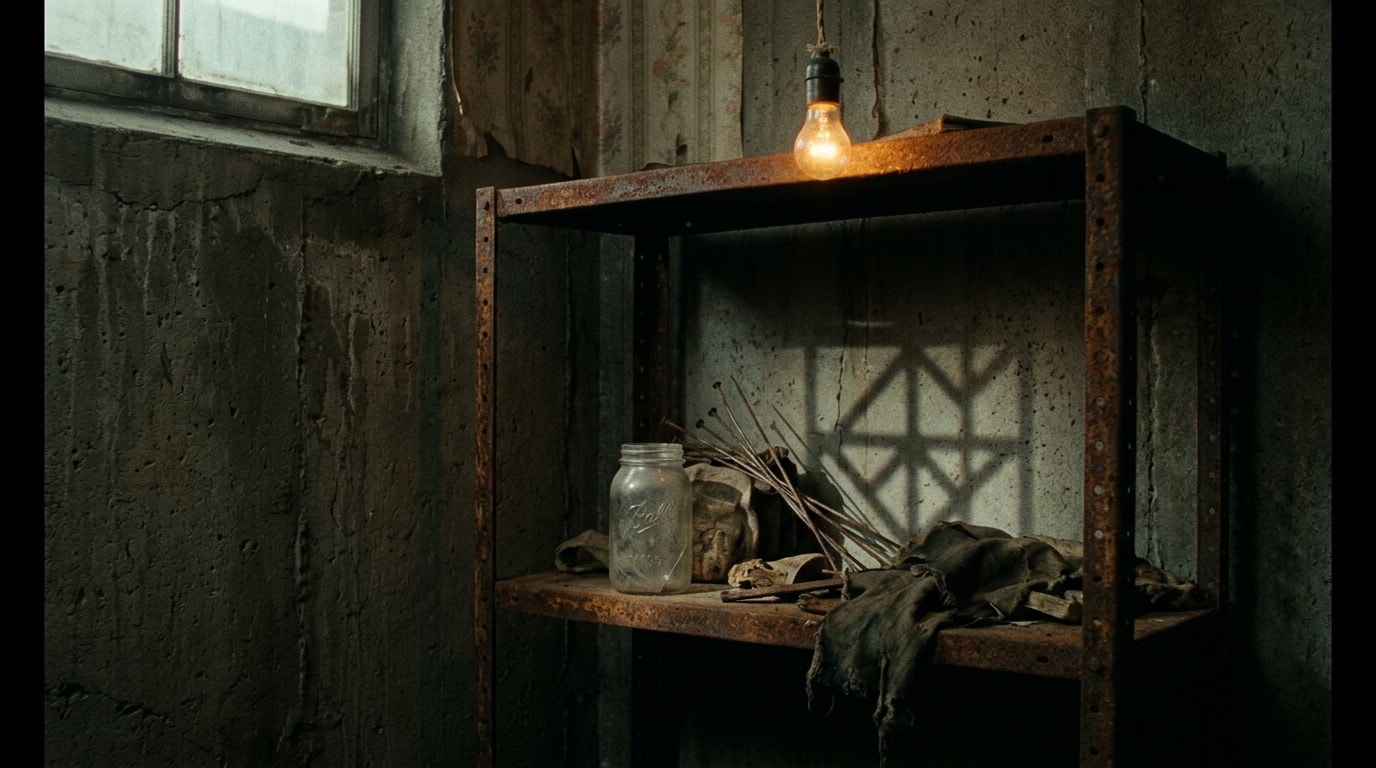
The Colony House basement contains overlooked cross-arrival evidence that only a trained investigator would recognize, because the survivors have been filtering objects through their own assumptions about utility for years.

Sophia's Bible Lesson Targets Tabitha
Sophia uses the Achan parable to convert the township's ambient suspicion about the Matthews into a structured theological accusation, giving the community a moral framework to hold Tabitha responsible for their collective suffering.

Boyd Sees Abby Every Time He Looks at Acosta
Boyd's drive to recruit Acosta rather than confine or ignore her is not strategic calculation but a guilt-driven compulsion to rewrite his failure with Abby through a woman who mirrors her exactly.