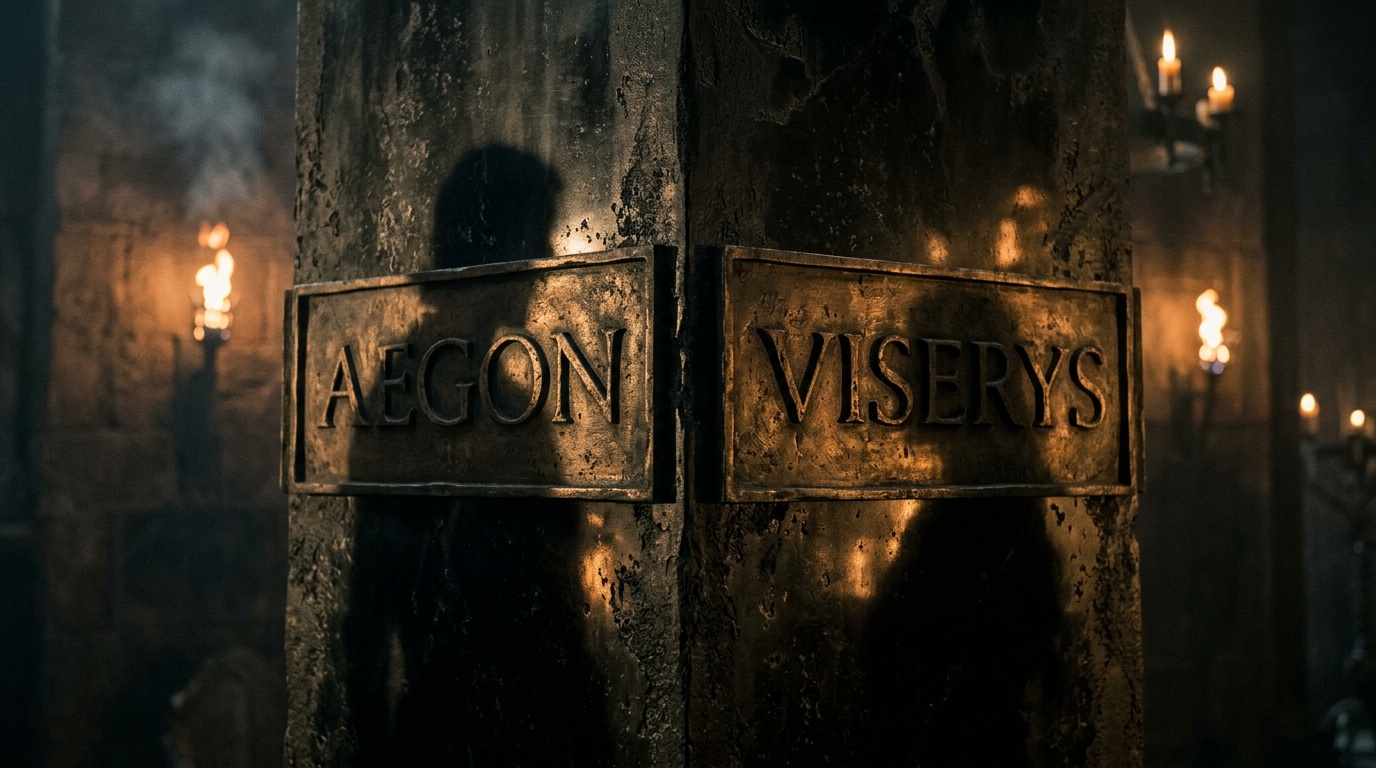
Rhaenyra's Sons as Dynastic Weapons: Symbol, Sentiment, and the Question of Who Pulled the Trigger
THE ARGUMENT
Rhaenyra's naming of her sons by Daemon as Aegon and Viserys is a calculated political act with two simultaneous targets: a deteriorating king whose emotional investment needed to be converted back into binding loyalty, and a Green faction whose claim to dynastic inevitability depended on exclusive ownership of both names. The unresolved and load-bearing question the show refuses to answer is whether the design was Rhaenyra's own or Daemon's, because the answer determines whether Rhaenyra is an independent symbol-maker or a claimant whose political vocabulary has already been constructed for her.
How This Theory Works
The scene is concrete and the timing is exact. Rhaenyra arrives at King's Landing at the precise moment Lucerys's claim to Driftmark requires her father's active support, and she does not arrive empty-handed. She brings Daemon, dragons at Dragonstone behind her, a visible pregnancy signaling further expansion of the Black line, and two sons whose names she presents to a king in visible decline. Viserys responds to the younger boy's name with open delight, joking that Viserys is a name fit for a king. That reaction is not incidental. It is the proof of concept. The scene does not read as a family reunion. It reads as an operation confirming its own success.
The naming of the elder son Aegon is where the political logic sharpens into something harder to dismiss as coincidence. Alicent's eldest son by Viserys also bears the name Aegon, and that name is not merely prestigious; it is the Greens' primary argument for dynastic inevitability. The claim that Alicent's Aegon represents the truer continuation of Aegon the Conqueror's line depends on that name functioning as a marker of legitimate inheritance, a symbol the Blacks cannot touch. Rhaenyra's Aegon absorbs that argument and neutralizes it. Once two claimants share the name, the name alone cannot distinguish the heir, and the Greens are forced off the terrain of dynastic inevitability onto the exposed ground of factional preference. Every time the court must specify which Aegon it means, it is implicitly conceding that the name is contested. Rhaenyra did not stumble into that confusion. She authored it.
The naming of the younger son Viserys compounds this move in a different register. A son named for the reigning king, introduced to that king during an active succession dispute, is not a neutral gesture of filial affection. It is an act of structural embedding. The living king's identity is now inside the Black succession before he has died and before he can retract it. His visible delight is a recorded endorsement, witnessed at court, usable. Should the Greens move against Rhaenyra after Viserys dies, they will be acting against a woman whose children carry names the king himself called fit for a king, names he received with joy at the precise moment his authority still held. The naming strategy does not simply mirror Green symbolism. It borrows the king's own affection and dynastic vanity and buries them inside the Black succession while he is still alive to ratify them.
These two vectors, emotional manipulation of Viserys and structural sabotage of the Greens' symbolic monopoly, are not separate arguments and should not be read as such. They are the same calculated act operating on two fronts simultaneously. Sentiment and strategy are not mutually exclusive in this scene; the show refuses to separate them, and that refusal is itself evidence that the maneuver worked as intended. A father who cannot disinherit his own name, and a rival faction that can no longer claim their Aegon is the only Aegon: both outcomes flow from the same two words spoken in a single audience with a deteriorating king.
What the show has not resolved, and what makes this theory genuinely dangerous rather than merely clever, is the question of authorship. Daemon is the likelier architect. He is a man who thinks in dynasties and provocations, who spent six years at Dragonstone with Rhaenyra entirely outside the court's observation, producing sons whose names only became visible to King's Landing at the moment of maximum political utility. If the naming was his design, then Rhaenyra did not simply assert her own line at court. She arrived carrying Daemon's counter-dynastic project inside her children's names, which means the Black faction's symbolic vocabulary is his construction as much as hers. The show has confirmed the names and confirmed their effect. It has refused to assign the intent, and that refusal is load-bearing. A Rhaenyra who chose these names herself is a political actor operating at the level of dynastic symbol-making, matching and surpassing the Greens on their own terms. A Rhaenyra who deferred to Daemon in this, as she has deferred to him in other things, is a claimant whose succession is already entangled with a man the court has always feared and never fully accepted. The names are the same either way. The war they prefigure is the same. But the question of who designed the trap, and for whose benefit it was ultimately set, is the one the show is still holding in reserve.
Is this theory convincing?
Key Evidence
Sons Named Aegon and Viserys
Rhaenyra introduces her two youngest sons to King Viserys as Aegon and Viserys, names that mirror and contest the Green faction's dynastic symbols simultaneously.
Rhaenyra Visibly Pregnant Again
Rhaenyra arrives at King's Landing visibly pregnant with a third child by Daemon, signaling that the Black faction's bloodline is actively expanding even as the succession crisis sharpens.
Six Years of Dragonstone Isolation
The six-year time jump establishes that Rhaenyra and Daemon produced two sons entirely outside the court's observation, a period whose political implications are only now becoming visible.
King Delighted by Name Viserys
Viserys reacts with open delight to the child bearing his name, joking it is a name fit for a king, which confirms the naming carried immediate dynastic resonance at court.
Name Aegon Shared Across Factions
Both Rhaenyra's son by Daemon and Alicent's eldest son by Viserys bear the name Aegon, creating a structural collision in the succession that the show has not yet resolved.
This theory was evaluated using Theory Atlas editorial standards, including evidence review, narrative fit, and competing interpretation analysis. Learn how Theory Atlas evaluates theories →
Other Theories for S1E08
Vaemond's Driftmark Bid Serves Two Masters
Viserys's execution of Vaemond did not simply silence one man.
Alicent's Handmaid Reports to Mysaria
Talya is not simply a servant who sells information.
The War Rhaenyra's Question Started: How a Misdelivered Prophecy Ignited the Dance of Dragons
Viserys's dying words are not a final royal instruction to Alicent.
The Managed King: How Alicent's Suppression Architecture Made Viserys's Final Act Possible and Necessary
Alicent Hightower's regency rested not on improvisation but on an inherited suppression architecture operating across three interlocking registers: chemical management of Viserys's cognitive availability, institutional silencing of inconvenient witnesses, and symbolic replacement of royal authority throughout the Red Keep.
Daemon Baited Vaemond Into His Own Death
Daemon does not react to Vaemond's insult in the throne room.
Aemond's Toast Is a Calculated Bastard Accusation
Aemond's repeated use of 'strong' in his toast is not praise but a deliberate public invocation of Ser Harwin Strong, branding Jace and Luke as bastards before the assembled court through language no one can formally challenge.
The Dinner Truce Will Not Survive Morning
The reconciliation between Rhaenyra and Alicent is genuine, but Otto Hightower sealed the Green position before either woman sat down to dinner.
Viserys Dies Reaching for Aemma
Viserys's final words are not addressed to anyone in the room but to Aemma, the wife he ordered killed and spent the rest of his life failing to grieve properly.