Simon Strong's 'Prince' Is a Power Move
THE ARGUMENT
Ser Simon Strong's repeated use of 'my Prince' instead of 'Your Grace' is a calculated refusal to recognize Daemon's kingship, not an old man's oversight. His loyalty to Rhaenyra is already secured, which means the disrespect is aimed specifically at Daemon's co-authority within her cause. The real danger is not that Simon snubs Daemon in private, but that he is positioned to carry that diminishment into every conversation with the riverlords who must decide whether to march.
How This Theory Works
Simon Strong is not confused about titles. He is a castellan who has governed Harrenhal and navigated the politics of a great house for years. A man of his experience knows precisely what 'Your Grace' signals and what withholding it communicates. When he addresses Daemon as 'my Prince' repeatedly, even after being corrected, he is drawing a boundary: I will serve Rhaenyra, but I will not elevate you.
The distinction between 'Prince' and 'Your Grace' is the entire argument. Daemon's claim to the title rests on his position as Rhaenyra's king consort, not on any independent right to rule. Simon's refusal to grant that title is a precise strike at exactly that vulnerability. He bends the knee to the queen but declines to acknowledge the man beside her as anything more than a prince of the blood. In a negotiation over who commands Harrenhal and who rallies the Riverlands, that is not a small thing.
What sharpens this reading is the psychological truth the show has not needed to state directly: Simon does not merely distrust Daemon's authority, he resents it. His allegiance runs to Rhaenyra as principal, and Daemon represents something Simon has not chosen and will not ratify. He has already demonstrated he will speak plainly when it costs him, openly calling Larys Strong a kinslayer and a curse on their family to a near-stranger. This is not a man who chooses his words carelessly or softens truths to protect himself. If Simon can name his lord's crimes without flinching, he can certainly remember to say 'Your Grace' after being corrected. The persistence of 'my Prince' is the tell. Simon is signaling to Daemon that Harrenhal's cooperation has a ceiling, and that ceiling is defined by Simon's own judgment of who deserves what.
The practical implication runs forward into everything that follows at Harrenhal. Daemon needs the Riverlands lords to rally behind Rhaenyra's cause, and Simon Strong is the man who shapes that outreach. If Simon will not privately acknowledge Daemon's co-authority even when directly corrected, how he frames Daemon's leadership to the riverlords becomes urgent. Lords deciding whether to commit their armies will take their cues from Harrenhal's own castellan. Simon calling Daemon 'my Prince' in those conversations, even once, plants exactly the seed of doubt that Daemon's enemies need: that the man commanding this campaign is a consort playing at kingship, not a ruler with legitimate authority over them. Daemon's correction in that private exchange was not just a matter of pride. It was an attempt to close a gap that, if left open, could quietly undermine every levy he hopes to raise.
Is this theory convincing?
Key Evidence
Daemon's Explicit Title Correction
After Simon addresses him as 'my Prince,' Daemon corrects him with 'Your Grace,' asserting his right to the title as Rhaenyra's king consort and signaling the error was not ignored.
Repeated Misaddressing Pattern
Simon's mis-titling of Daemon happens multiple times across their exchange, enough that it reads as intentional rather than a single slip of protocol.
Simon's Demonstrated Bluntness
Simon openly calls Larys Strong a kinslayer and a curse on their family to Daemon without hesitation, establishing that he does not speak carelessly or avoid uncomfortable truths.
Title as Legitimacy Claim
Daemon's insistence on 'Your Grace' is an assertion that his kingship derives from his marriage to Rhaenyra, making the title a direct marker of political recognition rather than mere courtesy.
Loyalty Ceiling Toward Daemon
Simon swears allegiance to Rhaenyra swiftly but directs his disrespect specifically at Daemon, suggesting his cooperation has a defined upper bound that stops short of acknowledging Daemon's co-authority.
This theory was evaluated using Theory Atlas editorial standards, including evidence review, narrative fit, and competing interpretation analysis. Learn how Theory Atlas evaluates theories →
Other Theories for S2E03
Harrenhal Selects for Fire, Processes Through Alys, and Destroys Through Recognition
Harrenhal operates as a three-stage trap: it admits claimants through fire as a structural criterion, uses Alys Rivers as its active processing mechanism to engineer the psychological sequence that follows, and delivers its killing blow not through spectral violence but through the one confrontation Daemon has organized his entire life to avoid.
Larys Manufactured the Threat He Sold Aegon
Larys Strong manufactured the council conspiracy rumor he presented to Aegon as a warning, engineering the very threat he claimed to be exposing in order to secure the Master of Whisperers appointment that now gives him control over the king's entire information supply.
The Meeting Rhaenyra Is Engineering Is the One Alicent Cannot Survive Without a Confession
Rhaenyra is quietly protecting a direct approach to Alicent from her own council, drawn to it not by strategic logic but by unresolved guilt over a false oath sworn at the most vulnerable moment of their friendship.
A Local Feud Ignites the Dance of Dragons
The Dance of Dragons does not spread through the Riverlands by royal command but through feudal hatreds that use the succession crisis as permission to activate.
Dragon Eggs Sent to Pentos as Dynastic Failsafe
Rhaenyra has already run the losing scenario to its end, and the Pentos mission is what that conclusion looks like in practice: she is moving irreplaceable dynastic assets beyond the reach of any Westerosi outcome and installing a bonded Targaryen rider there by promising Rhaena a hatchling.
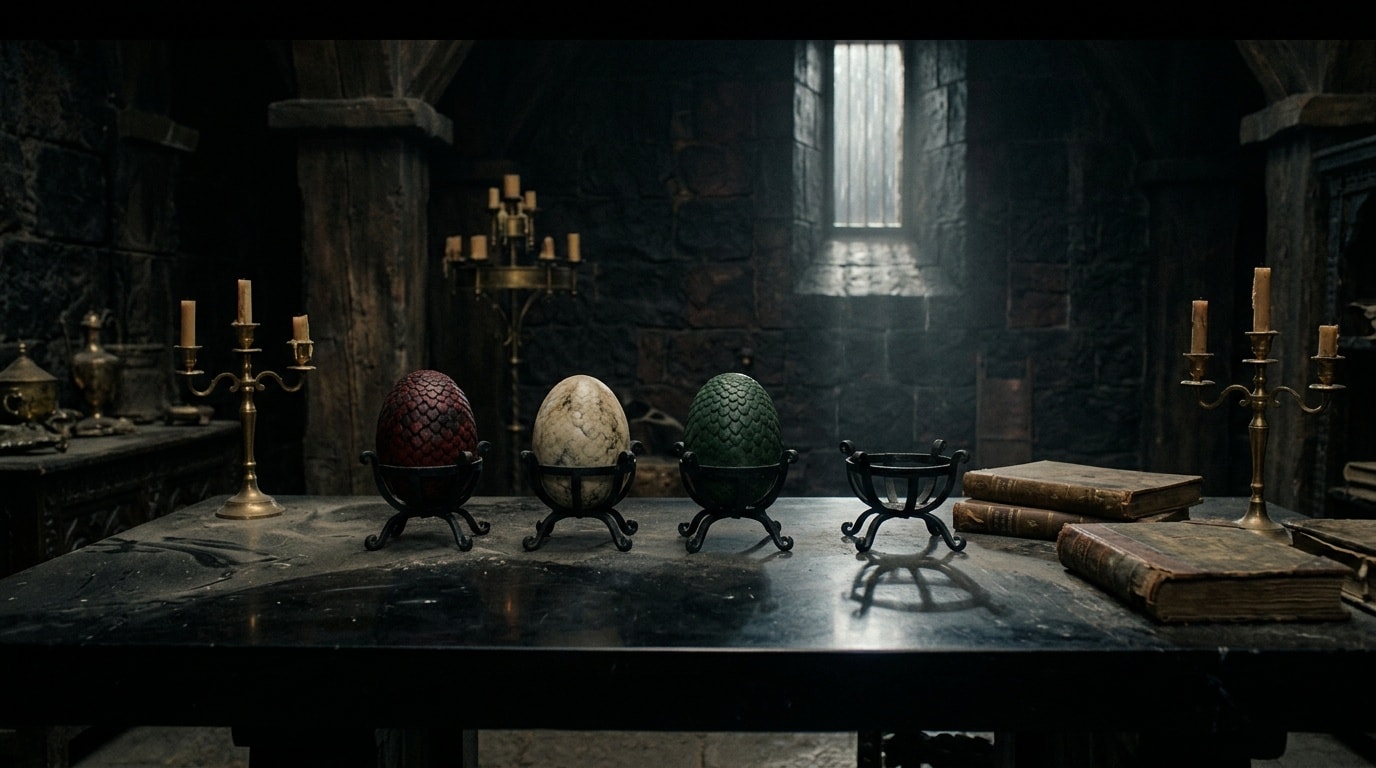
Rhaena's Four Eggs Become Daenerys's Three
The four dragon eggs Rhaenyra sends with Rhaena to Pentos are the same clutch that hatches into Drogon, Viserion, and Rhaegal at Daenerys Targaryen's wedding, with one egg lost somewhere in the intervening two centuries.