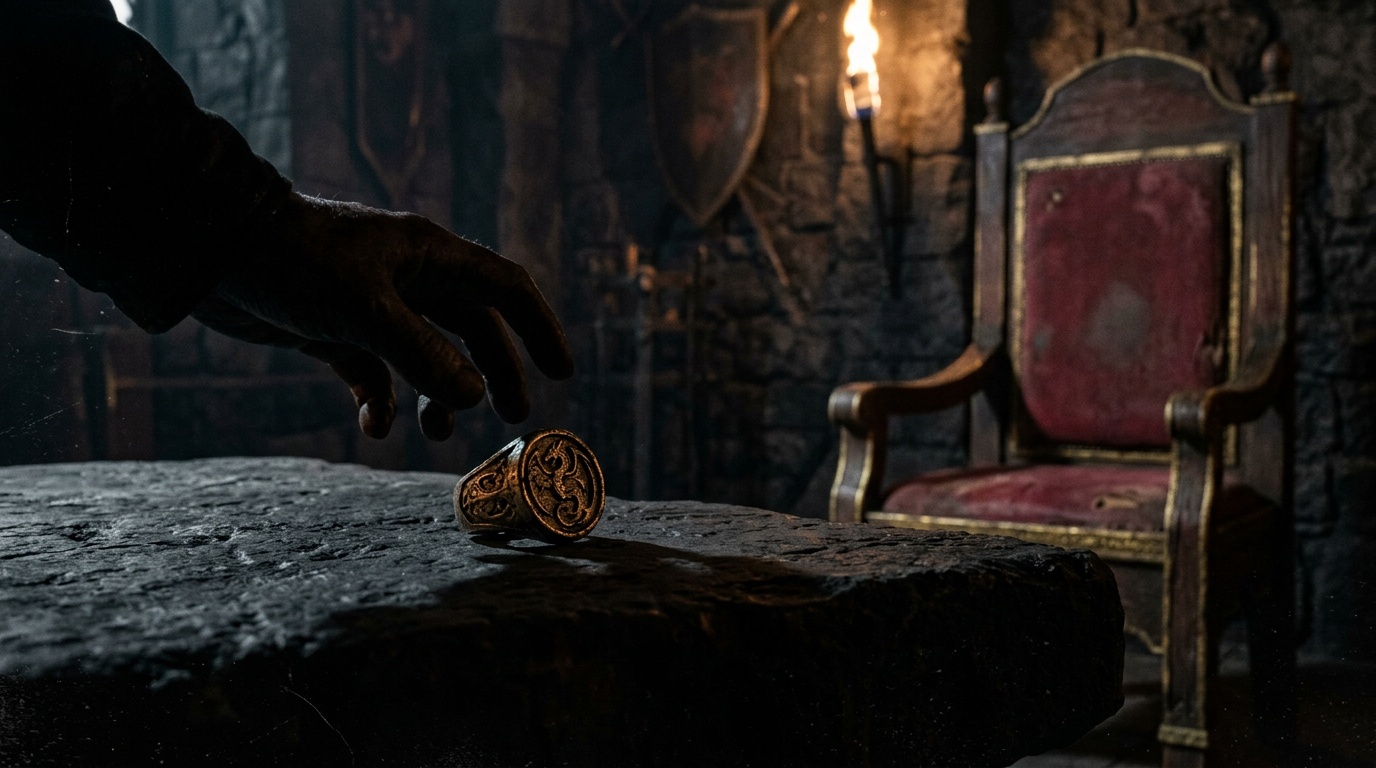
Daemon Trades a Loyalist for a Coalition
THE ARGUMENT
Daemon's execution of Willem Blackwood is not an act of authority but an act of submission, revealing that his power at Harrenhal is Oscar Tully's to grant rather than his own to wield. By complying without hesitation, Daemon accepts the terms of institutional governance he has always refused, without appearing to recognize that he has done so. The precedent now belongs to the Riverlords: Daemon bends when the political cost of refusal exceeds the personal cost of compliance.
How This Theory Works
Daemon kills Willem Blackwood not because he judges Willem guilty, but because he cannot afford not to. That distinction exposes something the show has circled without naming: Daemon does not understand that he has just accepted the same condition of governance he has spent his entire life refusing. Every prior act of violence in his history has been on his own initiative or in service of his own agenda. This one is commissioned by a boy lord who arrived with conditions, and Daemon met them without recorded hesitation.
Willem claims he was acting on Daemon's orders. Oscar dismisses this, but the dismissal is structurally convenient: it lets Oscar demand justice without implicating Daemon directly, while still requiring Daemon to perform contrition in public. The compliance reads less as confidence than as calculation. Daemon understands the arithmetic. One man's head for an entire coalition's banners is an obvious trade. What he does not appear to register is what it costs him beyond the immediate exchange: any man in his service now knows that Daemon will cut them loose the moment political math requires it.
The deeper problem is what Daemon believes he is building at Harrenhal versus what he is actually constructing. He arrived expecting a dragon and a Targaryen name to be sufficient instruments of authority. Oscar Tully's arrival proves they are not, and Daemon proves he knows it by complying. He has not secured the Riverlords' loyalty. He has purchased a conditional alliance by accepting a condition, which means the Riverlords now hold a precedent: Daemon bends when pressed hard enough. Oscar, young as he is, has already established the terms of every future negotiation. The vision of Viserys asking whether Daemon still wants the crown arrives at precisely this moment not as cosmic interruption but as the question Daemon's own psychology is generating: he has just done the thing Rhaenyra's governance would require of him, and he did it for a coalition rather than a queen.
Is this theory convincing?
Key Evidence
Oscar's Demand as Prerequisite
Oscar demands that Daemon prove himself worthy of the Riverlords' banners by showing contrition and dispensing justice before any allegiance is offered, structuring the execution as a condition rather than a choice.
Willem's Defense Implicates Daemon
Willem Blackwood claims his savagery against House Bracken was done on Daemon's orders, directly connecting Daemon to the atrocities that Oscar uses as justification for the loyalty test.
Daemon's Immediate Compliance
Daemon agrees to execute Willem without recorded hesitation, which contributors read as political calculation prioritizing coalition over personal loyalty rather than genuine agreement with the verdict.
Dragon Strength Proves Insufficient
Despite arriving at Harrenhal with a dragon and a Targaryen name, Daemon is still required to submit to Oscar's conditions, demonstrating that military threat alone cannot command Riverlord loyalty.
Daemon's Vision of Viserys
After the execution, Daemon experiences a vision of Viserys asking whether Daemon still wants the crown, positioning the execution as a moment that destabilizes rather than consolidates Daemon's ambition.
This theory was evaluated using Theory Atlas editorial standards, including evidence review, narrative fit, and competing interpretation analysis. Learn how Theory Atlas evaluates theories →
Other Theories for S2E07

Corlys Velaryon's Hidden Bloodline Is the Foundation of Rhaenyra's Dragonseed Program
Corlys Velaryon carries latent Valyrian dragon-bonding capacity through an undocumented maternal lineage, making Addam's bonding with Seasmoke a hereditary expression of Velaryon blood rather than a Targaryen derivation.

The Dragonseed Program Dismantles Jacaerys on Three Levels Simultaneously
Rhaenyra's decision to recruit dragonseed riders does not merely weaken Jacaerys's succession claim.
Rhaenyra's Dragonseed Program Is Falsifying Its Own Doctrine in Real Time
Rhaenyra's strategy of recruiting common-born dragonriders rests on three stacked inferences the show has not confirmed: that Seasmoke's acceptance of Addam proves Targaryen ancestry, that her pacification of Vermithor constitutes transferable authority over where that dragon's loyalty flows next, and that dragon bonding tracks the presence of legitimate will rather than its absence.
Alicent's Exit Leaves No One to Stop Aemond
Alicent's retreat to the Kingswood is the completion of a structural collapse she set in motion herself: the logic she installed in Aemond to make him a weapon has displaced her as its director and left the Green faction with no internal moderating force.
Rhaena's Detour Is a Dragon Claim
Rhaena's secret return toward Sheepstealer's territory is a deliberate dragon claim, not a detour.
Vhagar's Unbeatable Streak Has Ended
Vhagar was never unconditionally dominant.
Alyn of Hull Refuses Dragonrider Destiny
Alyn of Hull is not indifferent to power.
Hugh Hammer Entered the Dance Already Knowing His Claim
Hugh Hammer is the grandson of Jaehaerys I through Saera Targaryen, and he has known it his entire life.