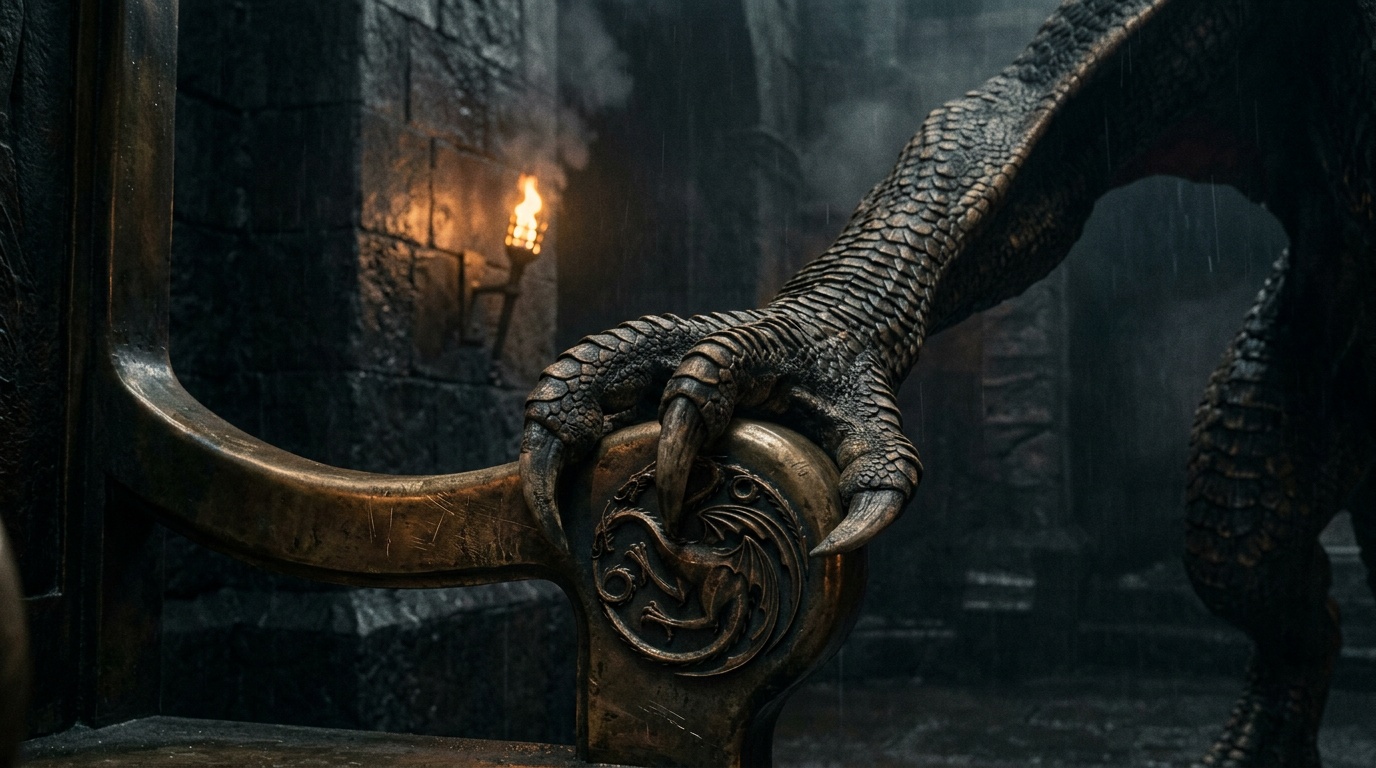
Hugh Hammer Entered the Dance Already Knowing His Claim
THE ARGUMENT
Hugh Hammer is the grandson of Jaehaerys I through Saera Targaryen, and he has known it his entire life. His silver hair, his mother's explicit comparison of him to Viserys and Daemon, his deliberate concealment of the knowledge to protect his wife, and Vermithor's categorical rejection of every candidate before him all converge on the same conclusion: Rhaenyra has not elevated a lucky soldier. She has armed a claimant whose dynastic legitimacy structurally predates her own cause.
How This Theory Works
Hugh Hammer is not a man who discovered what he was when a dragon bowed to him. He is a man who spent his entire adult life managing the knowledge that his blood was either an asset or a death sentence, and waiting for circumstances that would determine which. The evidence begins not with Vermithor but with Hugh's own words about his mother: a silver-haired woman who worked in a pleasure house and told her son he was no different from her brothers Viserys and Daemon. That statement has only one coherent reading. You do not compare a child to a king and a prince unless you are their sibling. Hugh's mother identified herself as Saera Targaryen, Jaehaerys's exiled daughter, last documented alive in Essos, and she made certain her son understood exactly what that made him.
Mysaria's framing to Rhaenyra retroactively charges this backstory with structural significance. When she tells Rhaenyra to look for dragonseeds not in woodpiles but under sheets, she is drawing on direct knowledge: she worked in a brothel where Targaryens spent considerable time and where their children were made and left behind. That is the pattern Mysaria is describing, and Hugh is its clearest embodiment. A silver-haired woman of obvious Valyrian lineage, working in the pleasure trade, telling her son he is the equal of the royal family she came from — this is not a coincidence or a rumor Hugh half-believed. It is a genealogy his mother delivered to him deliberately, because she wanted him to know what he was. Hugh's subsequent behavior, the concealment, the careful silence around his wife, the treatment of this knowledge as something that could get him killed, belongs to a man who understood the information. He did not stumble onto a secret. He was raised inside one.
That psychological portrait, of a man carrying a claim he has actively suppressed, is what separates Hugh from the other dragonseeds and explains the asymmetry in how he approaches Vermithor. The show frames the dragon pit sequence as a test of courage, and it is. But courage cannot account for the behavioral break. Vermithor had already incinerated every prior candidate before Hugh approached, which means the dragon was not in a mood of general tolerance. The shift from lethal hostility to submission requires something Hugh carried that the others did not. The show has already provided its own answer to that question in the same episode: when Seasmoke selected Addam on Driftmark, Rhaenyra concluded immediately that the dragon's choice confirmed Targaryen blood. The show establishes bloodline recognition as the operative framework for dragon bonding and then cuts to Vermithor, presenting Hugh's acceptance not as a miracle but as an application of the same principle the audience just watched Rhaenyra articulate.
The genealogical precision matters here. Hugh does not merely carry Targaryen blood in some general sense. He carries the Jaehaerys line specifically, the bloodline of Vermithor's only prior rider, a bond that lasted decades. A dragon bonded for that long to one person does not respond to temperament or desperation in a stranger. It responds to something it has encountered before. When Vermithor peers at Hugh and bows, the show is showing recognition, not generosity. The dragon has identified the closest living connection to the only person it ever accepted, and that connection runs through Saera to Jaehaerys, directly. Hugh almost certainly understood this too. A man who knows his mother was Saera Targaryen, who knows Jaehaerys's dragons are riderless, and who enters a war where those dragons are being offered to anyone brave enough to try: that man is not taking a blind gamble. He is making an informed bet on what his blood will do.
The sharpest implication is not about Vermithor. It is about Rhaenyra. The Dance of the Dragons is fought over competing interpretations of Targaryen succession, and every faction's claim derives its legitimacy from Jaehaerys's line. Hugh does not compete with Rhaenyra on her terms. He stands at the origin point of those terms. His claim does not require a Great Council ruling or a deathbed declaration or an interpretation of ancient tradition. It requires only that his mother was who she said she was, and Vermithor has already answered that question. Jacaerys warned Rhaenyra that a dragonseed might decide to rule. The deeper problem is that she may have handed Vermithor to someone who has known for decades that he could.
Is this theory convincing?
Key Evidence
Vermithor Kills Candidates Before Hugh
Vermithor breathes fire and kills multiple dragonseed candidates who approach before Hugh, demonstrating that the dragon's eventual acceptance of Hugh was not a general openness to new riders.
Dragon Calms Inexplicably for Hugh
After incinerating the prior candidates, Vermithor peers at Hugh and then bows down to accept him, a behavioral shift the show presents without explicit explanation.
Hugh's Readiness to Die
Hugh approaches Vermithor prepared to accept his fate, but the theory argues this bravery is insufficient on its own to explain the dragon's response given that other candidates showed comparable desperation.
Jaehaerys as Vermithor's Sole Prior Rider
Vermithor's only known rider was King Jaehaerys I, making direct descent from Jaehaerys the most targeted bloodline that could trigger the dragon's recognition.
Seasmoke Selects Addam Same Episode
In the same episode, Seasmoke selects Addam of Hull on Driftmark, and Rhaenyra immediately concludes he must carry Targaryen blood, establishing bloodline as the operative framework for dragon bonding the show itself endorses.
Rhaenyra Fears a Dragonseed Rival Claimant
Jacaerys warns Rhaenyra directly that a dragonseed dragonrider might decide to rule the Seven Kingdoms themselves, framing Hugh's bond with Vermithor as a potential dynastic threat rather than just a military asset.
This theory was evaluated using Theory Atlas editorial standards, including evidence review, narrative fit, and competing interpretation analysis. Learn how Theory Atlas evaluates theories →
Other Theories for S2E07
Corlys Velaryon's Hidden Bloodline Is the Foundation of Rhaenyra's Dragonseed Program
Corlys Velaryon carries latent Valyrian dragon-bonding capacity through an undocumented maternal lineage, making Addam's bonding with Seasmoke a hereditary expression of Velaryon blood rather than a Targaryen derivation.
The Dragonseed Program Dismantles Jacaerys on Three Levels Simultaneously
Rhaenyra's decision to recruit dragonseed riders does not merely weaken Jacaerys's succession claim.
Rhaenyra's Dragonseed Program Is Falsifying Its Own Doctrine in Real Time
Rhaenyra's strategy of recruiting common-born dragonriders rests on three stacked inferences the show has not confirmed: that Seasmoke's acceptance of Addam proves Targaryen ancestry, that her pacification of Vermithor constitutes transferable authority over where that dragon's loyalty flows next, and that dragon bonding tracks the presence of legitimate will rather than its absence.
Alicent's Exit Leaves No One to Stop Aemond
Alicent's retreat to the Kingswood is the completion of a structural collapse she set in motion herself: the logic she installed in Aemond to make him a weapon has displaced her as its director and left the Green faction with no internal moderating force.
Rhaena's Detour Is a Dragon Claim
Rhaena's secret return toward Sheepstealer's territory is a deliberate dragon claim, not a detour.
Vhagar's Unbeatable Streak Has Ended
Vhagar was never unconditionally dominant.
Alyn of Hull Refuses Dragonrider Destiny
Alyn of Hull is not indifferent to power.
Daemon Trades a Loyalist for a Coalition
Daemon's execution of Willem Blackwood is not an act of authority but an act of submission, revealing that his power at Harrenhal is Oscar Tully's to grant rather than his own to wield.