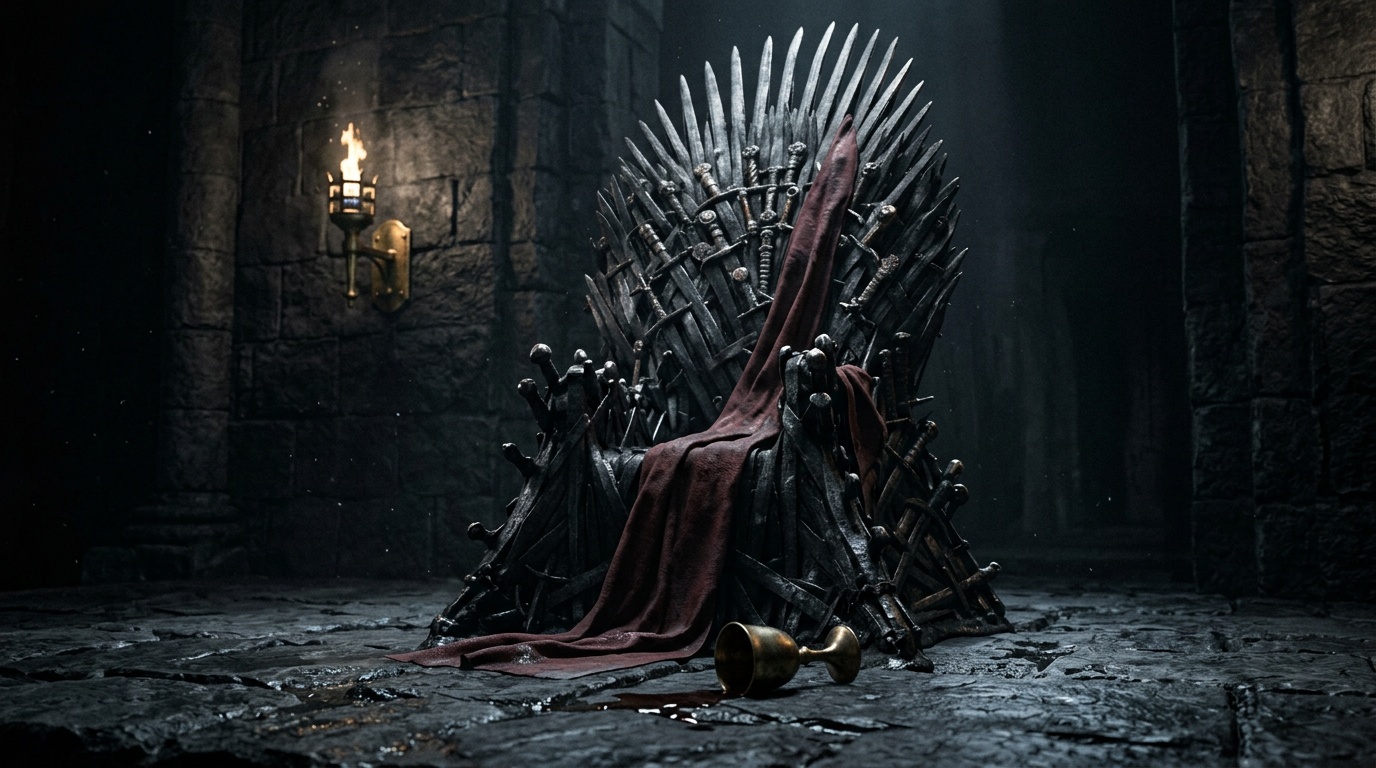
Grief Makes Rhaenyra Cross the Final Line
THE ARGUMENT
Rhaenyra took King's Landing as a mother shattered by grief, and the execution of Otto Hightower, performed while she wept openly, was the first life she had ever personally taken. The throne she now occupies was seized in a state of psychological rupture. The reign that follows belongs to whoever she becomes once the numbness lifts.
How This Theory Works
Rhaenyra's first response to Jace's body is to call out for him as though he might still answer. That is a mother who cannot process what she is looking at, and the grief that follows does not crystallize into clarity. It destabilizes. The show refuses to grant her the clean, steeling moment that war narratives often give to leaders at their lowest point. What we get is a woman who assaults King's Landing in emotional rupture, beheads Otto Hightower while openly weeping, and then sits down on the Iron Throne in a condition the episode frames as shaken. The throne is a place she has stumbled into while still inside the event that broke her.
That trajectory matters because of what it tells us about how she got there. For the entirety of the Dance of Dragons up to this point, Rhaenyra's violence has been proxied through others. Daemon fights. Jace commands. The dragonseeds fly sorties. Her hands have stayed clean by institutional design, and that distance has allowed her to function as a queen issuing orders without confronting what those orders produce at close range. Jace's body closes that distance. The assault on King's Landing follows directly from his death, and the episode frames the attack as emotionally driven by loss. The execution of Otto is the first life she has personally taken, and the show emphasizes that she had no practiced emotional framework for it. She weeps through the entire act.
The sharpest implication of this reading concerns the agreement she struck with Alicent. Rhaenyra's promise to spare Alicent's family, made in exchange for the opening of the gates, was extended by a woman who had not yet killed anyone with her own hands. She made that promise before crossing the threshold that Otto's beheading represents. Alicent then watched her father die at the hands of a queen who was crying. That is a foundation cracked before the mortar has set. It is the first fracture in an agreement that was already fragile, and what opened it was grief and psychological rupture, two things entirely outside the terms of their negotiation.
The episode's visual grammar reinforces this at every turn. Rhaenyra calling out to Jace, weeping through the execution, arriving at the throne shaken rather than triumphant: the show constructs a picture of a woman who did not choose this moment so much as arrive at it through a sequence of events that overwhelmed her capacity to choose. The ruler she intended to be made a promise of mercy. The ruler who beheaded Otto Hightower while sobbing is someone whose relationship to that promise is already complicated by what she has just done. Whether those two versions of Rhaenyra can be reconciled is the problem the throne now hands her.
Is this theory convincing?
Key Evidence
Rhaenyra's denial at Jace's body
When Jace's body is brought back, Rhaenyra's first response is to call out for him as though he might still be alive, showing maternal denial rather than a queen processing a military loss.
Sobbing through Otto's execution
Rhaenyra weeps throughout her execution of Otto Hightower, her first personal act of killing, framing the moment as emotional rupture rather than sovereign decisiveness.
Throne claimed in shaken state
Rhaenyra walks to the Iron Throne and sits down described explicitly as shaken, not triumphant, suggesting the emotional cost of what she just did rather than a moment of fulfilled ambition.
First personal act of violence
Until this episode, all violence in Rhaenyra's name had been carried out by proxies including Daemon, Jace, and the dragonseeds, making the execution of Otto her first direct crossing into personal killing.
Grief as catalyst for King's Landing assault
The assault on King's Landing follows directly from Jace's death, with the episode framing the attack as emotionally driven by loss rather than as the culmination of a deliberate strategic plan.
Alicent witnesses father's beheading
Alicent, who struck a secret deal with Rhaenyra to spare her family in exchange for opening the gates, watches Rhaenyra execute her father Otto while sobbing, immediately straining the agreement she risked everything to make.
This theory was evaluated using Theory Atlas editorial standards, including evidence review, narrative fit, and competing interpretation analysis. Learn how Theory Atlas evaluates theories →
Other Theories for S3E02

Otto Hightower Was Left Alive on Purpose, and the Execution Was Staged Before the Wrong Audience
Larys Strong left Otto Hightower alive in the Red Keep dungeons as what may have been a calculated act of sabotage timed to detonate Rhaenyra's alliance with Alicent at its first test.
Otto's Death Breaks the Deal Permanently
Alicent almost certainly reads Otto's execution as confirmation that Rhaenyra held him prisoner throughout their negotiations, staging his death as a public demonstration of power.
Jace's Last Order Doomed the Black Fleet
Jacaerys's order to lock Rhaenyra in her chambers was an unauthorized transfer of command authority executed through a named knight, leaving the Black fleet without sovereign direction at the Battle of the Gullet.
Rhaena Rode Sheepstealer and Lost Jace
Rhaena rode Sheepstealer at the Battle of the Gullet, lost control of the dragon under combat pressure, and bears direct responsibility for Jace's death as a consequence.
Alys Rivers Already Knew Aemond Was Coming
Alys Rivers used Daemon's presence at Harrenhal as a step in a sequence she had already mapped, extracting what she needed from his visit and discarding him the moment he served his purpose.