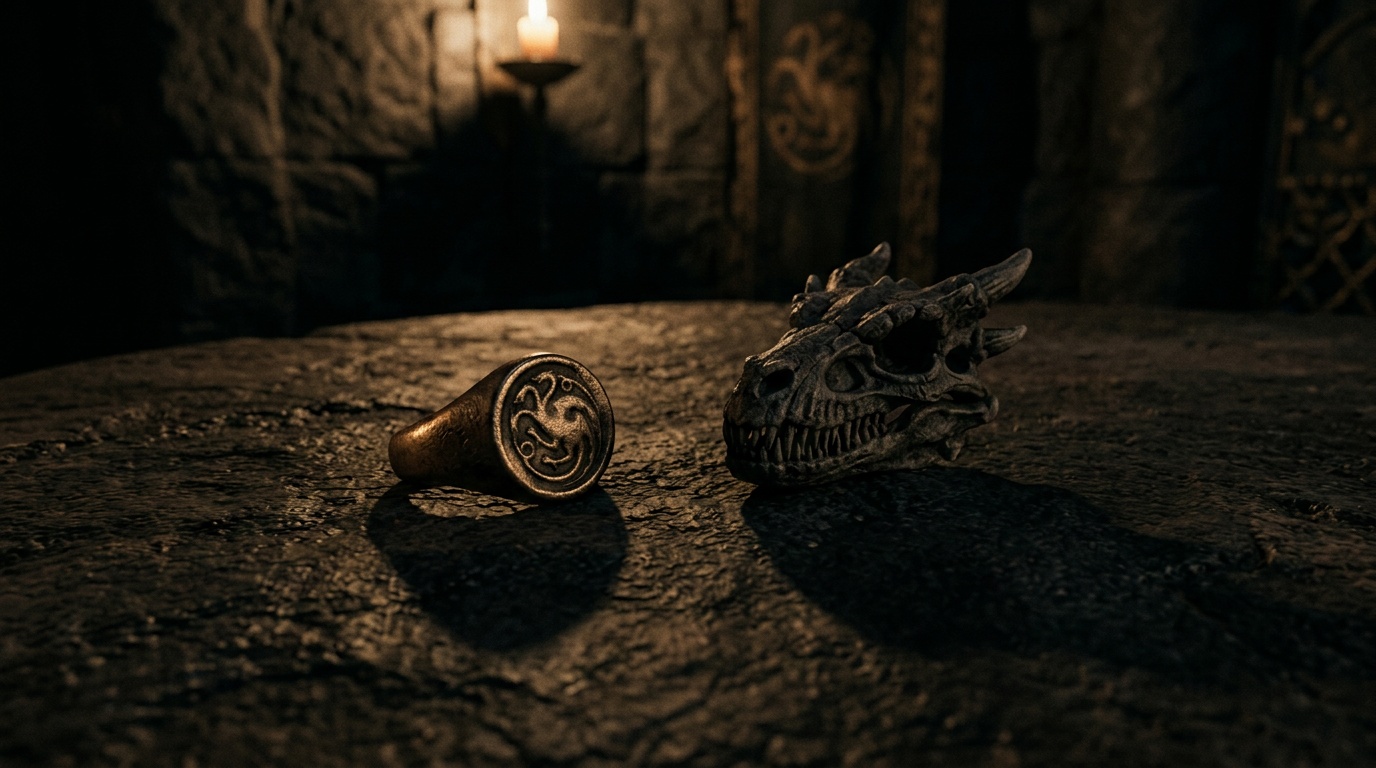
Daemon Mapped His Queen's Tolerance and Used It
THE ARGUMENT
Daemon concealed Rhaena's identity as Sheepstealer's rider because he had already calculated that framing his deception as paternal protection was the one condition under which Rhaenyra would absorb it without punishing him. His read was correct, and Rhaenyra's non-punitive response confirms he has now located and tested the ceiling on her distrust. The deeper cost is that this calculation retroactively converts every prior gesture of loyalty, most sharply the skull he gave her at her most vulnerable, into evidence of a marriage that has always been managed.
How This Theory Works
The episode frames Daemon's choice as a father protecting his daughter, and that framing holds as far as it goes. When he could not talk Rhaena out of hunting Vhagar, he offered to join her plan and kept it from Rhaenyra entirely. That is a deliberate subordination of his political obligation, which means he also weighed the cost of eventual discovery and found it survivable. His confession to Rhaena about his own neglected childhood, left alone after his mother's death, without a dragon of his own, provides the psychological account of why he acted. It does not change the fact that he chose, with full awareness of what he was doing, to deceive his queen. The paternal instinct and the political calculation were not in competition. They ran together, and the calculation depended on the instinct being legible to Rhaenyra when the time came.
The tool he relied on is visible in her response. Rhaenyra confronts him, hears that he was protecting Rhaena, and walks away without consequence. Mysaria had already asked the structural question: is there anything Daemon could do that Rhaenyra would truly not believe? The episode answers it obliquely. Protection of someone he loves is the frame that suspends Rhaenyra's political judgment. It does not matter that he operated outside her command structure. It does not matter that Mysaria was actively building a case for his treachery. The filial explanation closes the inquiry. Daemon appears to have known this before he made the choice, and Rhaena's parallel logic, acting outside Rhaenyra's authority to pay a personal debt and earn mercy, suggests father and daughter were running the same instinct: act first, justify to Rhaenyra later, trust that love will be accepted as sufficient currency. What reads as two people independently improvising is better understood as two people who have both internalized the same truth about their queen.
The skull is where the political calculation becomes a wound that cannot be undone. Rhaenyra told Daemon she had looked at it a hundred times believing it belonged to Jace's killer. He brought her that skull as consolation and proof of devotion at the moment she was most exposed. She now knows it was also cover for a secret he was keeping on behalf of his daughter. Every comfort she drew from it has been retroactively recolored. The lie did not merely deceive her once. It colonized her grief at its most acute point and administered that grief according to Daemon's private judgment about what she needed to believe. Her line, 'All this time, you knew,' marks the moment she understands the full scope of it: not a single act of omission but a sustained posture toward her.
Daemon's own defense encodes the problem he cannot resolve. He tells her Rhaena implored him, that she could not face the queen, that he wished only to protect his daughter. Each reason is individually defensible, and together they confirm exactly what Mysaria had suggested: he will deceive Rhaenyra whenever he personally judges concealment to be the kinder or more necessary option. The apology asks her to trust that his judgment about when to withhold will always align with her interests. The skull is direct evidence that it will not. The justification does not explain the breach away. It proves the breach was the system working as intended, that Daemon loves her partly by managing what she knows, the way a parent calibrates a child's exposure to unbearable things. Rhaenyra understands this now, and that understanding is not something an apology can reach.
Her cold dismissal, 'It's late,' and her departure without verbal reconciliation, suggest she has already completed the internal reckoning and chosen, for now, to keep functioning beside him. That choice is its own kind of information. She cannot afford to lose him. She cannot read protection of the people he loves as treason without losing the political logic that makes their alliance hold. Daemon appears to have known both of those things with a precision the show has not required him to state aloud. The condition under which he is effectively untouchable has been located, confirmed, and survived. Any future act he commits in the name of someone he loves now carries the same structural defense, and Rhaenyra has just demonstrated she will accept it. Whether she accepted it because she believes him, or because she has already quietly internalized that this is the form his love takes and she must work within it, is what 'It's late' refuses to resolve.
Is this theory convincing?
Key Evidence
Daemon Offers to Help Hunt Vhagar
When Daemon cannot talk Rhaena out of her plan, he offers to join her in hunting Vhagar rather than reporting her to Rhaenyra, a choice that subordinates his political obligation to his protective instinct toward his daughter.
Daemon's Confession of Neglect
Daemon tells Rhaena he had no dragon when he was young and was left alone after his mother's death, framing his concealment of her rider identity as an attempt to repair long-standing paternal failure.
Rhaenyra's Non-Punitive Response
After discovering Rhaena was Sheepstealer's rider all along, Rhaenyra confronts Daemon but accepts his explanation that he was protecting his daughter, choosing not to treat the deception as a political betrayal.
Daemon's Explicit Justification
Daemon tells Rhaenyra directly that Rhaena implored him not to reveal her identity, that he wished only to protect her, and frames it as a conflict between his role as husband and his role as father.
Mysaria's Unanswered Question
Mysaria asks Rhaenyra whether there is anything Daemon could do that she would truly not believe, a question the episode leaves structurally open even after Rhaenyra accepts Daemon's account.
Rhaena's Motive Mirrors Daemon's
Rhaena tells Daemon she sought Vhagar to pay her debt to Rhaenyra and earn mercy, showing that both father and daughter were operating outside Rhaenyra's command structure out of a shared sense of obligation and shame.
This theory was evaluated using Theory Atlas editorial standards, including evidence review, narrative fit, and competing interpretation analysis. Learn how Theory Atlas evaluates theories →
Other Theories for S3E07
Mysaria Seduces a Queen She Means to Rule
Mysaria's flattery, counsel, and physical intimacy with Rhaenyra constitute a sustained bid for shadow authority, using Rhaenyra's emotional need for validation as the lever and her growing political uncertainty as the fuel.
Aemond Means to Found a New Kingdom
Aemond has abandoned the Iron Throne as a goal and intends to establish Harrenhal as the seat of an entirely new dynasty, independent of both Rhaenyra and the Greens.
Alys Rivers Built Aemond's Collapse
Alys Rivers allowed Alicent's poison to reach Aemond because a warning proved correct in real time is worth more than an interception that goes unremembered.
Sunfyre Restores Aegon as an Instrument of Ruin
Sunfyre's return has not made Aegon a more capable king; it has made him a more dangerous one, by converting his survival into theological certainty that forecloses the compromise governance requires.
Rhaena Caused Jaces Death at the Gullet
Rhaena rode Sheepstealer at the Battle of the Gullet, lost control, and her loss of control killed Jacaerys Velaryon.
Helaena's Gray Mare Encodes a Coming Death
The gray mare Helaena names in response to Rhaenyra's interrogation is a death omen aimed at Rhaenyra herself, delivered in plain sight to the one person who cannot afford to read it clearly.