Sunfyre Restores Aegon as an Instrument of Ruin
THE ARGUMENT
Sunfyre's return has not made Aegon a more capable king; it has made him a more dangerous one, by converting his survival into theological certainty that forecloses the compromise governance requires. The show is building toward a configuration in which Aegon's restored agency is oriented entirely toward destruction: a rider who interprets divine mandate as permission to burn, paired with a second rider whose loyalty is purchased through appetite for revenge. What the Dance produces on Aegon's side is a pure mandate for annihilation, and Sunfyre is its proof.
How This Theory Works
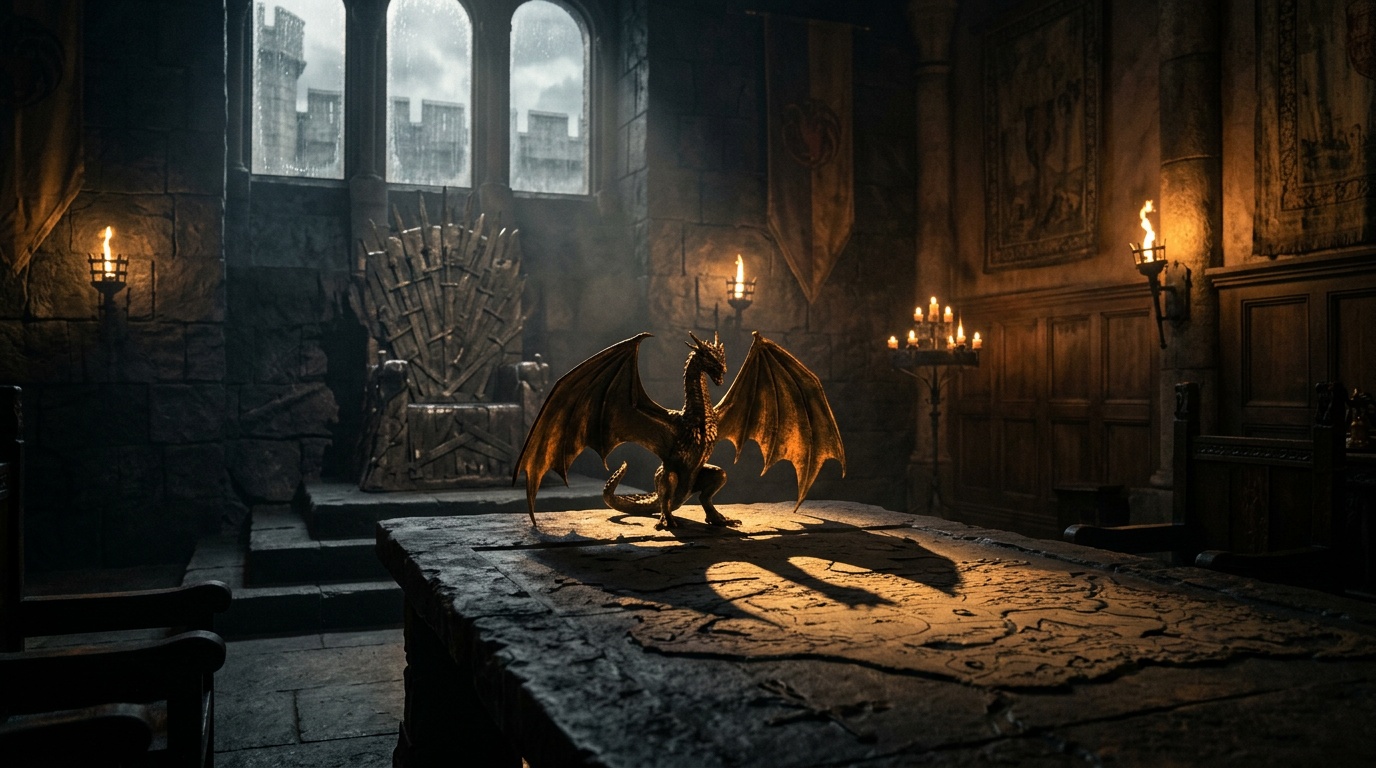
The central argument is about what Sunfyre's arrival actually does to Aegon psychologically, and the answer the show provides is more troubling than a simple restoration of power. Aegon spent prior episodes stripped of every symbol of authority, a dust-covered fugitive who had accepted death. His speech before Mooton's soldiers, invoking divine anointing and threatening holy retribution, reads as the declaration of a man who has already surrendered the ambition to win and wants only to die as something recognizable. When Sunfyre emerges from the dark with fire in its jaws, treating the stand as a summons, the episode transforms that surrender into sacred confirmation. For a man whose entire sense of self rests on the idea that he was anointed, a dragon answering a divine invocation is theological proof. The danger of theological proof is specific: it requires no further argument and tolerates no compromise.
Aegon's first command upon Sunfyre's arrival is 'Dracarys.' He laughs as the soldiers burn and flee. This is the evidence's sharpest exhibit, because it is the first act of restored agency and it is oriented entirely toward annihilation. A commander consolidating power calculates. Aegon's response to proof of divine mandate is immediate, instinctive destruction. His prior insistence across multiple episodes that Sunfyre was alive, despite the dragon showing no observable signs of life, reinforces the interpretation: Aegon's bond with Sunfyre operates on a level that bypasses evidence, which is precisely the psychology that makes theological certainty so durable and so ungovernable.
The Ulf White recruitment tightens the argument. In the same episode, Ormund delivers a second dragon rider to Aegon's cause by promising Driftmark and validating a grievance against Rhaenyra and Daemon. Two riders whose first instinct is to answer humiliation with dragonfire are the precise configuration that produces the burning of the Reach. The show is assembling a coalition incapable of building a monarchy.
The sharpest implication the evidence points toward is this: Sunfyre's survival has given Aegon the one thing that makes him genuinely catastrophic. A man who doubted his mandate, or who wanted power badly enough to bargain for it, could be negotiated with, outmaneuvered, or exhausted into concession. A man who has received confirmation from a dragon, whose theology has just been proven in fire, has psychologically closed off every mechanism that governance depends on. The episode stages this as triumph. The structure of what it has assembled points toward ash.
Is this theory convincing?
Key Evidence
Sunfyre Answers Aegon's Declaration
As Aegon delivers his coronation-speech defiance before Mooton's soldiers, Sunfyre emerges from the dark with fire in its jaws, directly answering what Aegon had framed as a divine invocation, which the episode presents as the dragon treating the stand as a summons.
Immediate Order to Burn Soldiers
Aegon's first command upon Sunfyre's arrival is 'Dracarys,' ordering the dragon to incinerate the soldiers, and he laughs as they die and flee, establishing destruction as the immediate and instinctive use of restored agency.
Aegon's Divine Mandate Speech
Aegon publicly announces himself as Viserys' true heir, invokes the Seven's anointing, and threatens divine retribution, framing his survival not as political strategy but as theological proof that he remains chosen.
Prior Insistence Sunfyre Lived
Aegon had maintained across prior episodes that he could feel Sunfyre was alive despite the dragon showing no signs of life, and the episode's confirmation of this supports the reading that Aegon's bond with Sunfyre operates on a level that bypasses observable evidence and reinforces his belief in his own special status.
Fugitive Made King by Dragon
The episode explicitly stages Aegon's transformation from a dust-covered fugitive who had accepted death to a laughing, victorious claimant within a single scene, with Sunfyre's appearance as the sole catalyst, underscoring that the dragon's return is the entire mechanism of his restored agency.
Ulf Recruited with Driftmark Promise
In the same episode, Ormund recruits Ulf White to Aegon's side by promising him Driftmark and validating his grievance against Rhaenyra and Daemon, pairing Aegon's destructive restoration with a second dragon rider motivated entirely by appetite for revenge and reward.
This theory was evaluated using Theory Atlas editorial standards, including evidence review, narrative fit, and competing interpretation analysis. Learn how Theory Atlas evaluates theories →
Other Theories for S3E07

Mysaria Seduces a Queen She Means to Rule
Mysaria's flattery, counsel, and physical intimacy with Rhaenyra constitute a sustained bid for shadow authority, using Rhaenyra's emotional need for validation as the lever and her growing political uncertainty as the fuel.
Daemon Mapped His Queen's Tolerance and Used It
Daemon concealed Rhaena's identity as Sheepstealer's rider because he had already calculated that framing his deception as paternal protection was the one condition under which Rhaenyra would absorb it without punishing him.
Aemond Means to Found a New Kingdom
Aemond has abandoned the Iron Throne as a goal and intends to establish Harrenhal as the seat of an entirely new dynasty, independent of both Rhaenyra and the Greens.
Alys Rivers Built Aemond's Collapse
Alys Rivers allowed Alicent's poison to reach Aemond because a warning proved correct in real time is worth more than an interception that goes unremembered.
Rhaena Caused Jaces Death at the Gullet
Rhaena rode Sheepstealer at the Battle of the Gullet, lost control, and her loss of control killed Jacaerys Velaryon.
Helaena's Gray Mare Encodes a Coming Death
The gray mare Helaena names in response to Rhaenyra's interrogation is a death omen aimed at Rhaenyra herself, delivered in plain sight to the one person who cannot afford to read it clearly.