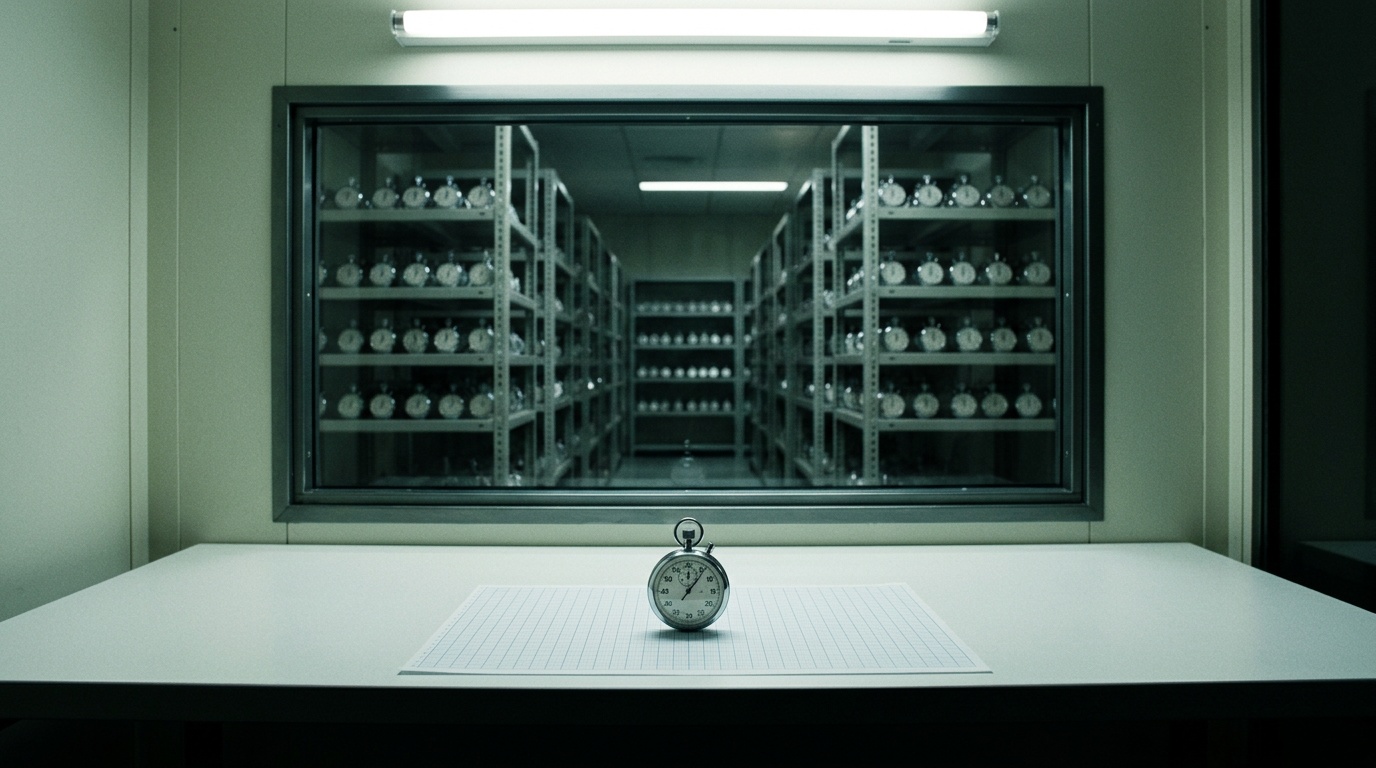
Mark Is Mapping the Severance Switch Itself
THE ARGUMENT
Mark's outie is conducting a structured timing experiment on the severance transition itself, using a stopwatch and silent manual count to measure the switch as a quantifiable interval Lumon has never disclosed. The two-phase measurement and the specific count of 37 point to iterative data collection, not punctuality. The most uncomfortable implication is that the experiment did not begin with curiosity but with a prior suspicion specific enough to design a protocol around.
How This Theory Works
Mark's outie is running a covert experiment on the severance mechanism itself, and the opening sequence is the lab. He starts a stopwatch at the building entrance, pauses it precisely at the locker when he removes the watch, then switches to a silent manual count that he holds through the wardrobe change and carries right up to the moment of transition. The two-phase approach is the tell: he knows the watch cannot survive the switch, so he transfers the measurement into a form the chip cannot strip away. A man who only wanted to be punctual would not need to count silently in his head through a wardrobe change.
The count reaching 37 before transition is the sharpest piece of evidence. That specific number implies a repeatable endpoint, not a vague impression. Mark is building a dataset. The goal, on the most aggressive reading, is to determine whether the transition interval is fixed or variable, which would tell him something the severance protocol has never disclosed: whether the chip operates on a timer, a physical trigger, or a biological threshold. That distinction matters enormously if his outie is searching for a way to communicate across the severance boundary or to predict when his innie will surface.
The sprint, the impatience at the reception desk, the ritualized changing sequence: all of it functions as variable control between trials. You do not optimize a routine you are only performing once. The outie is the only participant in this experiment. Because the innie has no awareness of the timing ritual, whatever Mark is building stays entirely on his outie side, which means he is accumulating private knowledge about the severance mechanism that Lumon has withheld from every severed employee. The question is not whether he is studying the switch. The question is what he already knows that made him start.
Is this theory convincing?
Key Evidence
Stopwatch Started at Building Entrance
Mark starts a stopwatch on his watch the moment he begins running toward the Lumon entrance, treating his arrival as the beginning of a timed interval rather than simply rushing to be on time.
Watch Paused at Locker Transition
Mark pauses the stopwatch precisely as he removes his watch at the locker and switches to a silent manual count, a two-phase approach that suggests he knows the watch cannot survive the severance transition and is compensating.
Manual Count Held Until Switch
Mark continues counting manually through his wardrobe change and holds the count right up until the moment he transitions to his innie self, treating the switch as a measurable endpoint.
Specific Count Reaching 37
The count reaches the specific number 37 before transition, implying a repeatable and precise measurement rather than a rough impression, consistent with iterative data collection.
Routine Optimized for Consistency
Mark's impatience at the reception desk and the sprint down the stairs suggest he is controlling variables to make each trial comparable, which is unnecessary behavior for simple punctuality.
Outie Studying Process Innie Cannot Access
Because the innie has no awareness of the timing ritual, the experiment exists entirely on the outie side, suggesting Mark's outie is building knowledge about the severance mechanism that Lumon has withheld from all severed employees.
This theory was evaluated using Theory Atlas editorial standards, including evidence review, narrative fit, and competing interpretation analysis. Learn how Theory Atlas evaluates theories →
Other Theories for S2E03
Lumon's Compliance Machine Built a Rival Husband
Lumon's family visitation protocol is a behavioral governance instrument, not a welfare accommodation, designed to convert emotional susceptibility into metered compliance.
Irving's Dreams Are a Map to the Exports Hall
Irving's outie has been painting a specific hallway that corresponds to a real location on the severed floor: the exports hall in Optics and Design.
Lumon's Loyalty Protocol Destroys What It Was Built to Preserve
Lumon's recanonized Kier paintings are a standardized loyalty protocol that instrumentalizes identity as recursive capture — transforming an employee's own self-image into the mechanism of their containment.

Lorne Knows Ms. Casey Was Not Released
Lorne does not believe Ms.
Lumon Weaponizes Language to Control Innies
Lumon has built a cross-departmental linguistic register that delivers Kier-based ideological conditioning below the threshold of conscious recognition, embedding doctrine not in what employees are told to think but in the grammatical structures through which they are permitted to report thinking it.
Reintegration This Early Changes Everything
Mark pursuing reintegration in episode 3 is a structural signal that the season's central conflict is something the show has not yet named, because no serialized drama spends its finale card this early without believing something worse is waiting.
Mark's Guilt Is Sabotaging His Innie Romance
Mark did not retain knowledge of Gemma by accident.

Cobel Fled Because She Knew the Trap
Cobel reversed in the parking lot not from intuition but from recognition: the board's invitation carried the structural signature of a containment maneuver she had personally used against others, and she identified herself as the target before she reached the entrance.