Dieter Is Kier's Repressed Self, Not His Brother
THE ARGUMENT
Dieter Eagan was Kier's psychological projection, not his brother, a constructed figure through whom Kier could externalize and ritually destroy the desiring, undisciplined parts of himself that threatened his commercial identity. If the founding mythology is itself a story about splitting an identity in two and eliminating the inconvenient half, severance is not Lumon's innovation but its reenactment of that original act. The severed workers are not employees. They are Dieters.
How This Theory Works
Kier Eagan was not a man who lost a brother. He was a man who could not tolerate what his brother represented in himself, and he built a religion around that intolerance. Dieter shares Kier's origin, travels with him as a constant companion, and dies in a manner so grotesque and sexualized that the text reads less like biography and more like a parable of suppression. Masturbation as the mechanism of physical dissolution, hair and eye lost before he melts into the forest floor, is not the death of an enemy. It is the death of a desire. Kier walks to the waterfall to drown out Dieter's cries, and Woe tells him the fate was his own doing. The guilt is built into the founding text because the founding text is a confession.
The show reinforces this reading structurally. Each MDR worker is given a silent double during the retreat, a figure that looks like them but only points directions and never speaks. Milchick frames this as a gift mirroring Kier's relationship with Dieter. But if Dieter was a psychological projection rather than a biological sibling, these silent doubles are something stranger: stand-ins for the parts of each innie that have been rendered unable to speak for themselves. The parallel is not subtle enough to escape Helly, who identifies the text as absurd on contact. Milchick's response is the more important data point. He does not defend the text's factual accuracy. He polices the reaction. That is not a denial. It is an admission that the text is not meant to be evaluated as fact.
What the theory refuses to say plainly is this: Kier may not have believed Dieter was real even while the myth was being constructed. The founding story of Lumon is not a memory of a twin who died. It is a document produced by a man who needed his own appetite to have a face, a name, and a cause of death he could point to. Every Lumon ritual that descends from this text, including severance itself, is structured around the same need. The innie is not a labor product. The innie is the part of the self that wants the wrong things, and the entire apparatus exists to ensure it can be made to dissolve without the outie having to hear it happen.
Is this theory convincing?
Key Evidence
Dieter's Sexualized, Grotesque Death
The Fourth Appendix describes Dieter masturbating, then losing his eye and hair before dissolving into the forest, framing his destruction as a consequence of shameful desire rather than any external conflict.
Kier's Guilt Confirmed by Woe
The text states that Woe appeared at the waterfall and told Kier that Dieter's fate was his own doing, embedding culpability into the founding myth itself.
Silent Doubles Mirror Each Worker
Milchick provides each MDR innie with a lookalike figure that silently guides them, explicitly linking the device to Kier's relationship with Dieter and suggesting the twin dynamic is psychological rather than biological.
Dieter Sought Freedom from Commerce
The Fourth Appendix establishes that Dieter wanted to live in the woods as a pauper while Kier pursued industry, casting the twin as the anti-capitalist, pleasure-seeking impulse Kier needed to overcome.
Helly's Laughter, Milchick's Deflection
When Helly mocks the text as the dumbest thing she has ever heard, Milchick responds by saying they laugh at what they do not understand, refusing to assert factual accuracy and instead policing the reaction.
Forbidden Text Held in Scissor Cave
The Fourth Appendix is described as forbidden on the severed floor, given such sanctity that workers are only allowed to encounter it in a controlled ritual setting, suggesting its content carries dangerous interpretive weight.
This theory was evaluated using Theory Atlas editorial standards, including evidence review, narrative fit, and competing interpretation analysis. Learn how Theory Atlas evaluates theories →
Other Theories for S2E04
Helena Eagan Has Been Helly All Along
The person the MDR team has accepted as innie Helly throughout Season 2 is actually Helena Eagan, her outie, running an extended impersonation on the severed floor -- feeding information to Lumon management and using the retreat to surveil how far the group will go in defiance.
Grief Cannot Be Severed From the Body
The severance chip blocks information, but grief is not stored as information.

Kier Killed Dieter and Buried the Evidence
Kier Eagan murdered his twin brother Dieter and authored the Fourth Appendix as the sole surviving account, engineering a grotesque punitive myth that redirected culpability onto the victim.
Lumon's Retreat Is a Ritual Conviction System
The wilderness retreat in 'Woe's Hollow' is not a team-building exercise but a closed theological system designed to make innie defiance impossible to experience as morally neutral.

Irving's Outdoor Past Was Never Erased
Irving's innie is not protecting a secret he was told about but one that has crossed the severance barrier without his knowledge, surfacing as instinctive defensiveness rather than retrievable memory.
Helena Slept With Mark for Reasons She Cannot Name
Helena Eagan did not sleep with Mark to secure her cover.
Lumon's Small Lies Are the Big Control
Lumon's severance procedure does not just erase memory; it surgically removes the social and epistemic infrastructure through which employees could challenge any claim the company makes.
Irving's Farewell Encodes the Overtime Contingency
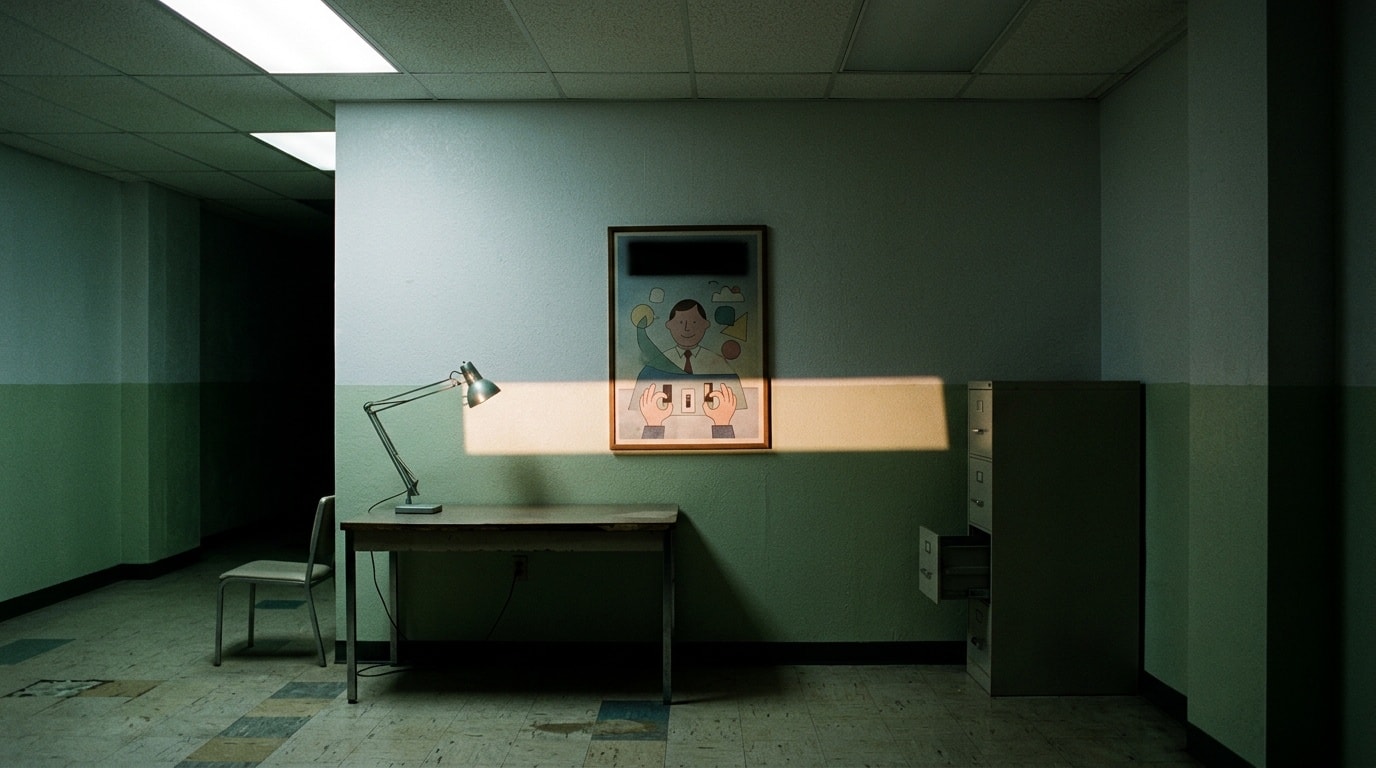
Irving's parting words to Dylan were a deliberate instruction keyed to a specific object: the break room motivational poster depicting Dylan holding the Overtime Contingency Protocol switches, captioned with that exact phrase.