Irving's Outdoor Past Was Never Erased
THE ARGUMENT
Irving's innie is not protecting a secret he was told about but one that has crossed the severance barrier without his knowledge, surfacing as instinctive defensiveness rather than retrievable memory. When Mark names the outside experience, Irving's response is to identify a leak rather than dispute the premise, revealing that the underlying fact registers as real to him even though he has no legitimate access to it. His outie's distress has infiltrated his innie's behavioral responses, which means the two versions of Irving are less separate than either believes.
How This Theory Works
Irving's innie does not protect a secret he has been told to keep. He protects a secret he has no conscious access to but is already living inside. That is the claim Mark's comment forces into the open.
When Mark references Irving's bad experience outside, Irving does not register confusion. He registers exposure. His first move is to identify the leak, not to question the premise. He goes straight to Dylan, demanding to know what was disclosed. Dylan denies saying anything. The sequence collapses the most comfortable explanation: if Dylan said nothing and Irving still recognized the claim as factual rather than strange, then Irving's innie is not guarding information he received. He is guarding information that arrived without a messenger.
The defensive escalation confirms this. Irving moves from alarm to accusation to deflection without any pause that would indicate genuine unfamiliarity with the underlying experience. A person encountering a foreign claim argues with the content. Irving argues with the distribution. He is trying to control the radius of the information, which is only a rational response if the information is real to him.
The painting already made this argument in a different register. Irving's innie spent his leisure hours reproducing the same Lumon corridor, not because he was told to, but because the image kept arriving. That compulsion was outie memory crossing the wall without credentials. What is happening during the retreat is the same mechanism operating at a social and behavioral level rather than a visual one. His outie's distress about the outside world is now generating instinctive defensiveness in his innie without any explicit memory transfer to justify it. Irving does not know why he is afraid. He only knows that he is, and that someone is getting too close to it.
The wall between his two selves is not holding. And critically, neither version of Irving knows how much has already passed through.
Is this theory convincing?
Key Evidence
Irving demands to know the source
When Mark says 'we all know you had a bad experience last time you were outside,' Irving's immediate response is to demand who said that rather than deny the experience itself, implying he recognizes the underlying fact.
Irving accuses Dylan of disclosure
Irving turns directly on Dylan and asks what he told Mark, treating Dylan as the likely source of a leak, which suggests Irving believes the experience is real even while refusing to discuss it.
Dylan denies telling Mark anything
Dylan explicitly denies having shared anything with Mark, leaving the origin of Mark's knowledge unexplained and opening the possibility that Irving's own behavior or unconscious signals communicated the trauma.
Irving's defensive escalation pattern
Irving's reaction moves immediately from denial to accusation to deflection without pausing on confusion, a behavioral pattern consistent with someone suppressing a known experience rather than encountering a foreign claim.
Memory bleed precedent in the show
The series established in Season 1 through Petey's deterioration that severance is not a perfect seal, and Irving's innie painting the same Lumon hallway repeatedly already suggested outie memories can surface as compulsive behavior without explicit recall.
This theory was evaluated using Theory Atlas editorial standards, including evidence review, narrative fit, and competing interpretation analysis. Learn how Theory Atlas evaluates theories →
Other Theories for S2E04
Grief Cannot Be Severed From the Body
The severance chip blocks information, but grief is not stored as information.
Helena Eagan Has Been Helly All Along
The person the MDR team has accepted as innie Helly throughout Season 2 is actually Helena Eagan, her outie, running an extended impersonation on the severed floor -- feeding information to Lumon management and using the retreat to surveil how far the group will go in defiance.

Kier Killed Dieter and Buried the Evidence
Kier Eagan murdered his twin brother Dieter and authored the Fourth Appendix as the sole surviving account, engineering a grotesque punitive myth that redirected culpability onto the victim.
Dieter Is Kier's Repressed Self, Not His Brother
Dieter Eagan was Kier's psychological projection, not his brother, a constructed figure through whom Kier could externalize and ritually destroy the desiring, undisciplined parts of himself that threatened his commercial identity.
Lumon's Retreat Is a Ritual Conviction System
The wilderness retreat in 'Woe's Hollow' is not a team-building exercise but a closed theological system designed to make innie defiance impossible to experience as morally neutral.
Helena Slept With Mark for Reasons She Cannot Name
Helena Eagan did not sleep with Mark to secure her cover.
Lumon's Small Lies Are the Big Control
Lumon's severance procedure does not just erase memory; it surgically removes the social and epistemic infrastructure through which employees could challenge any claim the company makes.
Irving's Farewell Encodes the Overtime Contingency
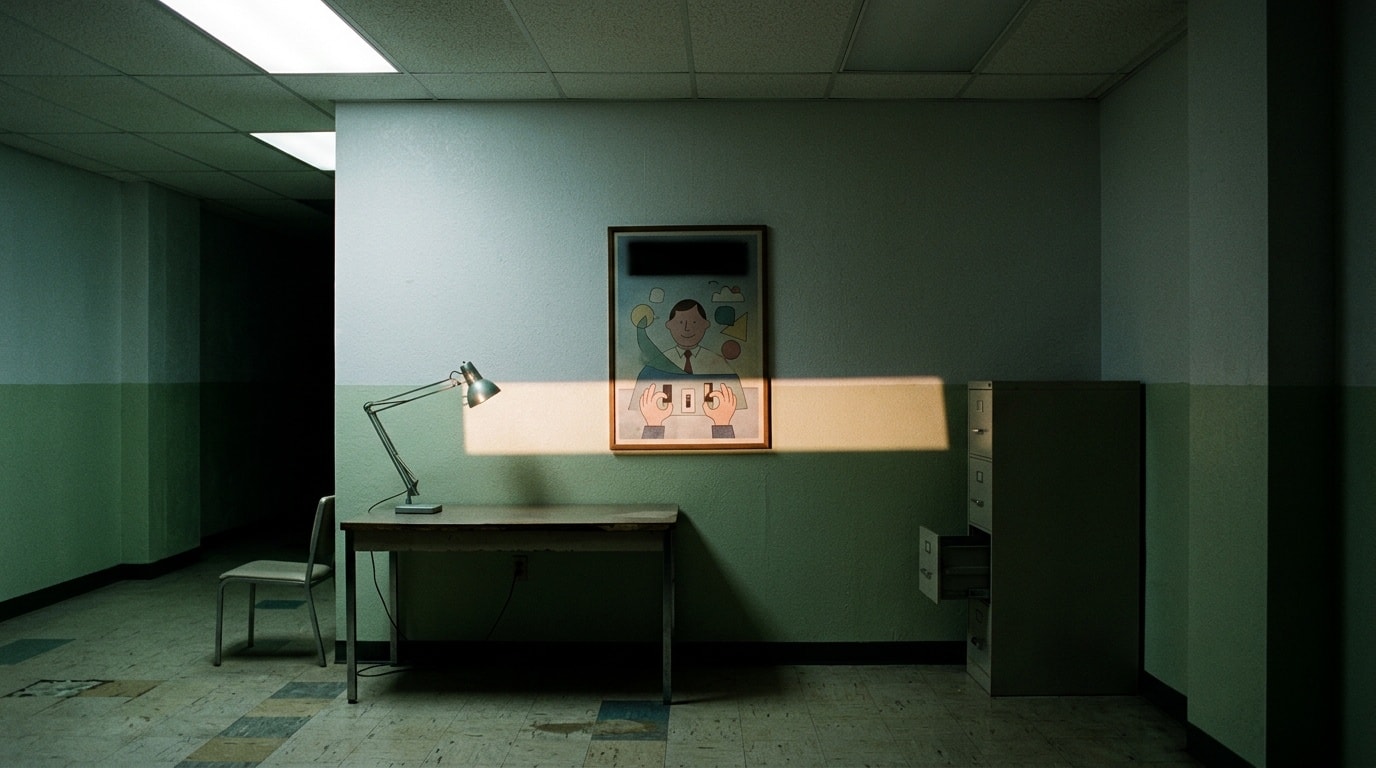
Irving's parting words to Dylan were a deliberate instruction keyed to a specific object: the break room motivational poster depicting Dylan holding the Overtime Contingency Protocol switches, captioned with that exact phrase.