Grief Cannot Be Severed From the Body
THE ARGUMENT
The severance chip blocks information, but grief is not stored as information. It lives in arousal thresholds, physical patterning, and the somatic tension that precedes tears, and those channels remain open under sufficient emotional intensity. When innie-Mark sees Gemma's face during his encounter with Helly, he is not experiencing a memory leak. He is experiencing proof that his outie's unresolved mourning is already restructuring his interior life through a pathway Lumon never designed its architecture to intercept.
How This Theory Works
Innie-Mark does not love Gemma through a crack in the barrier. He is haunted by her because the severance chip was built to suppress the wrong thing. The chip operates on information: retrievable facts, conscious memories, recognizable data. But grief is not stored that way. It is encoded somatically, in arousal thresholds and physical pattern, in the specific tension that arrives in the chest before tears do. When innie-Mark reaches a threshold of physical and emotional intensity with Helly, his nervous system does exactly what nervous systems do under those conditions. It surfaces the affective template of the person for whom that intensity was last real. The chip has no mechanism to intercept this because it was designed for a different problem entirely.
The Irving warning detail demonstrates the asymmetry with precision. Irving tells Mark he was warned about a bad experience outside. Mark has no memory of that warning. The information traveled one direction only: it exists in his outie's record and nowhere in Mark's felt experience. That is how the chip is supposed to work. Information flows down from outie to innie as procedure, not as lived sensation. Grief, by contrast, does not obey that architecture. It does not arrive as a fact Mark can access or deny. It arrives as Gemma's face replacing Helly's face at the moment of maximum exposure, unbidden, uncontrolled, and immediately suppressed. The directionality is inverted. Information is blocked going upward. Grief travels upward anyway, because it was never routed through the informational channel the chip monitors.
What makes this structurally significant is that the channel appears bidirectional. If outie-Mark's unresolved grief over Gemma can reach innie-Mark through somatic transmission, then every emotional spike innie-Mark generates at the retreat is a candidate for upward transmission to the outie. The separation is not just leaking. It is leaking specifically at moments of highest emotional load, and those moments are precisely what Lumon's retreat architecture was engineered to produce. Lumon sent these innies to a setting designed to maximize intimacy, vulnerability, and affective intensity. The retreat is a pressure system, and Lumon built it. Every condition the retreat was constructed to generate is a condition under which the affective channel fires.
Mark's suppression of the glitch is the detail that closes the structural argument. When Helly asks if he is okay, he says yes and resumes the kiss without pause. This is not the behavior of someone who experienced a harmless visual flicker. It is the behavior of someone who recognized what he saw and understood, at some inarticulate level, that acknowledging it would require admitting something is wrong with him at a depth he cannot yet name. The concealment is active, not reflexive. He buries it the way the show treats every other moment of uncontrolled severance failure: as something too dangerous to surface in the moment. His innie is already managing a process for which he has no vocabulary.
The reintegration sound accompanying the kiss, if present, sharpens the implication considerably. The severance system's own audio signature for consciousness transitions firing during this encounter would mean the system itself is registering what Mark is suppressing. Lumon's architecture is not blind to the glitch. It is simply not designed to treat an affective bleed as an emergency, because it was never designed to anticipate one. The chip flags informational crossings. It has no alarm for grief. Outie-Mark's unprocessed mourning is selecting which affective templates reach his innie, colonizing innie-Mark's choices and desires with a loss that has no name for him yet, and doing so through a channel the entire severance enterprise was built around the assumption could not exist.
Is this theory convincing?
Key Evidence
Mark Sees Gemma's Face Briefly
While intimate with Helly, Mark momentarily perceives Gemma's face instead of Helly's, a visual glitch lasting a fraction of a second that the episode presents from Mark's subjective point of view.
Reintegration Sound Accompanies the Kiss
One account of the moment describes a reintegration sound playing as Mark kisses Helly, directly linking the glitch to the severance system's known audio signature for consciousness transitions.
Innie-Mark Has No Access to Gemma
Innie-Mark has never been introduced to Gemma within his severed experience, making her appearance in his perception inexplicable without some form of cross-barrier memory or consciousness bleed.
Mark Conceals the Glitch Immediately
When Helly asks if he is okay after the glitch, Mark says yes and resumes the kiss, suppressing the experience rather than acknowledging it, which mirrors how the show treats other moments of uncontrolled severance failure.
This theory was evaluated using Theory Atlas editorial standards, including evidence review, narrative fit, and competing interpretation analysis. Learn how Theory Atlas evaluates theories →
Other Theories for S2E04
Helena Eagan Has Been Helly All Along
The person the MDR team has accepted as innie Helly throughout Season 2 is actually Helena Eagan, her outie, running an extended impersonation on the severed floor -- feeding information to Lumon management and using the retreat to surveil how far the group will go in defiance.

Kier Killed Dieter and Buried the Evidence
Kier Eagan murdered his twin brother Dieter and authored the Fourth Appendix as the sole surviving account, engineering a grotesque punitive myth that redirected culpability onto the victim.
Dieter Is Kier's Repressed Self, Not His Brother
Dieter Eagan was Kier's psychological projection, not his brother, a constructed figure through whom Kier could externalize and ritually destroy the desiring, undisciplined parts of himself that threatened his commercial identity.
Lumon's Retreat Is a Ritual Conviction System
The wilderness retreat in 'Woe's Hollow' is not a team-building exercise but a closed theological system designed to make innie defiance impossible to experience as morally neutral.

Irving's Outdoor Past Was Never Erased
Irving's innie is not protecting a secret he was told about but one that has crossed the severance barrier without his knowledge, surfacing as instinctive defensiveness rather than retrievable memory.
Helena Slept With Mark for Reasons She Cannot Name
Helena Eagan did not sleep with Mark to secure her cover.
Lumon's Small Lies Are the Big Control
Lumon's severance procedure does not just erase memory; it surgically removes the social and epistemic infrastructure through which employees could challenge any claim the company makes.
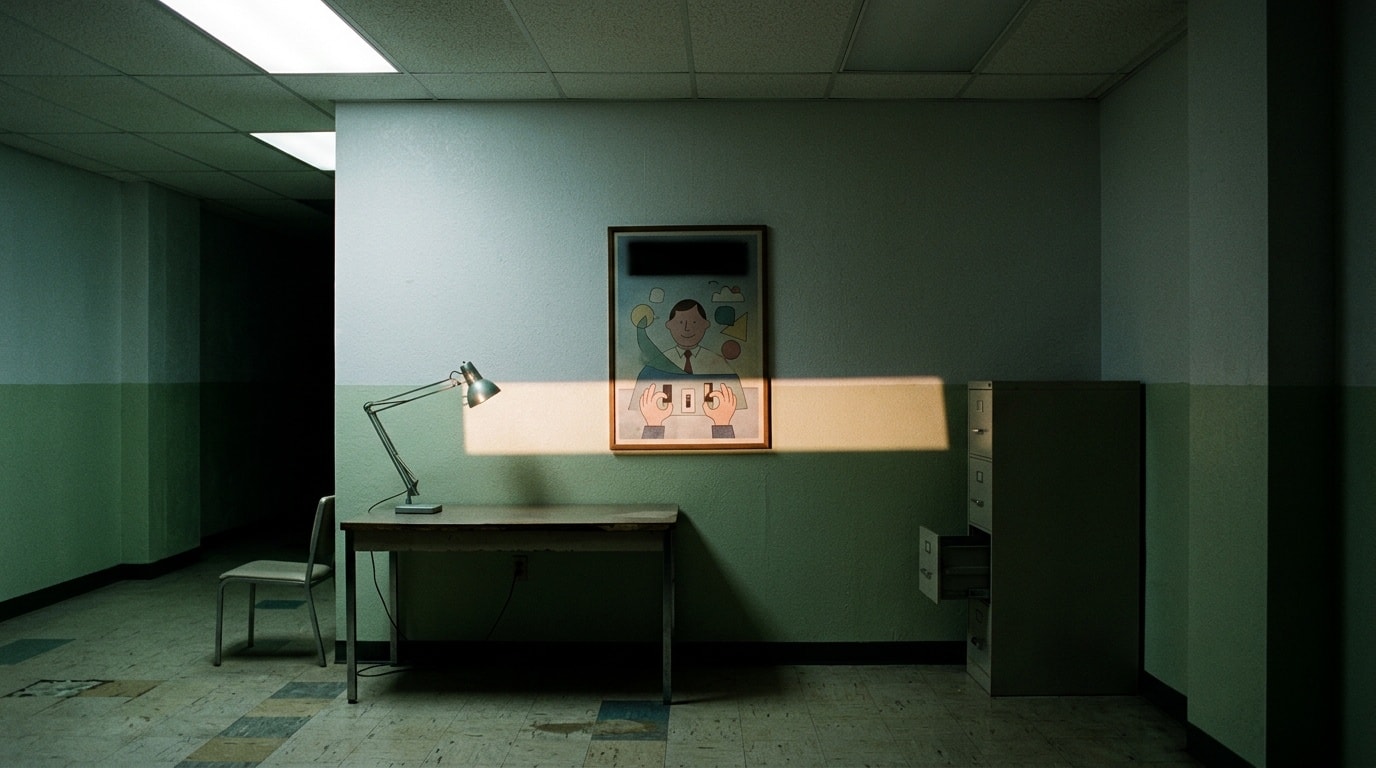
Irving's Farewell Encodes the Overtime Contingency
Irving's parting words to Dylan were a deliberate instruction keyed to a specific object: the break room motivational poster depicting Dylan holding the Overtime Contingency Protocol switches, captioned with that exact phrase.