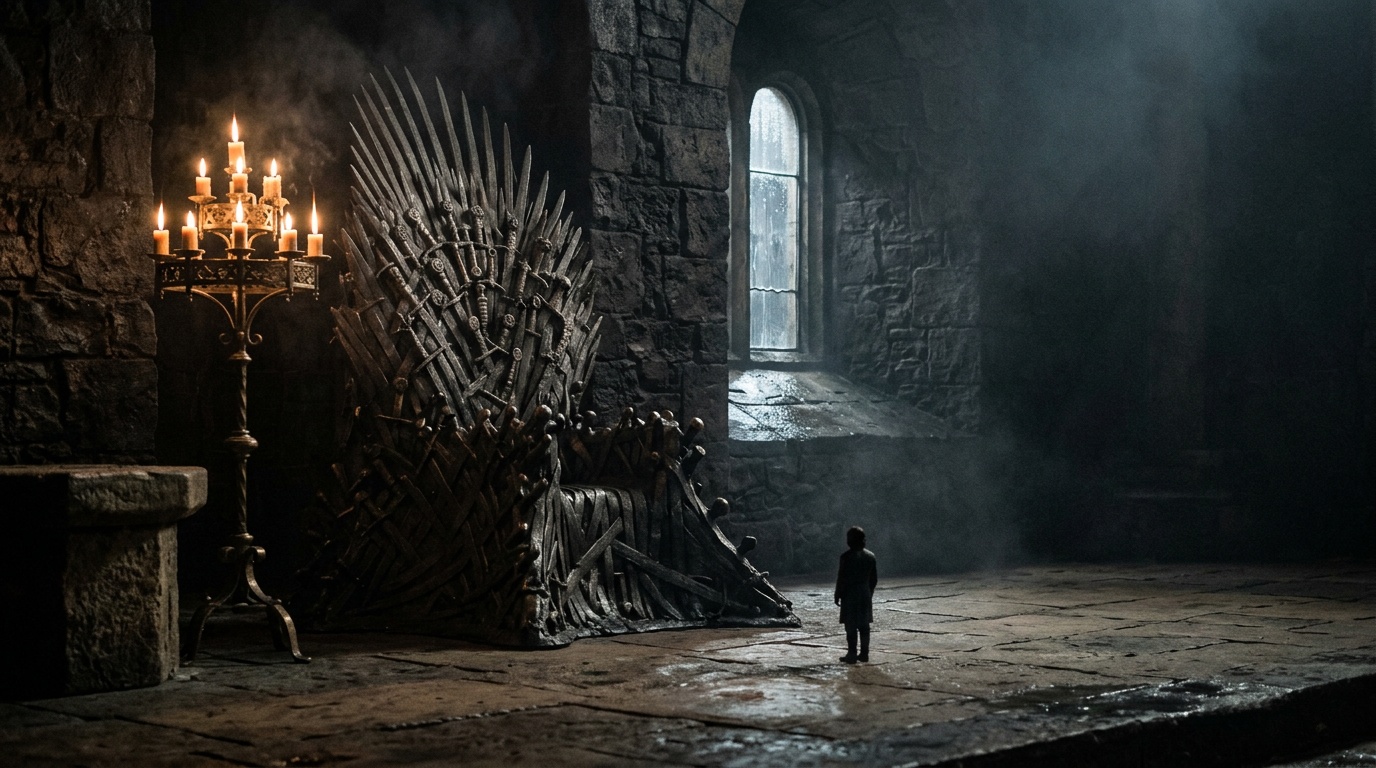
Helaena's Line Predicts the Throne's Fate
THE ARGUMENT
Helaena's line 'if one possesses a thing, the other will take it away' is not oblique character texture but a directional prophecy with a specific implied outcome: Rhaenyra will take the Iron Throne from Aegon, and the verb 'take' demands an agent, a deliberate act, and a victor rather than stalemate or mutual destruction. The line's placement immediately before Aegon's involuntary coronation frames it as a structural forecast of the war's resolution, not merely its premise. If Helaena is prophesying, the Dance of the Dragons does not end in ambiguity -- it ends with the throne changing hands in exactly the direction the Green succession was designed to prevent.
How This Theory Works
Helaena's statement that 'if one possesses a thing, the other will take it away' is a structural forecast with a specific terminus: Rhaenyra will take the Iron Throne from Aegon, and Helaena already knows it. The theory holds that she is describing the Dance of the Dragons in miniature, possession given to Aegon by the Green coup and possession taken by Rhaenyra as the war resolves. The line arrives at the exact narrative hinge where Aegon is about to be crowned against his own stated wishes, which is not coincidence but placement.
Aegon's involuntary possession is the load-bearing detail. What is held reluctantly, held only because others' ambition demanded it, is easier to have taken away. Helaena's line does not describe a symmetric struggle. It describes a transfer with a direction. The second clause is not 'the other may contest it' or 'the other will fight for it.' The other will take it. That is a completed action, not an ongoing one, and it implies a victor.
The sharpest forward claim this theory makes is that Helaena's line will be confirmed not as character color but as outcome prophecy: Rhaenyra will hold the throne at some point the show has not yet reached, and when she does, the editing or dialogue will call back to this moment. What would destroy the theory is a conclusion in which the throne passes to neither claimant, is destroyed, or is held by Aegon until death rather than taken from him by Rhaenyra's deliberate act. What would confirm it is Rhaenyra sitting the Iron Throne in a scene that the show frames as an act of taking rather than winning. Helaena is not a sad figure trapped in a coup she did not choose. She is a witness whose testimony has already been entered into the record.
Is this theory convincing?
Key Evidence
Helaena's Possession and Taking Line
Helaena states 'if one possesses a thing, the other will take it away,' a line that arrives in the same episode Aegon is forcibly crowned, creating an immediate literal frame for a conflict over possession of the throne.
Aegon Crowned Against His Will
Aegon explicitly states he does not want to be king and must be physically dragged back to the Red Keep, making his possession of the throne involuntary and structurally fragile in precisely the way Helaena's line implies.
Helaena's Prior Cryptic Accuracy
The show has previously established Helaena as a figure whose strange, sideways statements carry narrative weight beyond their immediate meaning, lending this new line credibility as intentional foreshadowing rather than character quirk.
Line Delivered at Narrative Hinge Point
Helaena speaks immediately before the coronation sequence, positioning her words as a commentary on the act of possession itself at the exact moment the Green succession is being sealed.
This theory was evaluated using Theory Atlas editorial standards, including evidence review, narrative fit, and competing interpretation analysis. Learn how Theory Atlas evaluates theories →
Other Theories for S1E09
Erryk's Conscience Becomes Rhaenys's Exit
Erryk's rescue of Rhaenys is not heading anywhere specific.
Alicent's Ignorance Was Otto's Most Sophisticated Weapon
Otto Hightower ran an active coup apparatus for years before Viserys died, and the conspiracy's most deliberately engineered feature was Alicent's complete exclusion from it.
Mysaria Uses Aegon as Political Bargaining Chip
Mysaria's demand that Otto shut down the child fighting rings was not the point of the exchange.
Beesbury Names the Crime No One Will Investigate
The Green council's coup rests on a charge its members never rebut: Lyman Beesbury's argument that a king well the night before does not reverse thirty years of succession policy on his deathbed with only the new heir's mother as witness.
Rhaenys's Mercy Is a Power Play That Guarantees the War
Rhaenys withholds Meleys's fire not from loyalty to Rhaenyra or scruple about kinslaying, but from a cold, premeditated act of self-assertion by a woman who has already learned what Westerosi power does to female claimants, and who has decided to manage this war rather than serve in it.
Aemond Is Already Positioning Against Aegon
Aemond views Aegon's coronation not as a settlement but as an opening position, and he is already constructing the internal architecture that would allow him to govern from behind or beneath a king he considers illegitimate.
Cole Kills for Alicent, Not the Crown
Criston Cole does not serve the Green faction.
Mysaria Undersold Aegon to Protect Something Else
Mysaria's decision to trade Aegon for the closure of child fighting pits was not a failure to press her advantage but a deliberate refusal to enter the court's economy of power and debt.