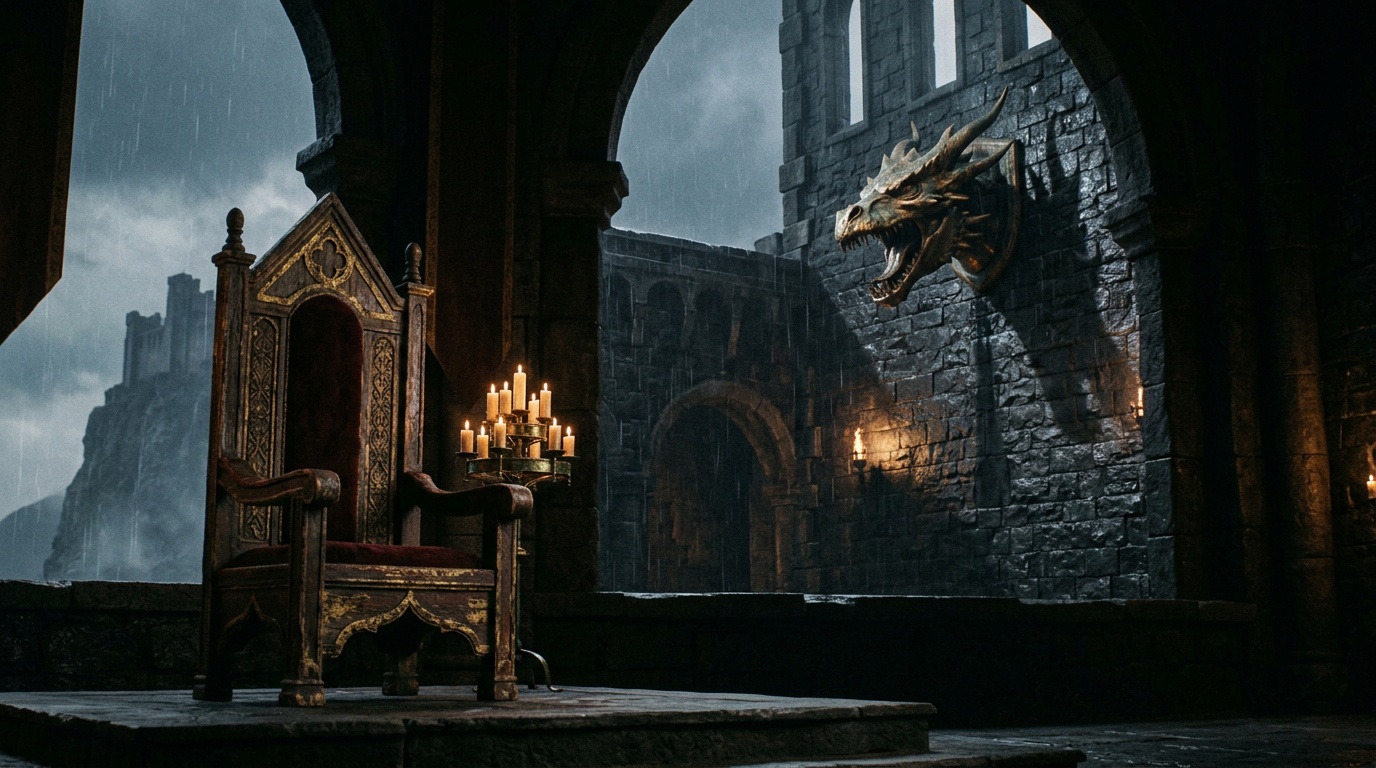
Rhaenys's Mercy Is a Power Play That Guarantees the War
THE ARGUMENT
Rhaenys withholds Meleys's fire not from loyalty to Rhaenyra or scruple about kinslaying, but from a cold, premeditated act of self-assertion by a woman who has already learned what Westerosi power does to female claimants, and who has decided to manage this war rather than serve in it. That same night, Alicent refuses to sanction Rhaenyra's assassination from emotional rather than strategic instinct, and the show's internal logic treats both acts of restraint not as mercy but as violence deferred. Together they form a symmetrical night of mutual non-elimination that makes the coming war structurally inevitable.
How This Theory Works
The show stages Rhaenys's restraint with a precision that rules out hesitation. She arrives in full battle armor. Meleys kills smallfolk as she tears through the sept floor. The dragon closes to within feet of Aegon and Alicent, opens her mouth, roars, and then nothing. Rhaenys turns and flies directly for Dragonstone. Every element of that sequence is constructed: in the source text, Rhaenys is absent from the coronation entirely, which means the showrunners invented each detail, the armor, the crowd deaths, the open mouth, the withdrawal, as a deliberate argument. The smallfolk are the argument's hinge. Rhaenys was willing to kill. The smallfolk died. The king did not. That distinction is not mercy. It is precision, and precision at that scale belongs to someone who decided in advance exactly how far she was willing to go and exactly what outcome she was engineering.
The theory that Rhaenys acts out of loyalty to Rhaenyra's cause cannot survive the show's characterization of her. Rhaenys has already been denied succession. She carries no illusions about what this political order does to women who claim power within it. Her restraint beneath the Dragon Pit is the action of someone who has processed that lesson and drawn a specific conclusion: she will not hand Rhaenyra an unearned throne, because an unearned throne is precisely the kind of gift that destroys the woman who sits on it. By sparing Aegon and flying to Dragonstone, Rhaenys forces Rhaenyra to confront a war already in motion, shaped on Rhaenys's terms, with Rhaenys positioned not as a subject delivering a queen but as the person who chose how the conflict would begin. This is not deference. It is the opening move of someone who intends to be indispensable rather than subordinate.
The kinslaying argument is real but it functions as reinforcement, not explanation. Burning Aegon at his own coronation would have handed Rhaenyra a throne consecrated by the incineration of children in a sept, a legitimacy catastrophe before the reign begins. That calculation may have sharpened Rhaenys's resolve, but it does not account for the staging: the drawn-out approach, the roar held directly at the royal family, the withdrawal that reads as performance rather than escape. Rhaenys needed the Greens to survive long enough to receive a message, and she needed Rhaenyra to receive a different one: that the war is already begun, that Rhaenys was the one who set its terms, and that Rhaenyra is now in a conflict she did not choose and cannot yet control.
What gives this theory its structural force is what happens in the Small Council chamber on the same night. Alicent, faced with her advisors' unanimous argument that a living Rhaenyra with dragons and a rival claim cannot be resolved by diplomacy, refuses to sanction the assassination. Her resistance is emotional rather than strategic: she cannot authorize the murder of someone who was once her closest friend. The show voices the council's counterargument directly through Orwyle and Otto, which means the narrative has already acknowledged the charge against Alicent and declined to refute it. Two women, on the same night, each possessing the means to end the conflict decisively, chose restraint. The show frames both choices as something like dignity. Its own internal logic indicts both as catastrophic.
This symmetry is the show's thesis. Rhaenys's restraint converts a decisive moment into a declaration of allegiance and nothing more. Alicent's refusal to let Rhaenyra die is a debt written into the ledger of a war Alicent's mercy made possible. The war Rhaenys could have ended in seconds beneath the Dragon Pit will now require years and lives to resolve, and Alicent's promissory note (Rhaenyra survives because Alicent willed it) means that when the conflict reaches its terminal point, one of these women will face the same choice again. Mercy extended to a rival in this world does not de-escalate conflict. It relocates it, defers it, and guarantees that when it finally arrives it will be worse.
Is this theory convincing?
Key Evidence
Dragon Mouth Opens, No Fire
Meleys closes to within feet of Alicent and Aegon, opens her mouth, and roars directly at them without releasing any flame, making the restraint a visible on-screen choice rather than an inability to act.
Rhaenys in Full Battle Armor
Rhaenys arrives clad in full battle armor, indicating she came prepared for combat, which makes her decision not to use lethal force a deliberate departure from her apparent readiness.
Immediate Departure After Roar
After the warning roar, Rhaenys turns Meleys and flies away from King's Landing, with no pursuit attempted, consistent with a pre-planned withdrawal to alert Rhaenyra at Dragonstone.
Kinslaying Taboo as Restraint
Burning Aegon and his siblings would constitute kinslaying under Westerosi custom, a deeply stigmatized act that would delegitimize Rhaenyra's claim even if it eliminated the rival succession.
Scene Invented for the Show
In the source text Fire and Blood, Rhaenys is absent from Aegon's coronation entirely, meaning the showrunners created this confrontation from nothing, giving every detail of her restraint intentional narrative weight.
Crowd Deaths vs. Royal Sparing
Meleys crushes and kills smallfolk as the dragon emerges into the sept, establishing that Rhaenys was willing to cause casualties, which makes the specific non-killing of Aegon and Alicent a pointed distinction.
This theory was evaluated using Theory Atlas editorial standards, including evidence review, narrative fit, and competing interpretation analysis. Learn how Theory Atlas evaluates theories →
Other Theories for S1E09
Erryk's Conscience Becomes Rhaenys's Exit
Erryk's rescue of Rhaenys is not heading anywhere specific.
Alicent's Ignorance Was Otto's Most Sophisticated Weapon
Otto Hightower ran an active coup apparatus for years before Viserys died, and the conspiracy's most deliberately engineered feature was Alicent's complete exclusion from it.
Mysaria Uses Aegon as Political Bargaining Chip
Mysaria's demand that Otto shut down the child fighting rings was not the point of the exchange.
Beesbury Names the Crime No One Will Investigate
The Green council's coup rests on a charge its members never rebut: Lyman Beesbury's argument that a king well the night before does not reverse thirty years of succession policy on his deathbed with only the new heir's mother as witness.

Cole Kills for Alicent, Not the Crown
Criston Cole does not serve the Green faction.
Aemond Is Already Positioning Against Aegon
Aemond views Aegon's coronation not as a settlement but as an opening position, and he is already constructing the internal architecture that would allow him to govern from behind or beneath a king he considers illegitimate.
Mysaria Undersold Aegon to Protect Something Else
Mysaria's decision to trade Aegon for the closure of child fighting pits was not a failure to press her advantage but a deliberate refusal to enter the court's economy of power and debt.
Helaena's Line Predicts the Throne's Fate
Helaena's line 'if one possesses a thing, the other will take it away' is not oblique character texture but a directional prophecy with a specific implied outcome: Rhaenyra will take the Iron Throne from Aegon, and the verb 'take' demands an agent, a deliberate act, and a victor rather than stalemate or mutual destruction.