Woe's Hollow Was Always a Simulation
THE ARGUMENT
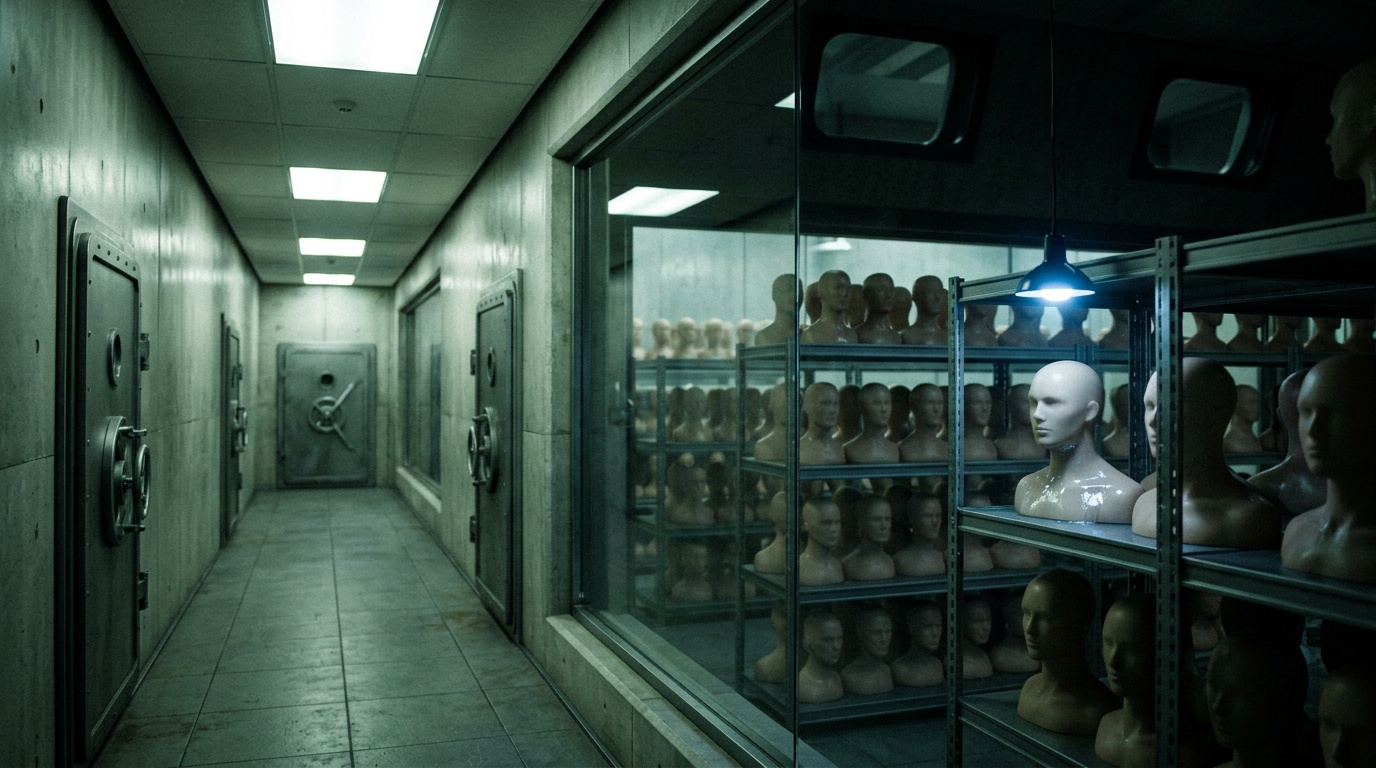
The Woe's Hollow retreat was not an outdoor excursion but a fully constructed simulation, built and operated by Lumon to manufacture the experience of freedom while keeping the innies completely contained. The guide figures resembling each MDR employee were prefabricated before any worker expressed a desire to go outside, confirming the retreat was a pre-planned behavioral management ritual rather than a responsive reward. What animates those figures remains the theory's open edge, pointing toward a Lumon technological infrastructure deeper than anything the show has yet named.
How This Theory Works
Lumon did not take the MDR innies outside. It built outside for them, and the sharpest proof is an object that cannot logistically exist: the television set in the snowy clearing. When the team locates the TV, it has no cables, no visible power source, and no logistical explanation for its presence in a real remote wilderness. More precisely, it does not appear in the wide shot of the clearing that precedes the close shot in which it occupies the frame. A physical object in a real environment cannot do that. Continuity errors produce mismatched props and inconsistent positions; they do not produce objects that cease to exist between camera angles of the same space. The TV is behaving like a rendered element in a controlled interface, not like hardware someone carried into a national forest.
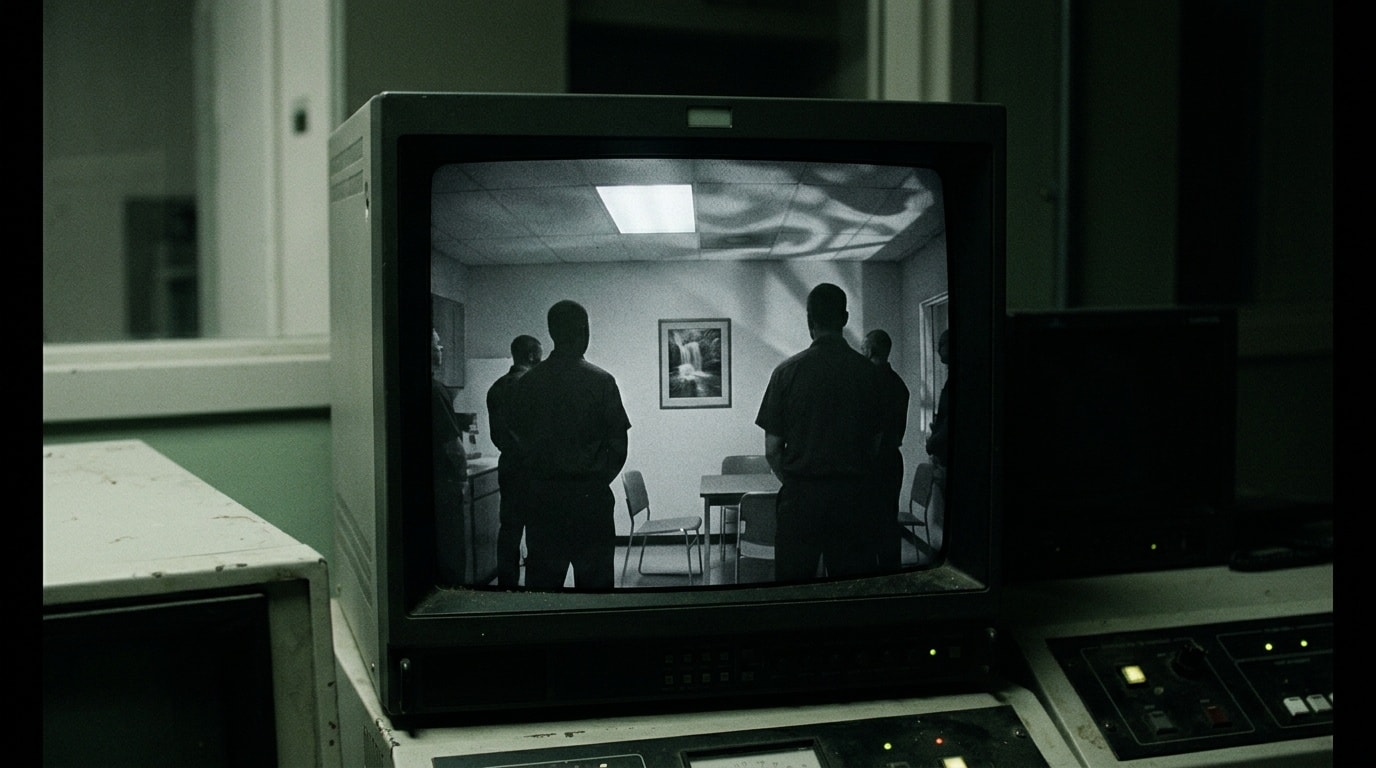
The doppelganger guides extend the same logic into the social layer of the retreat. Four figures, each resembling one MDR innie, appear at intervals along the path in standard work clothes with no winter gear, raise their arms to redirect the group, and then vanish. Real human stand-ins hired for a genuine wilderness excursion would require logistical preparation visible somewhere in the production of the environment, and would require cold-weather gear to survive it. These figures behave instead like waypoints: they appear where the route requires direction and disappear once that function is complete. The uncanny quality observers have described, the wrongness of the head angles, the flatness of the expressions, the stiffness of gesture, does not register as eerie-human-actor but as approximate-copy-of-something-organic. That is a different category of wrongness entirely, and it is the category that synthetic fabrication produces.
The hallway figure spotted in the season premiere, before the retreat was announced to anyone, collapses the last possible interpretation of the guides as improvised props assembled in response to employee desire. Whatever moved through that corridor was already built. The retreat itinerary, the guide placement along the route, the mythological framing Milchick delivered on cue: none of it was assembled in response to need. Milchick's explanation, that because Kier's twin was always with him, Lumon has provided each employee with the same, is a script designed to route attention toward a feeling of corporate blessing and away from the question of what the figures actually are. It pointedly avoids describing their composition or mechanism. The 3D printers visible in the Optics and Design lab on the severed floor establish that Lumon has physical infrastructure capable of fabricating human-form synthetic objects. The bodies are the easy part of this answer.
The hard part is locomotion. The figures move, redirect, and vanish. Industrial 3D printing can account for a convincing shell; it does not account for directed movement in a cold environment, proximity response without speech, and disappearance on a precise cue. Whether these are remotely operated shells, pre-programmed automatons following a fixed route through a constructed space, or something involving a more disturbing application of the same neural-control logic behind severance itself, the show has not closed. That gap is the theory's live edge. If the answer is remote operation, the retreat required Lumon personnel managing the simulation in real time. If the answer involves severance neuroscience, the guide figures represent a far more unsettling application of the same technology that splits a person's memory at the elevator. Irving surviving a full night of below-freezing exposure and walking away coherent the next morning is the environmental evidence that tilts toward a constructed space rather than a real one, since the cold of a genuine wilderness does not calibrate itself to narrative necessity.
The retreat's geography further supports a managed environment. The waterfall appears exactly when Milchick needs it. The campground materializes in darkness on his lead. Nothing about the landscape resists or surprises the Lumon representatives conducting the excursion. A real wilderness has friction; this one has blocking. Every element of the environment resolves on cue, because every element was placed on a cue that was written before the MDR team ever stepped off the elevator.
Is this theory convincing?
Key Evidence
Uncabled Television in Clearing
The television set that plays Milchick's welcome video has no visible cables or power source, and does not appear in the preceding wide shot of the clearing, suggesting it is not a physical object placed in a real outdoor location.
Doppelgangers in Work Clothes
The four doubles appear at elevated positions in the wilderness wearing standard work attire with no winter gear, and vanish without explanation after directing the team, behavior inconsistent with hired human guides in a real environment.
Irving Survives Full Night Exposure
Irving sleeps outside in freezing conditions through the entire night and is found walking and coherent the next morning, surviving cold that would be medically serious in a real wilderness scenario without protective equipment.
Environment Resolves on Narrative Cue
The waterfall and campground appear precisely when the Lumon narrative requires them, with Milchick guiding the team to each destination in sequence as if the geography itself is following a script.
Innies Awaken with No Transit Memory
The four MDR workers wake in the wilderness with no memory of travel or preparation, which is consistent with never having left a controlled Lumon facility at all rather than with a legitimate outdoor expedition.
Lumon Controls Every Variable
Milchick and Miss Huang manage all food, light, shelter, and movement throughout the retreat, and no element of the environment resists or surprises the Lumon representatives present, suggesting they operate with complete situational knowledge.
This theory was evaluated using Theory Atlas editorial standards, including evidence review, narrative fit, and competing interpretation analysis. Learn how Theory Atlas evaluates theories →
Other Theories for S2E04
Grief Cannot Be Severed From the Body
The severance chip blocks information, but grief is not stored as information.
Helena Eagan Has Been Helly All Along
The person the MDR team has accepted as innie Helly throughout Season 2 is actually Helena Eagan, her outie, running an extended impersonation on the severed floor -- feeding information to Lumon management and using the retreat to surveil how far the group will go in defiance.
Kier Killed Dieter and Buried the Evidence
Kier Eagan murdered his twin brother Dieter and authored the Fourth Appendix as the sole surviving account, engineering a grotesque punitive myth that redirected culpability onto the victim.
Dieter Is Kier's Repressed Self, Not His Brother
Dieter Eagan was Kier's psychological projection, not his brother, a constructed figure through whom Kier could externalize and ritually destroy the desiring, undisciplined parts of himself that threatened his commercial identity.
Lumon's Retreat Is a Ritual Conviction System
The wilderness retreat in 'Woe's Hollow' is not a team-building exercise but a closed theological system designed to make innie defiance impossible to experience as morally neutral.
Irving's Outdoor Past Was Never Erased
Irving's innie is not protecting a secret he was told about but one that has crossed the severance barrier without his knowledge, surfacing as instinctive defensiveness rather than retrievable memory.
Helena Slept With Mark for Reasons She Cannot Name
Helena Eagan did not sleep with Mark to secure her cover.
Lumon's Small Lies Are the Big Control
Lumon's severance procedure does not just erase memory; it surgically removes the social and epistemic infrastructure through which employees could challenge any claim the company makes.