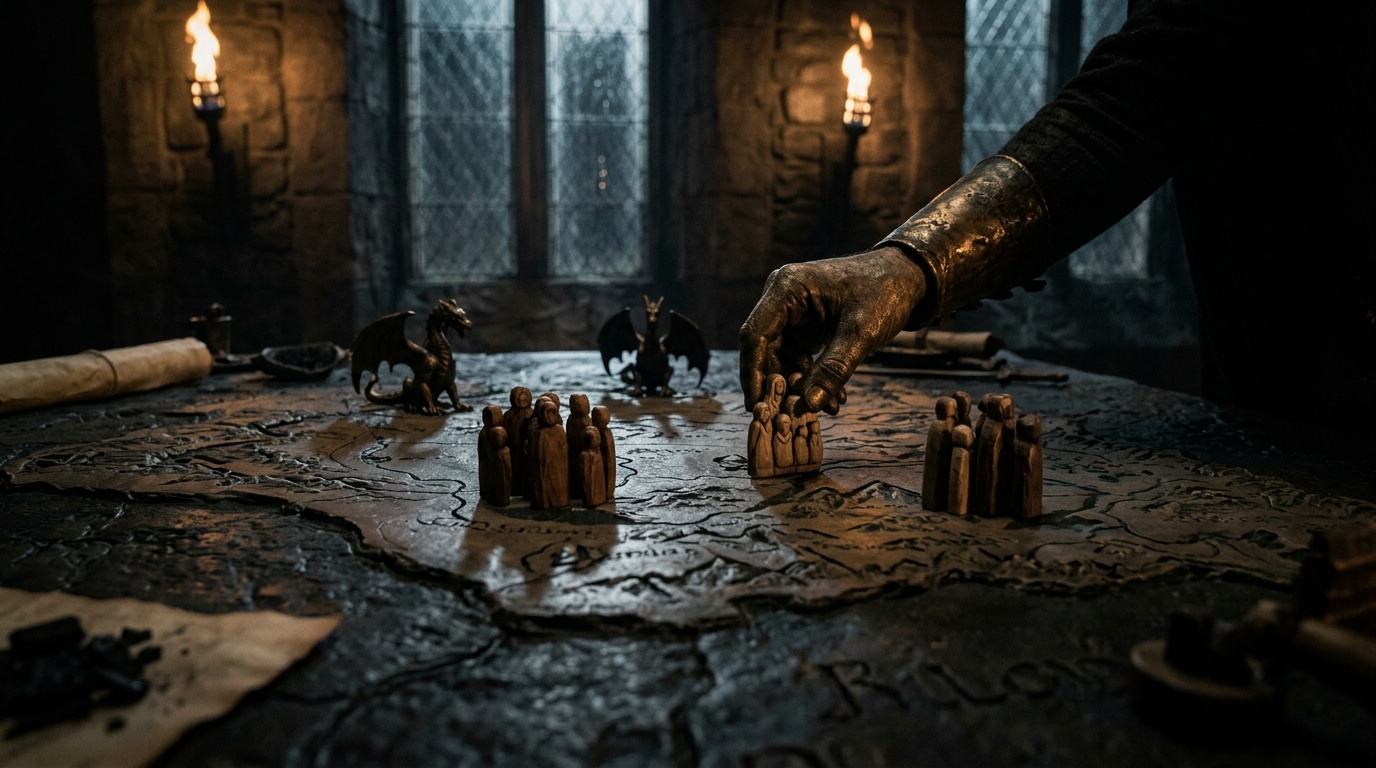
Ormund Hightower Weaponizes Rhaenyra's Own Mercy
THE ARGUMENT
Ormund Hightower has identified Rhaenyra's dependence on civilian legitimacy and is engineering that dependence into a military constraint. His near-effortless surrender of a false Daeron marks him as a commander who stages capitulations as tactical maneuvers, buying time while the real Daeron moves freely. Every decision he makes rests on one cold certainty: she will not burn what she is trying to rule, and that certainty is all the leverage he needs.
How This Theory Works
Ormund Hightower has identified a structural weakness the Blacks cannot easily fix: Rhaenyra needs the smallfolk. That need is a political necessity, and Ormund treats it as a weapon. By positioning himself behind civilian populations in Tumbleton, he forces Rhaenyra into an impossible choice between her dragons and her reputation. A city she claims to govern cannot be burned without destroying the very legitimacy that justifies her claim. He knows this, and he plans accordingly.
The imposter gambit is what elevates him from loyalist general to active strategist. He stages surrenders, bleaches a child's hair, and sends a false hostage behind enemy lines. The ease with which he handed the decoy boy to Daemon is the tell. A commander acting out of desperation fights harder before giving up something of value. Ormund offered almost no resistance, because the exchange cost him nothing. He gave Daemon a victory that consumed nothing real while buying time and freedom of movement for the actual Daeron. The surrender was the deception, offered at a moment calculated to seem like relief.
The episode's closing image sharpens this considerably. The real Daeron traveled undetected as a dark-haired squire in Ormund's own column, hidden in plain sight while Daemon celebrated a hostage that was never what it appeared to be. Ormund's willingness to kneel before three dragons and perform total submission while simultaneously concealing his most valuable asset suggests a commander who has fully separated the performance of compliance from the reality of his position. The bow means nothing. The boy beside him is everything.
What makes this read most uncomfortable is that Ormund's tactics compound each other rather than run in parallel. The civilian shield denies Rhaenyra the use of her dragons against Green forces in the field. The false Daeron floods her court with paranoia and spends her political capital on an interrogation that ends in humiliation. These are layers of the same campaign, each one widening the gap between what Rhaenyra can do militarily and what she can afford to do politically. Any attack risks killing her own subjects. Any diplomatic victory risks being revealed as staged. Ormund is not holding a defensive position while hoping for relief. He is building a set of constraints from Rhaenyra's own values, tightening them with each move, and waiting for her to make an error that her principles will not allow her to correct.
Is this theory convincing?
Key Evidence
Tumbleton Civilians as Military Shield
Ormund positions the people of Tumbleton as hostages, preventing Rhaenyra from deploying her dragons against Green forces without massacring her own subjects.
Effortless False Daeron Handover
Ormund offers almost no resistance before surrendering the decoy boy, signaling that the exchange was a prepared deception rather than a genuine capitulation.
Real Daeron Hidden in Plain Sight
The episode closes with the implication that the actual Daeron Targaryen traveled undetected as a dark-haired squire alongside Ormund, confirming his capacity to hide assets in plain view.
Civilian Casualties Threaten Legitimacy
Rhaenyra cannot attack Green-held civilian areas without killing the very subjects whose loyalty she requires to justify her claim to the throne.
Calculated Bend-the-Knee Performance
Ormund's willingness to kneel before Daemon and three dragons while simultaneously concealing Daeron demonstrates he uses gestures of submission as tactical cover.
This theory was evaluated using Theory Atlas editorial standards, including evidence review, narrative fit, and competing interpretation analysis. Learn how Theory Atlas evaluates theories →
Other Theories for S3E03
The Greens Built a Throne She Could Only Lose
The Greens evacuated King's Landing rather than surrendering it, stripping the treasury, blocking ecclesiastical coronation, and coordinating an ideological campaign against dragons before withdrawing, leaving Rhaenyra to occupy a throne hollowed of every resource that makes a throne governable.
Rhaenyra's Bastard Hypocrisy Will Cost Her Navy
Rhaenyra's refusal to grant Addam of Hull the Velaryon name has made Corlys's continued loyalty structurally untenable, and his departure would lift the naval blockade that underpins her hold on King's Landing.
Shared Grief Quietly Binds Two Enemy Queens
Rhaenyra has shifted from treating Alicent as a prisoner to be managed toward treating her as the only person alive who understands what losing children costs.
The Faith Has Already Chosen the Greens
The Faith of the Seven has taken sides in the Dance of the Dragons, and that side is Green.
The Throne Already Judged Her Body
The show appears to be building toward a specific narrative payoff: the legend in Fire and Blood, in which the Iron Throne rejects Rhaenyra by causing her to bleed upon it, will ultimately be traceable to this moment of concealed menstruation.
Alicent's Dead Son Gambit Protects the Living One
Alicent's advice to declare Aegon II dead serves her sons, not Rhaenyra's reign: a formal death announcement removes the crown's incentive to keep searching for Aegon while shielding Daeron from scrutiny in the field.
Tessarion's Silence Exposed Daemon's Fatal Blind Spot
Daemon's lifelong intimacy with dragon-rider bonds should have made Tessarion's silence the first thing he questioned, and it was the one thing he never questioned at all.
Daemon's Report on Sunfyre Is a Lie
Daemon's declaration that Sunfyre is 'long dead and decaying' is a single-source assertion shaped to foreclose questions he could not safely answer, with no corroborating witness and a speaker who has a documented history of deciding what version of events Rhaenyra receives.