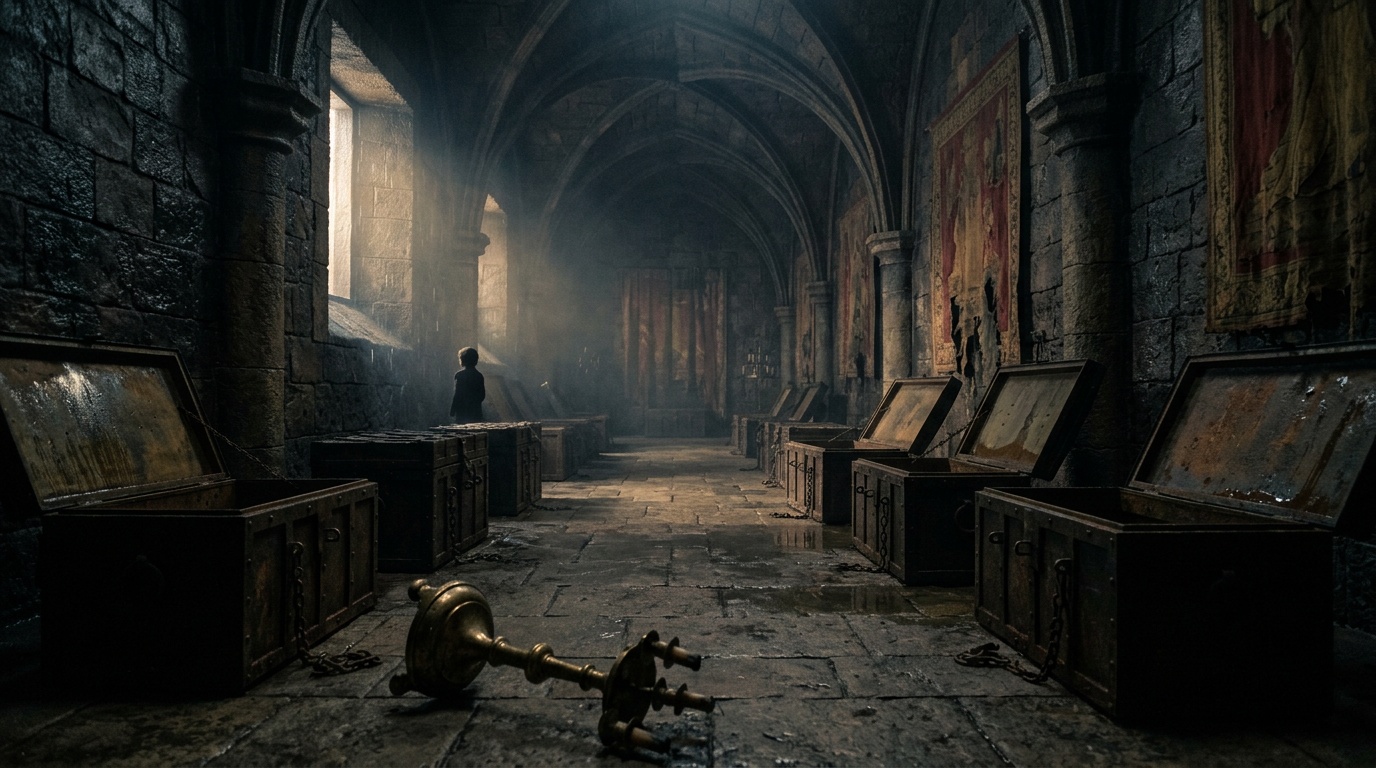
The Greens Built a Throne She Could Only Lose
THE ARGUMENT
The Greens evacuated King's Landing rather than surrendering it, stripping the treasury, blocking ecclesiastical coronation, and coordinating an ideological campaign against dragons before withdrawing, leaving Rhaenyra to occupy a throne hollowed of every resource that makes a throne governable. She arrived into that trap carrying an internal one already built: grief functioning as a decision-maker, Daemon converting her restraint into a legible weakness, and a prophecy mythology that sealed both vectors against honest scrutiny. The impostor prince hallucination is where these two systems meet and confirm each other as one coordinated undoing.
How This Theory Works
The episode titled 'Rhaenyra Triumphant' is an act of authorial prosecution, and the irony of that title is the theory's opening evidence. Before Rhaenyra can issue a single governing order, she discovers that the treasury has been stripped toward Lannisport, the city's food supply is strangled by blockade, the High Septon is withholding coronation pending physical proof of Aegon's death, and the Faith has already begun framing Targaryen dragons as profane rather than sovereign. This combination carries a shape too precise to be the ordinary chaos of a contested transition. The Greens did not surrender the throne in defeat. They evacuated it, removing its financial, ecclesiastical, and informational resources before withdrawing, and left the seat itself as bait. Rhaenyra holds the chair and controls none of what makes the chair mean anything.
Within three days she is authorizing raids on noble grain stockpiles, staging a rat banquet as a theatrical response to a structural famine, and demanding tribute as a substitute for actual governance. The rat banquet is the clearest single image of this predicament: framed as bold populism, its necessity reveals that she has no better tool for managing the city's food crisis than theatrical redistribution. These are the actions of someone who inherited a throne stripped to its symbol and had no administrative foundation to fall back on, because she never built one and no one ever required her to.
The institution that elevated her built this exposure long before the Greens exploited it. Being designated heir presumptive and being prepared to govern are distinct conditions, and everyone around Rhaenyra allowed the first to permanently substitute for the second. Her Small Council remains on Dragonstone because she cannot bring herself to trust it enough to relocate it. Her confrontation with Corlys Velaryon over legitimizing Addam of Hull fractures her most experienced coalition partner at the moment she can least afford friction with anyone who knows how to govern. She makes that refusal as a mother protecting dynastic lineage rather than as a ruler managing a coalition, and she cannot see the difference because no one ever taught her to see it. The institution of heirship trained her to claim and protect what was hers. It did not train her to build what winning requires. The Greens understood this. The evacuated throne was prepared for a ruler they had observed for decades and knew would arrive without the apparatus to fill what they removed.
But the external trap required an internal counterpart to be decisive, and Rhaenyra arrived with one already constructed. She is governing through sleeplessness and grief for Jacaerys, and in her case grief has become a governing force rather than merely an emotional condition. The dead have taken positions in her decision-making: she describes the Red Keep's air as thick with Viserys and Daemon and Jacaerys, each pressing a competing moral instruction into the vacuum left by living advisors she cannot fully trust. Daemon accelerates this by operating on her identity rather than her tactics. His sustained argument is that her instincts toward clemency and restraint reveal she still does not know who she is. He does not need to win that argument in the moment. He needs only the war to go badly enough that Rhaenyra internalizes his logic herself, arriving at his conclusions through her own suffering and believing she reached them independently.
The prophecy mythology completes this interior trap. Rhaenyra inherited the Song of Ice and Fire from Viserys as a burden requiring humility and sacrifice. Under Daemon's sustained pressure she has converted it into cosmic ratification of whatever she concludes after grief has already compromised the conclusion. A burden demands honest scrutiny. A divine mandate demands none. What their combination produces is a ruler who cannot perceive her own undoing from inside it, because the capacity for honest self-scrutiny is precisely what Daemon's identity pressure and the prophecy mythology have together removed.
The impostor prince is where both systems, external and internal, collapse into a single event. The evidentiary sequence is precise and the sequence matters. Rhaenyra is mid-deliberation on clemency for the captive believed to be Daeron when she reverses course without new intelligence, without revised counsel, without any shift in Mysaria's position. She declares intent to execute. The episode offers no external trigger for the change. What it does show is Rhaenyra moving through a Red Keep she herself describes as thick with the ghosts of her dead sons, governing through a grief she names as rage beyond her grasp. The reversal mid-sentence suggests grief making the decision. Mysaria witnesses the reversal and records no pushback, which points toward structural positioning rather than conspiracy: a figure who operates through proximity and information in a court already shaped by Daemon's framing and Rhaenyra's self-mythology cannot offer the queen a counter-framing that prophecy and grief have not already foreclosed. She sees the break and cannot name it.
The episode closes with the confirmation that the real Daeron Targaryen traveled undetected as a dark-haired squire alongside Ormund Hightower while Daemon paraded a bleached merchant's son back to the capital as a trophy. The Greens captured no one and neutralized no rival claimant. They demonstrated, from a position of apparent weakness, that they can falsify Rhaenyra's perception of the war's landscape at the precise moment of her greatest confidence. That demonstration casts its shadow backward over everything else she holds. The empty treasury, the coordinated ecclesiastical refusal, the managed retreat from the capital: they all carry the shape of deliberate prior design once it becomes clear that the people who designed them can still operate inside her intelligence at this level of sophistication. She accepted a prop for a conquest, and she accepted it because grief had already corrupted her judgment, because Daemon had already converted her restraint into a map her enemies could read before she exercised it, and because the prophecy had already ratified the result as correct before the evidence arrived. The masterstroke was not merely engineering an ungovernable throne. It was doing so against a ruler whose internal conditions, built long before she arrived, ensured she would interpret her own undoing as destiny rather than sabotage.
Is this theory convincing?
Key Evidence
Empty Treasury Left by Greens
The Greens deliberately emptied the royal coffers toward Lannisport before fleeing, leaving Rhaenyra to govern a major city with no financial base during an active blockade.
Ironic Episode Title Framing
The episode is titled 'Rhaenyra Triumphant' but immediately establishes that she 'quickly discovers that holding the crown is vastly more grueling than winning it,' signaling the title as authorial irony rather than endorsement.
High Septon Refuses Coronation
The High Septon refuses to formally coronate Rhaenyra without physical proof of Aegon II's death, denying her the religious legitimacy that would make her rule institutionally recognized.
Faith Denounces Dragons as Profane
The Faith Militant publicly frames Targaryen dragons as 'profane magic,' beginning an ideological counter-campaign against the very power base that won Rhaenyra the throne.
Imposter Prince Accepted as Real
Daemon brings a bleached merchant's son back to King's Landing believing he has captured Prince Daeron, and Rhaenyra nearly executes the boy before Alicent's non-recognition exposes the deception.
Real Daeron Escapes Undetected
The episode closes with the implication that the real Daeron Targaryen traveled unnoticed as a dark-haired squire alongside Ormund Hightower, meaning the Blacks captured no one and neutralized no rival claimant.
Rat Banquet as Symptom of Failure
Rhaenyra's 'Rat Banquet' forcing nobles to eat smallfolk rations is framed as a bold populist move, but its necessity reveals that she has no better tool for managing the city's food crisis than theatrical redistribution.
This theory was evaluated using Theory Atlas editorial standards, including evidence review, narrative fit, and competing interpretation analysis. Learn how Theory Atlas evaluates theories →
Other Theories for S3E03
Rhaenyra's Bastard Hypocrisy Will Cost Her Navy
Rhaenyra's refusal to grant Addam of Hull the Velaryon name has made Corlys's continued loyalty structurally untenable, and his departure would lift the naval blockade that underpins her hold on King's Landing.
Ormund Hightower Weaponizes Rhaenyra's Own Mercy
Ormund Hightower has identified Rhaenyra's dependence on civilian legitimacy and is engineering that dependence into a military constraint.
Shared Grief Quietly Binds Two Enemy Queens
Rhaenyra has shifted from treating Alicent as a prisoner to be managed toward treating her as the only person alive who understands what losing children costs.
The Faith Has Already Chosen the Greens
The Faith of the Seven has taken sides in the Dance of the Dragons, and that side is Green.
The Throne Already Judged Her Body
The show appears to be building toward a specific narrative payoff: the legend in Fire and Blood, in which the Iron Throne rejects Rhaenyra by causing her to bleed upon it, will ultimately be traceable to this moment of concealed menstruation.
Alicent's Dead Son Gambit Protects the Living One
Alicent's advice to declare Aegon II dead serves her sons, not Rhaenyra's reign: a formal death announcement removes the crown's incentive to keep searching for Aegon while shielding Daeron from scrutiny in the field.
Tessarion's Silence Exposed Daemon's Fatal Blind Spot
Daemon's lifelong intimacy with dragon-rider bonds should have made Tessarion's silence the first thing he questioned, and it was the one thing he never questioned at all.
Daemon's Report on Sunfyre Is a Lie
Daemon's declaration that Sunfyre is 'long dead and decaying' is a single-source assertion shaped to foreclose questions he could not safely answer, with no corroborating witness and a speaker who has a documented history of deciding what version of events Rhaenyra receives.